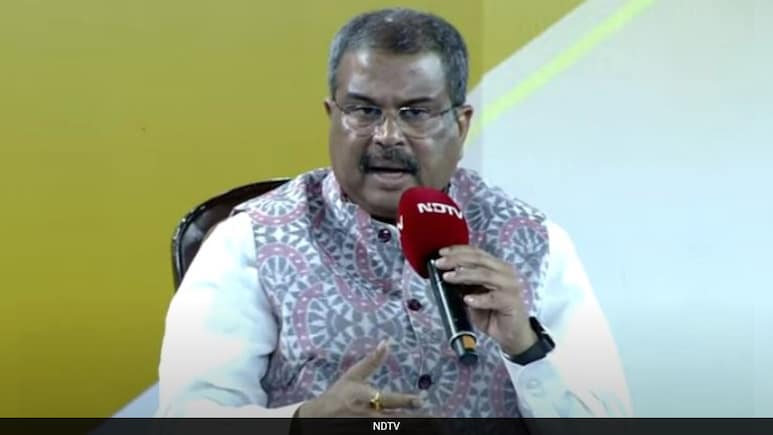

Union Education Minister Dharmendra Pradhan on Monday outlined the government's rationale behind the proposed Viksit Bharat Shiksha Adhishthan Bill, saying the legislation aims to simplify higher education regulation, eliminate overlapping authorities and grant institutions the autonomy needed to meet global standards.
Addressing a press briefing, Pradhan said India's higher education system has expanded rapidly, with nearly 60,000 institutions, including 1,200 universities, 6,000-7,000 autonomous colleges, and around 15,000 teacher education institutions, but continues to operate under multiple regulators, standard-setting bodies and accreditation agencies.
"In regulation, standard-setting and accreditation, there have been too many parallel setups," Pradhan said, adding that the fragmented framework has resulted in duplication of roles, conflicts of interest and inefficiencies.
Why the Government Is Proposing A New Framework
Pradhan traced the regulatory evolution from the University Grants Commission (UGC), established in 1956 as a single authority overseeing regulation, standards and accreditation through NAAC, to the later creation of bodies such as AICTE in the 1980s, NCTE in the 1990s, institutions of national importance, and statutory councils like the Council of Architecture.
"In teacher education, NCTE prescribes standards, but institutions also run UG and PG programmes. This overlap leads to conflict of interest and repeated data handling," he said, noting that AICTE and UGC also perform similar regulatory functions in several areas.
Three Autonomous Councils Under An Apex Body
Under the proposed Bill, the government plans to bring all major regulatory functions under a uniform framework comprising three autonomous councils: a Standards Council, a Regulatory Council, and an Accreditation Council.
"All three councils will function independently. For coordination, correlation, and administrative and financial oversight, there will be an apex body," Pradhan said.
Responding to concerns over states' role, he clarified that the functioning of state universities will remain unchanged. "Education is on the Concurrent List. Standards and coordination will be addressed without disturbing state universities," he said.
Focus On Autonomy And Global Standards
Pradhan described autonomy as the central pillar of the Bill. "To make our universities globally competitive, we need flexibility and autonomy, and this Bill enables that," he said.
The new framework will also support interdisciplinary learning in a changing economy. "In a new-age economy, even a medical student needs to study management. Standards for such learning will be developed," he said.
Action Against Fake Universities
The minister said the Bill includes provisions to tackle the mushrooming of fake universities and unregulated institutional growth. Penal action will be taken against institutions found violating norms.
"It will be light but tight. We won't overimpose, but we won't give any leeway. The aim is zero malpractices," Pradhan said.
Transparent Accreditation And Student Feedback
Accreditation under the new system will rely on self-declared institutional data, backed by discreet student feedback, which Pradhan described as critical for assessing quality.
"Student feedback is very important for accreditation," he said, adding that the regulatory process will be simplified and opened to public scrutiny, with institutional data available in the public domain.
Rankings, Skills And Outreach
The government also plans to introduce a new ranking framework alongside existing mechanisms such as NIRF. A new credit architecture has been designed to support reskilling and upskilling, while encouraging research and entrepreneurship.
Pradhan said the reforms are expected to improve outreach and raise the Gross Enrolment Ratio in higher education.
JPC To Examine The Bill
A 31-member Joint Parliamentary Committee (JPC) has been constituted to examine the Bill and is expected to hold consultations and submit its report by the end of February.
Calling the legislation a structural reform aligned with the National Education Policy, Pradhan said the objective is to create a simplified, transparent and accountable higher education system capable of supporting India's long-term development goals
