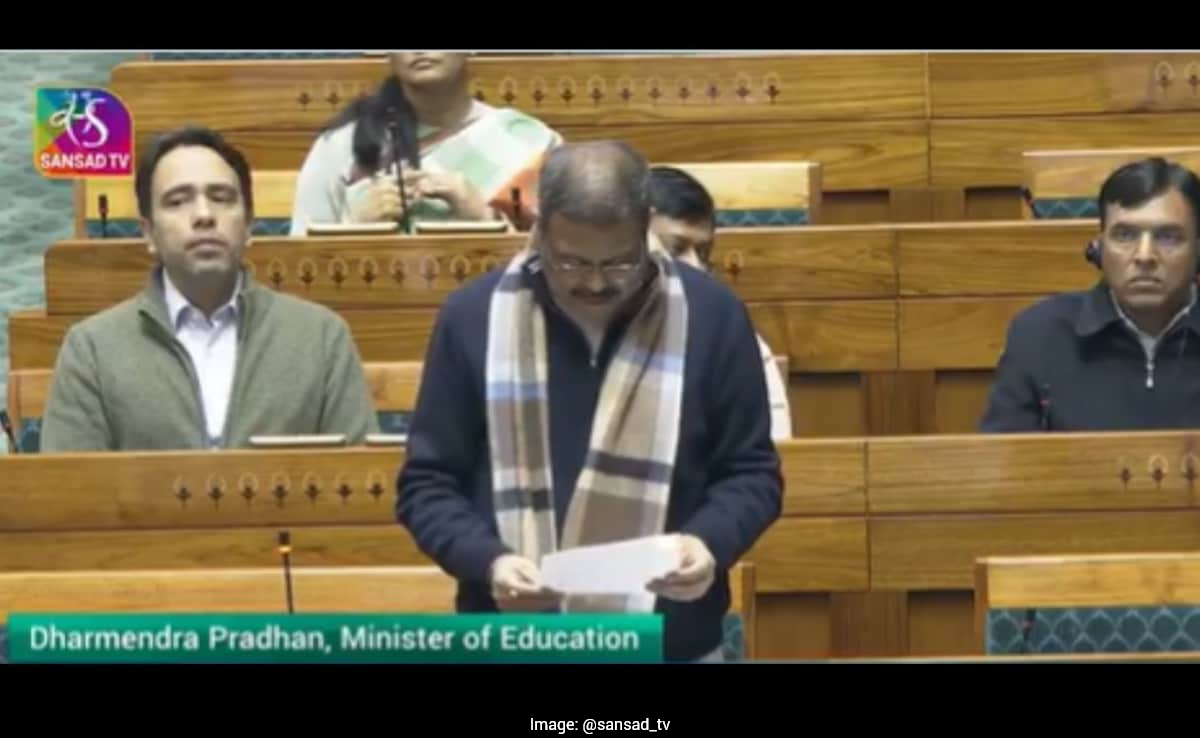

Union Education Minister Dharmendra Pradhan on Monday introduced the Viksit Bharat Shiksha Adhishthan Bill, 2025, in Parliament. The government has sent the draft bill to the Joint Parliamentary Committee after which a final decision will be taken. The bill seeks to restructure how higher education is regulated, accredited and governed in India.
The Bill proposes replacing the existing fragmented regulatory architecture with a single umbrella body backed by three specialised councils, a move the government says will bring transparency, autonomy and global competitiveness to Indian higher education.
One Apex Body, Three Councils
The Bill looks to set up a statutory commission that will act as the top policy and coordination authority for higher education in India. It will advise the government, promote India as an education destination, and integrate Indian knowledge systems and languages into higher education.
The Commission will consist of a Chairperson, senior academics, experts, and representatives from the Union government, supported by a full-time Member Secretary.
Under the proposed framework, the Commission will function through three independent councils with clearly defined roles.
The Regulatory Council will act as the single regulator for higher education, responsible for compliance, institutional governance, financial transparency, grievance redressal and preventing commercialisation of education.
The Accreditation Council will oversee the accreditation ecosystem, develop outcome-based accreditation frameworks, empanel accrediting agencies, and ensure public disclosure of accreditation outcomes.
The Standards Council will set academic standards, define learning outcomes, frame norms for credit transfer and student mobility, and lay down minimum requirements for institutions and faculty.
The separation of functions is intended to avoid conflicts of interest between regulation, assessment and standard-setting that existed earlier between bodies like the UGC, AICTE and others.
Who Will The Law Apply To?
The Bill has a wide sweep. It will apply to, Central and State universities, Deemed universities, Institutions of National Importance (IITs, NITs, etc.) Colleges affiliated to universities, Online, distance and digital education providers and Institutions of Eminence.
However, medical, law, pharmacy, nursing and allied health programmes regulated by separate statutory councils remain outside its direct purview. Though institutions offering such courses must still meet broader academic standards under the new framework
Role Of The Central Government
While the Bill emphasises institutional autonomy, it grants significant powers to the Central Government. These include issuing binding policy directions, appointing key office-bearers, approving foreign university operations, and superseding the Commission or Councils for specified periods in cases of persistent failure.
All bodies established under the law are accountable through annual reports, parliamentary oversight and audits by the Comptroller and Auditor General.
A Push Towards Autonomy, But With Conditions
One of the Bill's core promises is graded autonomy linked directly to accreditation status. Institutions that meet prescribed benchmarks can gain increasing academic, administrative and financial independence.
The accreditation will be outcome-based and technology-driven, focusing on learning outcomes, governance quality and financial probity rather than physical infrastructure alone.
Institutions will be required to place extensive information in the public domain, including finances, audits, faculty details, courses offered, student outcomes and accreditation status.
The Accreditation Council will empanel and monitor independent accrediting agencies and can recommend penalties for manipulation or false claims.
The Regulatory Council is empowered to take corrective action within 60 days if disclosures are found misleading.
In a significant departure from existing norms, the Council shall have the right to grant degrees to accredited higher educational institutions even if they are not universities, with prior approval of the Central Government. This authorisation can be withdrawn if institutions violate regulatory provisions.
Penalties and Enforcement Powers
The draft bill introduces a graded penalty structure for regulatory violations. Financial penalties range from Rs 10 lakh for initial violations, Rs 30 lakh for repeat violations, Rs 75 lakh or more for repeated or persistent non-compliance. In severe cases, institutions may face suspension of degree-granting powers, withdrawal of affiliation, or closure.
Setting up an unauthorised university or institution can attract penalties of at least Rs 2 crore, along with immediate closure. The Bill explicitly states that penalties should not adversely affect enrolled students.
Foreign Universities and Overseas Campuses
The Bill allows selected foreign universities to operate campuses in India, subject to regulatory standards and government approval. Existing foreign campuses approved under earlier UGC regulations will come under the new Regulatory Council.
It also enables high-performing Indian universities to establish campuses abroad, with prior approval, as part of efforts to internationalise Indian higher education.
Opposition Flags Centralisation, Lack of Scrutiny
Congress MPs objected to the introduction of the Bill in the Lok Sabha, saying members were not given enough time to study a legislation that proposes major changes to higher education regulation. They argued that the government was pushing through the bill during a short session without adequate scrutiny.
Trinamool Congress MP Saugata Roy said the bill was listed without sufficient opportunity for MPs to examine its provisions, weakening parliamentary oversight. Congress MP Manish Tewari said the opposition was being asked to respond to a sweeping overhaul of the education framework without consultation and called for the bill to be referred to a parliamentary committee.
CPI(M) MP John Brittas raised concerns about centralisation of regulatory powers, saying education is a concurrent subject. RJD MP Rajaram Singh supported demands for a Joint Parliamentary Committee review, citing the bill's impact on students and institutions nationwide.
