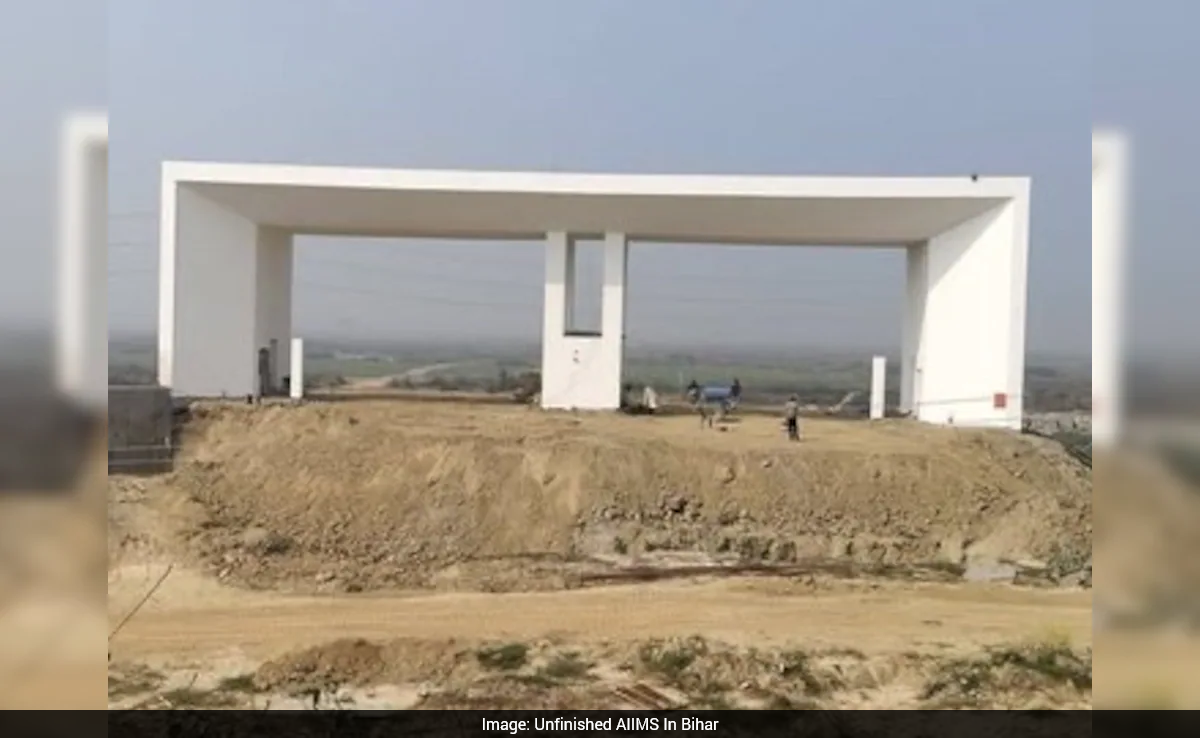
In Darbhanga, Bihar, the promised AIIMS stands today as a set of giant white pillars opening onto an empty field. Eleven years after the project was announced, only the entrance gate has been built. The future has not.
The structure is visible, ceremonial, and hollow. Eighteen-year-old Yashasvi Kumar sees his own life in it.
After three years of preparing for NEET-UG- sacrificing vacations, friendships, and his health for a medical seat increasingly hostage to paper leaks, administrative chaos, and political inertia- he says the unfinished AIIMS no longer feels like failed infrastructure. It feels like the Indian student experience itself.
"My dreams are like that gate," he said from his home village of Harnaut in Bihar's Nalanda district while preparing for yet another NEET re-examination. "Only the front has been built. The rest is stalled because of the system."
For students in states like Bihar, where quality public education and medical seats remain scarce, NEET is more than an exam. It is often treated as an escape route from economic uncertainty, social hierarchy, and generational limitations.
"No one in my family is a doctor," Yashasvi said. "My father wanted someone in the family to become a doctor or an IAS officer. I just obeyed."
His father works as an insurance adviser; his mother is a homemaker. Until Class 10, Yashasvi was more interested in technology and mathematics. But after scoring high marks in science, he shifted to biology.
"My mother insisted," he said. "'If you take PCB, then you have to prepare for NEET and make our family proud.' In Bihar, even being a medical aspirant is seen as a status symbol."
Like thousands of aspirants from Bihar, he moved away from home for coaching.
For Classes 11 and 12, he lived with his aunt in Noida while studying through Physics Wallah programs alongside school classes. The transition was brutal.
"People think Classes 11 and 12 are just two school years. For us medical aspirants, it felt like survival training," he said. "In the morning I studied for boards; at night I solved coaching modules.
Somewhere in between, I was supposed to remain mentally normal. By the end, I didn't even know whether I was studying to learn or just to stay in the race."
He scored 86 percent in his board examinations. Then came the drop year- the unofficial but normalized extra year many NEET aspirants take to prepare again.
Ten to twelve hours a day. No vacations. No outings. No weddings or family functions.
"I would see my family going somewhere while I stayed back alone studying," he said. "I deactivated social media. I even developed severe migraines from the pressure."
The family spent nearly 1.3 lakh over two years on coaching and related expenses- a significant sum in Bihar, where per capita income remains among the country's lowest.
"I just couldn't let my father down," he said. "So I surrendered completely to the routine."
While Yashasvi was preparing for his first serious NEET attempt in 2024, the examination was engulfed in controversy after allegations of a paper leak surfaced in Bihar. Police in Patna arrested several people, including students accused of paying large sums of money for access to the paper. Public outrage intensified after an unusually high number of candidates secured top ranks, with many students alleging irregularities in the marking and moderation process.
For aspirants already under pressure, the scandal deepened a growing sense of distrust.
"After the 2024 leak, everyone assumed the next exam would become tougher," Yashasvi said. "Whenever a paper leak happens in India, honest students suffer afterward."
His first attempt at NEET did not go as he had hoped. He blamed divided attention between board examinations and entrance preparation. The 2026 attempt became his real target.
On May 2, Yashasvi and his father boarded the Budh Purnima Express to Patna, where his examination centre was located. By then, his migraines had become frequent, but he tried to ignore them.
"The security checking at the centre felt excessive," he said. "I've never been to an airport, but I'm sure even there it's not this invasive. It felt strange to be treated like a threat when all you want is to become a doctor."
At 2 p.m. on May 3, 2026, Yashasvi and 22.78 lakh young Indians sat for NEET-UG, the nationwide medical entrance examination conducted by the National Testing Agency (NTA). But little did he know that nearly 42 hours earlier, the questions had begun circulating on WhatsApp.
Yashasvi On NEET Paper Leak
The Rajasthan Special Operations Group said in its first communication on May 12 that it had been working on an Intelligence Bureau tip-off. The document recovered by the SOG was a handwritten paper containing approximately 410 questions. When the SOG compared this document with the actual NEET-UG 2026 question paper, around 120 of the 180 questions matched. Most of these were in Biology, with the remainder in Chemistry.
The NTA spent five days denying any leak, insisting the exam had proceeded normally and claiming reports of malpractice surfaced only on May 7, four days after NEET-UG, before being escalated on May 8. During the same week, Director General Anil Jain was sent on leave, and the Director General of the Indian Council of Medical Research was appointed interim chief.
On May 12, the Government of India cancelled NEET-UG 2026, handed the case to the Central Bureau of Investigation, and announced a re-examination on June 21, along with plans for computer-based testing from 2027.
For many students, the announcement was devastating.
Yashasvi had walked out of the examination hall believing, for the first time in years, that he might finally be done.
"I thought I could finally rest," he said. "Then suddenly everything started again."
Now, he says, opening his books feels physically difficult.
"I feel numb," he said quietly. "The migraines are worse now. Mentally, I feel exhausted."
His frustration is directed less at the examination itself than at what he sees as institutional indifference.
"My father told me that a similar paper leak happened in 2015 in Bihar, and a retest was conducted. Yet, after 12 years, the same mistake has happened again. The poor pay the cost, while the rich pay the price for the leak".
"I have no expectations from the government. After the 2024 NEET paper leak, they said the government would make the exam online instead of pen-and-paper, but they didn't. The paper leaked again. They don't care about us except during elections," Yashasvi said frustratingly.
The crisis has also again triggered protests across the country with the union education minister Dharmendra Pradhan assuring that the reexam of NEET-UG will be free of cost, it will be extended for 15 minutes, and online exams will take place from next year. The minister also asserted that those involved in malpractice undermining the exam systemwill face serious consequences.
As of May 18, 2026, the CBI has arrested 9-10 people in the NEET-UG 2026 paper leak case, including Maharashtra coaching operator Shivraj Motegaonkar and NTA committee member Manisha Mandhare, among several others from the state.
NEET this year saw more than 22 lakh applicants competing for roughly 1.08 lakh MBBS seats, only a fraction of which are government-funded and affordable for middle-class families.
The pressure has produced an enormous parallel economy of coaching institutes, mock tests, hostel accommodations, online courses, and repeat attempts- an ecosystem in which failure often carries emotional, financial, and social consequences far beyond the exam hall.
Reports of student suicides following the exam cancellation have only deepened the sense of despair among aspirants already struggling with burnout and uncertainty.
"So many students think one exam decides their entire worth," he said. "Parents should not put so much pressure on children. Students also need to understand that they should always have a Plan B."
Now, after years of preparation, he has decided this will be his final attempt.
"No more drop years," he asserted.
As a backup, he also appeared for engineering entrance examinations and has secured admission in bioinformatics at Vellore Institute of Technology.
"Even if I fail to crack NEET now, I won't regret trying," he said. "I gave my best. I'll give my best again in the re-exam too. But I won't let this exam define my life anymore."
Around him, Bihar's contradictions remain impossible to ignore ambitious students emerging from villages with collapsing schools; political promises outlasting governments; and world-class institutions existing more vividly in speeches than on the ground.
The stalled AIIMS Darbhanga project has become one such symbol. It receives much backlash on social media. The structure remains suspended between announcement and execution- much like the aspirations of many young Indians preparing for examinations conducted by a body that's meant to be "fair and transparent" whose credibility they increasingly distrust.
Yashasvi speaks about Bihar with a sense of resignation, "There is unemployment, casteism, and politics everywhere," he said. "During elections, money gets distributed in villages and people still vote for the same corrupted leaders. So, who should I blame?"
Then he paused.
"If I ever get an opportunity to go abroad," the aspirant said, "I'll run away."
