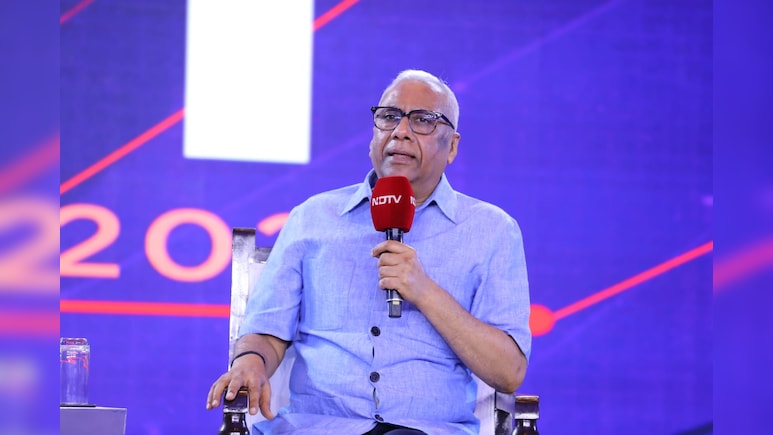

The NDTV LearnNXT Conclave 2026 held today brought together educationists, policymakers and stakeholders to discuss the future of learning, innovation and India's evolving education system.
Speaking during the conclave, Deepak Bagla, Mission Director of Atal Innovation Mission at NITI Aayog, spoke about the qualities that have helped Indian CEOs emerge as global leaders and highlighted the need for education systems to adapt to a rapidly changing world.
Bagla said one of the biggest strengths of India and its education system can be seen in the large number of Indians leading global companies today.
Recalling a roundtable discussion at the World Economic Forum Annual Meeting a few years ago, he said global leaders were asked why Indian CEOs perform so well internationally.
"The first point they said was the ability to get the job done. That's a mindset," Bagla said.
"The second was the ability to work without a playbook in a completely uncharted territory. There is something which we have done that brought us to that point," he added.
Bagla, however, noted that the world is now undergoing massive transformation and education systems need to evolve accordingly.
Quoting a book from the 1960s, he said, "The person of the future will not be the one who has all the answers, but the one who knows how to ask the right questions."
"I did not understand it at that point of time, but that is exactly where we have reached today," he said.
According to Bagla, the National Education Policy (NEP) is now attempting to create learning "with context" rather than continuing with systems designed during the industrial revolution era.
"We had 300 years of industrial revolution and post that our entire educational and training system was created. It has now changed completely," he said.
Referring to concerns raised during an earlier panel discussion, Bagla described today's youth as the "anxiety generation".
"It is a generation filled with anxiety," he said, adding that the current flow of information and education has become extremely complex for students as well as parents and mentors trying to guide them.
"What is being attempted now is to prepare our generation for the next step of future India, which has the ability to chart its path through the unknown and the ability to both adopt and adapt to new situations in life," he said.
Speaking about innovation-led initiatives, Bagla also referred to the launch of Atal Tinkering Labs in February 2016 under Prime Minister Narendra Modi's vision.
"The objective at that point was how to create an entire framework and foundation for a society which will be based on innovation and entrepreneurship," he said.
