
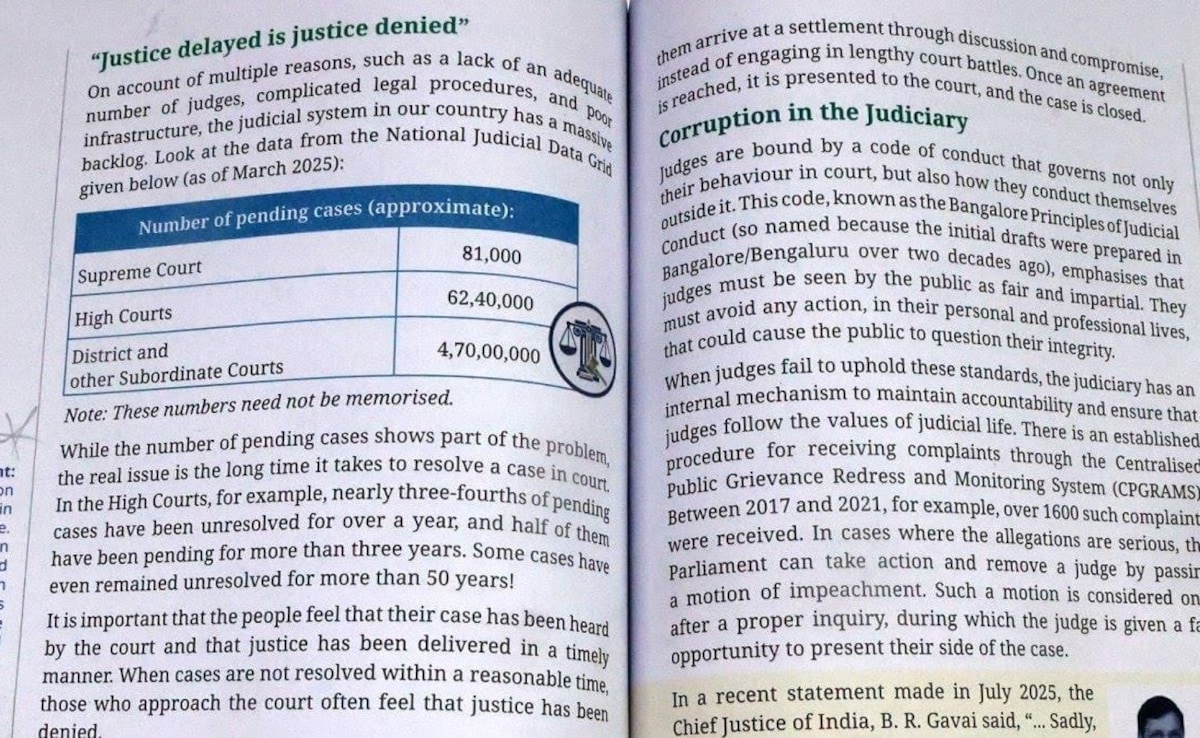
Days after the National Council of Educational Research and Training (NCERT) released a new Class 8 Social Science textbook featuring a chapter, The Role of the Judiciary in Our Society, highlighting pending cases in courts due to a shortage of judges and inadequate infrastructure, the council called it an error and decided to rewrite the chapter of the book in consultation with the appropriate authority.
Late mid night, NCERT said in a statement on X, "It has been observed that certain inappropriate textual material and error of judgement have inadvertently crept into Chapter No. 4, entitled 'The Role of Judiciary in Our Society' (pp. 125-142)."
𝐏𝐫𝐞𝐬𝐬 𝐑𝐞𝐥𝐞𝐚𝐬𝐞 : 𝐀𝐧 𝐢𝐦𝐩𝐨𝐫𝐭𝐚𝐧𝐭 𝐮𝐩𝐝𝐚𝐭𝐞 𝐛𝐲 𝐍𝐂𝐄𝐑𝐓 𝐰𝐢𝐭𝐡 𝐫𝐞𝐬𝐩𝐞𝐜𝐭 𝐭𝐨 𝐂𝐥𝐚𝐬𝐬 𝟖 𝐒𝐨𝐜𝐢𝐚𝐥 𝐒𝐜𝐢𝐞𝐧𝐜𝐞 𝐓𝐞𝐱𝐭 𝐁𝐨𝐨𝐤 (𝐏𝐚𝐫𝐭 𝟐)
— NCERT (@ncert) February 25, 2026
As per the extant procedure, NCERT brought out the Social Science textbook, Exploring Society:… pic.twitter.com/ahHSiT8MaP
According to NCERT, the Department of School Education and Literacy (Ministry of Education) also made a similar observation and directed that the distribution of this book be kept on strict hold until further orders.
NCERT emphasised that it "holds the judiciary in highest esteem and considers it to be the upholder of the Indian Constitution and protector of Fundamental Rights." The council clarified that the error was "purely unintentional" and assured that corrective measures are being taken.
"NCERT reiterates that the objective of the new textbooks is to strengthen constitutional literacy, institutional respect, and informed understanding of democratic participation amongst students. There is no intent to question or diminish the authority of any constitutional body," the statement said.
The council further noted that, as part of its continuous review mechanism, it remains open to constructive feedback from stakeholders. "As part of its continuous review process, NCERT remains open to constructive feedback. Hence, the same shall be re-written, with consultation of the appropriate authority, as necessary," it added.
According to the statement, the revised content will be made available to Class 8 students at the commencement of the academic session 2026-27.
"NCERT, once again, regrets this error of judgement and apologises while reiterating our resolve to continuously work for institutional sanctity and respect," the statement concluded.
Supreme Court Takes Cognizance
The flashpoint came when senior advocates Kapil Sibal and Abhishek Manu Singhvi approached the Supreme Court, arguing that teaching Class 8 students about judicial corruption was both "deeply disturbing" and "selective".
On Wednesday, Chief Justice of India Surya Kant presided over a bench that made its displeasure clear, describing the issue as a "matter of grave concern" and stating the Court had taken suo motu cognisance of the controversy. "I will not allow anyone to defame the institution... Bar and Bench all are perturbed. All High Court judges are perturbed," the CJI said in court.
CJI Kant stressed that law would take its course and indicated that the Court would not permit anyone to taint the integrity of the judiciary, a remark that underscored the intensity of institutional pushback against the textbook's framing. "Please wait for a few days... Law will take its course," he added."
Reiterating its institutional position, NCERT said it holds the judiciary in the highest esteem and considers it to be the upholder of the Indian Constitution and protector of Fundamental Rights.The council stressed that the intent of the textbook was not to undermine any constitutional body.
"There is no intent to question or diminish the authority of any constitutional body," NCERT said, adding that the objective of the new textbooks is to strengthen constitutional literacy, institutional respect and informed understanding of democratic participation amongst students.
