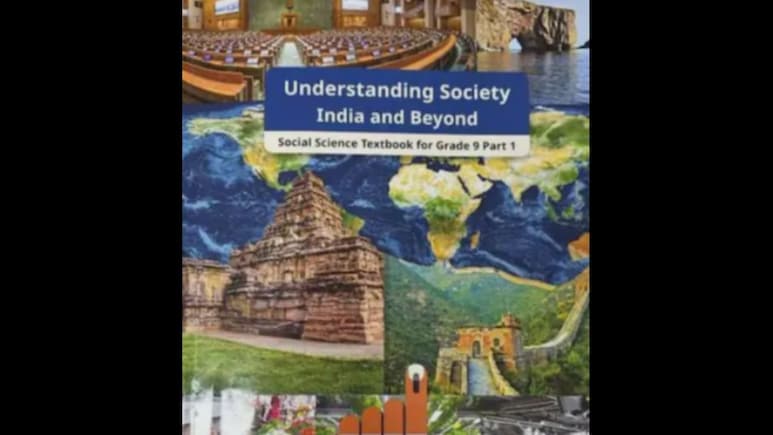
The National Council of Educational Research and Training (NCERT) has described the judiciary as an "impartial and independent institution" in its newly introduced Class 9 Social Science textbook, released months after a controversy over a Class 8 chapter on the judiciary reached the Supreme Court.
The new Class 9 textbook, however, was prepared before the controversy over the Class 8 book broke out.
In a chapter on democracy under the section titled 'Separation of Powers', the textbook says the judiciary takes Public Interest Litigation (PIL) "from time to time to ensure access to justice for all", safeguards citizens' rights and upholds the spirit of the Constitution.
It also outlines the judiciary's constitutional role, stating that courts review executive actions and constitutional amendments, can invalidate unconstitutional laws, "uphold the Constitution", and "play a vital role in protecting and promoting democratic values and the rights of all sections of the society."
The section presents the judiciary as an institution that functions independently while protecting citizens' rights and preserving constitutional values.
The description marks a contrast with the controversy surrounding the Class 8 Social Science textbook in February, which included the section on "corruption in the judiciary".
The chapter triggered a Suo motu case in the Supreme Court. During the hearing, Chief Justice B.R. Gavai and Justice Augustine George Masih observed that students had only just begun to understand the complexities of life and that exposing them at such an age to what the court described as a one-sided portrayal of the judiciary was "fundamentally wrong".
Following the controversy, NCERT issued an unconditional apology and withdrew both the physical and digital copies of the textbook. The Supreme Court subsequently imposed a 100 per cent restriction on its reprinting and digital dissemination.
On March 11, the Supreme Court directed the Centre, states, Union Territories and educational institutions to disassociate from three experts-Michel Danino, Suparna Diwakar and Alok Prasanna Kumar-who had been involved in preparing the chapter.
However, on May 22, the top court modified that order after accepting the experts' explanation that the textbook was the result of a collective exercise and that there had been no intention to portray the judiciary negatively.
Following the row, the Ministry of Education on March 16 constituted an oversight committee headed by former Supreme Court judge Justice Indu Malhotra. Former Attorney General K.K. Venugopal and Vice-Chancellor Prakash Singh were appointed as members. The Centre also associated the head of the National Judicial Academy with the revision of curricula for Class 8 and higher classes.
Separately, the Supreme Court directed that a three-member expert committee rewrite the chapter on the judiciary in the Class 8 Social Science textbook.
NCERT also reconstituted its National Syllabus and Teaching Learning Material Committee (NSTC) to oversee syllabus and textbook development for Classes 3 to 12, while revising its terms of reference to give the council formal authority to approve, publish, and distribute textbooks.
The earlier NCERT Class 9 Political Science textbook discussed the judiciary in the chapter "Working of Institutions" as part of India's constitutional design. It described an "independent and powerful judiciary" as essential to democracy, stating that courts must remain free from the control of the executive and legislature.
Students were also taught that judges do not function under government directions, with the textbook highlighting safeguards in judicial appointments and removal. It further explained the judiciary's role in resolving disputes, checking the arbitrary exercise of power, and protecting constitutional governance.
