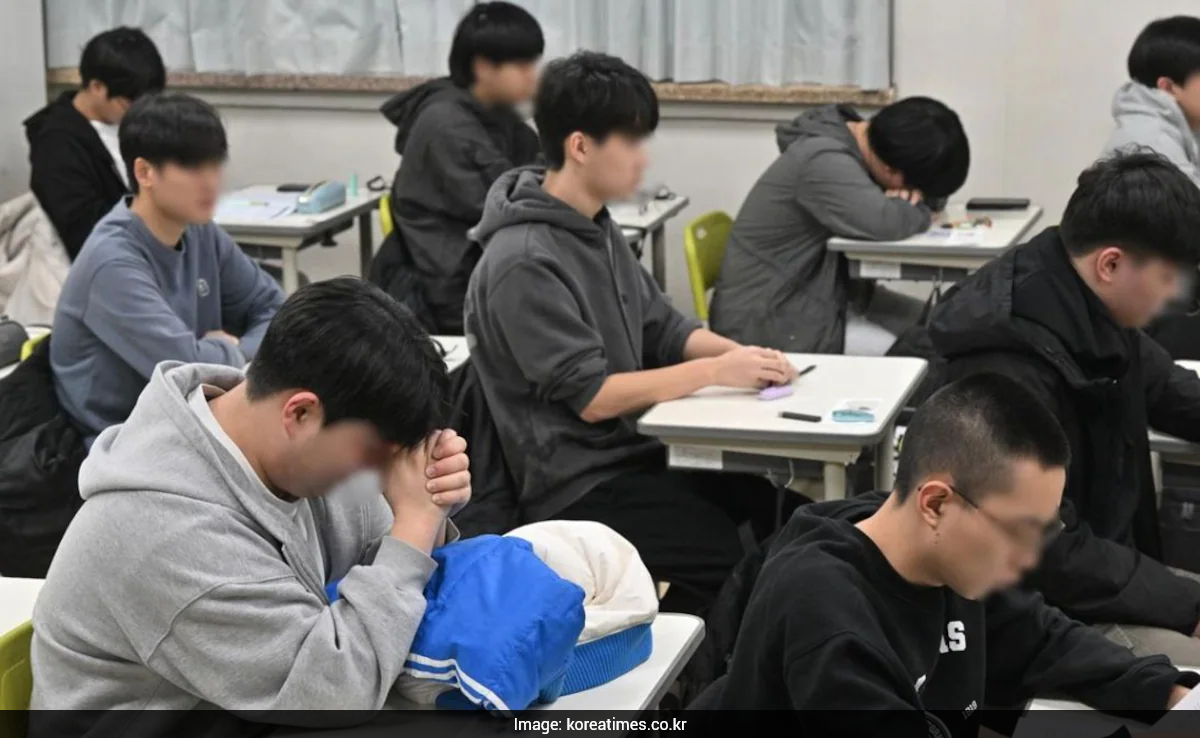

South Korea's notoriously demanding college entrance exam, the Suneung, has triggered a worldwide debate this year after its English paper drew sharp criticism from students, teachers and parents, ultimately forcing the top official overseeing the test to resign.
The eight-hour, back-to-back exam, often described as one of the world's toughest, dominated headlines after students complained about the unexpected difficulty and wording of the English section. Many said the paper felt less like a language test and more like deciphering an academic manuscript. Some examinees called it "insane", while others compared it to interpreting classical philosophical texts.
Amid mounting backlash, Suneung chief Oh Seung-geol stepped down, taking responsibility for what he described as the "chaos" caused by the exam. "We sincerely accept the criticism that the difficulty of the questions was inappropriate," Oh said, according to the BBC, admitting the test "fell short" despite multiple rounds of review and editing.
At the centre of the controversy were several questions that students and educators said were unnecessarily complex. One passage drew on Immanuel Kant's philosophy of law, while another, worth three marks, revolved around dense game theory terminology. The question required students to determine where a sentence should be placed within a paragraph discussing perception through a video game avatar, a task many felt relied more on abstract reasoning than English comprehension.
Criticism quickly spilled onto online forums. One Reddit user termed the question as "fancy smart talking", while another described it as "awful writing that doesn't convey a concept clearly".
Students were given 70 minutes to answer 45 questions in the English section. This year, just over three per cent of candidates achieved the top grade, down from around six per cent previous year.
"It took me a long time to figure out several questions, and understanding the texts themselves was difficult," BBC quoted Im Na-hye, a senior at Hanyeong High School as saying. "Some answers looked very similar, so I wasn't sure until the last minute."
Not everyone, however, believes the issue was simply about difficulty. Jung Chae-kwan, an English language professor at Incheon National University and a former employee of the institution that administers the Suneung, argued the problem lay in how the questions were framed. "The texts aren't necessarily impossible, but they are maddeningly confusing," he said. "That makes them useless for real education."
According to Professor Jung, such questions push teachers to focus on test-taking strategies rather than genuine language learning. "You don't even need to read the full text if you know the tricks," he added.
Some critics also pointed out that several passages were taken from published books and presented out of context, making them harder to understand. The gaming-related passage, for example, was drawn from Game Feel, a game design guide by Steve Swink.
Others defended the exam's intent. Kim Soo-yeon, an English literature professor at Hankuk University of Foreign Studies in Seoul, said the difficulty reflects the purpose of the Suneung.
"It measures whether students can handle the level of material they will encounter at university," she told The Korea Times, adding that the passages are deliberately specialised to test reading comprehension.
Held every November, the Suneung is an eight-hour marathon that can shape a person's future, influencing university admissions, job prospects, income and even personal relationships. Students answer close to 200 questions across subjects including Korean, mathematics, English, and social and natural sciences.
Preparation often begins early, with many children attending private tuition centres, known as cram schools, from as young as four. On exam day, the impact extends far beyond classrooms: construction sites shut down, flights are delayed or grounded, and even military training is paused to ensure a quiet testing environment.
Since its introduction in 1993, only four of the 12 Suneung chiefs have completed their full three-year terms. While most previous resignations were linked to errors in exam questions, Oh Seung-geol is the first to step down over the difficulty level of the test itself.
