





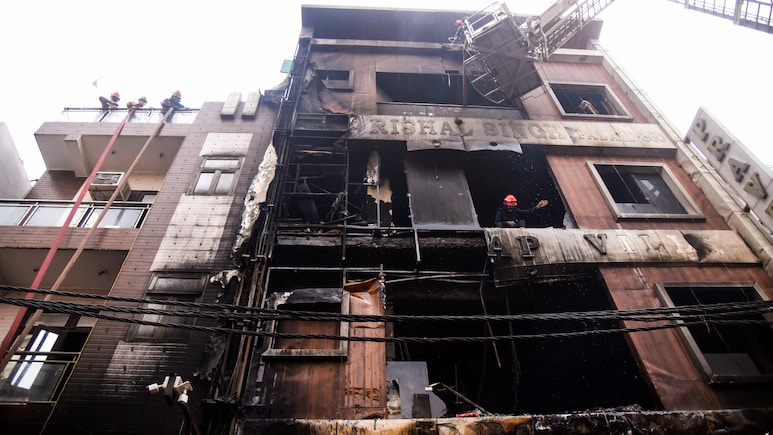
People trapped on the third-floor balcony of a burning building in southwest Delhi's Palam could be seen waiting to be rescued.
In the congested lane below, a specialised Bronto Skylift took position. But its hydraulic boom did not rise.
Firefighters had to manually move low-hanging cables and remove banners. A manual ladder could not reach the balcony, while no effective alternative tall-reach equipment was immediately available.
A second Skylift was called, but by the time it arrived, all nine members of the family trapped inside had died.
A magisterial inquiry into the March 18 fire at a residential-cum-commercial building near Palam Metro Station has now identified lapses by multiple agencies, including the Municipal Corporation of Delhi, Delhi Fire Services and the Electrical Inspectorate.
The fire killed nine members of a family across three generations, including three children. Three others were injured.
The inquiry identified an electrical short circuit near an MCB box between the ground and first-floor staircase as the probable cause. It, however, said the cause could not be conclusively established because the electrical installation had been extensively damaged and the forensic report was awaited.
The inquiry was conducted by South-West District Magistrate and examined the cause of the fire, violations of law, departmental lapses, action against those responsible and the applicability of the Disaster Management Act, 2005.
Fire Began Before Dawn
According to the inquiry's reconstruction, the fire likely began at around 6 am near the MCB box inside the four-storey building.
At approximately 6.15 am, eyewitness Ramesh noticed the flames while the family was asleep.
Shortly afterwards, Sachin escaped through the roof of an adjoining building with burn injuries and was evacuated.
Police personnel and fire tenders reached the spot at 7.11 am. The initial Delhi Fire Services deployment included four water tenders, one quick-response vehicle, one motor pump, one Bronto Skylift and one water bowser.
The response was upgraded from Make-4 to Make-6 at 7.20 am as the fire intensified.
At around 7.40 am, the Bronto Skylift, identified as BS-III, reached the narrow lane and took position outside the building.
Residents were seen waiting on the third-floor balcony. A child identified in the inquiry brief as Baby Mitali fell from the building during the rescue operation and was evacuated with injuries.
The Skylift's boom, however, failed to rise.
A second Bronto Skylift was requested at 7.55 am. The incident was upgraded to the "medium" category at 8.05 am, additional water bowsers were requested at 8.35 am and a turntable ladder was demanded at 9.14 am.
By the time the second Skylift arrived, all nine people trapped inside had died.
The fire was reported under control at 10.20 am and declared stopped at 2.20 pm. Delhi Fire Services ultimately deployed 31 firefighting units.
The inquiry credited firefighters with preventing the blaze from spreading to an adjoining handloom shop and the wider market, despite being unable to save the trapped residents.
Boom Failed, Ladder Fell Short
The Bronto Skylift is a hydraulic aerial platform used by Delhi Fire Services for high-rise rescue and firefighting operations.
The report said BS-III failed at the scene amid an apparent technical glitch, most likely compounded by its boom becoming entangled in overhead cables, wires and banners.
Firefighters, assisted by local residents, had to manually shift the low-hanging cables and clear banners before the vehicle could be positioned, directly delaying the rescue.
The failure left rescuers without an immediate way to reach the third-floor balcony. The manual ladder at the scene was not tall enough, and no effective alternative tall-reach equipment was immediately available as a second line of defence.
Maintenance records for February and March 2026 showed no previous fault in BS-III.
The vehicle had recently operated at Indira Gandhi International Airport, Tilak Nagar and Dwarka, as well as at another, unrelated Palam fire on March 18, without any reported problem.
The crew had more than two years of experience operating the vehicle. But the inquiry found that the authorised dealer, Brijbasi Hi-Tech Udyog Limited, had conducted no formal operator training since 2006.
Operators had instead learned informally from their predecessors.
The inquiry recommended a technical expert committee to establish why the Skylift malfunctioned, mandatory recurring company-certified training and the availability of genuine backup tall-reach equipment at major fire incidents.
Short Circuit Suspected, Proof Awaited
The building had six BSES Rajdhani Power Limited electricity connections, two commercial and four residential, and a solar meter installed in July 2023.
The BSES supply box outside the building was found intact and undamaged, ruling out a fault on the power-distribution company's side.
The internal MCB box, however, was completely destroyed.
Video footage reportedly showed the fire first appearing near the MCB box, where wiring connected to roughly six electricity connections was densely concentrated.
Combustible cosmetics and other commercial stock kept inside the building are believed to have accelerated the spread of the flames.
A joint inspection by the Electrical Inspectorate and BSES, whose report was submitted on March 30, could not establish whether an electrical defect caused the fire or whether the fire caused the short-circuit damage found later.
The ground and first-floor electrical installations were too badly burnt for a definitive conclusion.
One Balcony, No Ventilation
The compact residential-cum-commercial building had four floors and a basement. It was constructed before 2007 and was covered under the NCT of Delhi Laws (Special Provisions) Act, 2007.
The approximately 14.3-metre-high structure stood on a 150-square-metre plot beside a road officially measuring nine metres in width.
It had no ventilation shaft or rear setback.
The first and second floors had toughened-glass fronts but no windows or balconies. The third floor had the building's only balcony, where the residents were seen waiting to be rescued.
The inquiry linked the lack of ventilation to the fatal accumulation of smoke, referring to post-mortem findings of smoke inhalation and suffocation.
The basement was partially burnt. The ground, first and second floors were fully burnt, while the third floor was partially damaged, with one room unaffected.
The air-conditioning system on the roof was burnt, while a solar installation was also present.
Licences Stopped At Ground Floor. Business Didn't
Three MCD trade licences valid until March 31, 2026, permitted the sale of cosmetics and innerwear only in the basement and on the ground floor.
But investigators found commercial activity and storage on the first floor, where remnants of bangles and innerwear were recovered.
The office of the Sadh Nagar Market Association was also functioning from the first floor.
The inquiry described this as a deviation from the permitted mixed-land-use conditions and found that compliance monitoring was absent, allowing the commercial use to continue unchecked.
The concerned MCD Licensing Inspector and the supervising Assistant Commissioner of the Najafgarh Zone failed to detect and act against the violation, the report said.
The removal of unauthorised banners and other aerial obstructions was also the responsibility of the Licensing Inspector under the Assistant Commissioner's supervision.
The Assistant Commissioner acknowledged the lapse during the inquiry.
Disciplinary action was specifically recommended against Licensing Inspector Narender Dabas for failing to check mixed-land-use and licence-condition violations.
Illegal Wires Over A Congested Lane
Gali No. 2 of Palam is approximately 150 metres long, with narrow, congested streets, widespread encroachments and no proper parking arrangements.
Although the road was officially nine metres wide, encroachments restricted the movement and positioning of emergency vehicles.
A web of low-hanging telecom, internet and cable television wires crossed the lane.
BSES had authorised only Bharti Airtel to use its low-tension poles there. Other operators identified through site information included Net 24 Into 7 Internet, a local provider associated with Mahesh Chaudhary, Rakesh DEN TV and OM Internet.
The inquiry recommended penal action against operators found culpable.
It also proposed mandatory clamps and connectors, limits on cable sagging, minimum clearance from electricity lines and provider-name markings on cables.
Road width should determine whether wires can remain overhead or must be moved underground, it said.
853 Firefighting Posts Vacant
Of 3,312 sanctioned firefighting posts in Delhi Fire Services, 853, nearly 25 per cent, were vacant.
The inquiry recommended filling the vacancies on priority, providing certified recurring training and ensuring backup tall-reach equipment at major incidents.
It also referred to multiple Comptroller and Auditor General observations concerning Fire Department equipment and procurement.
Pending CAG observations and procurements routed through the Delhi Metro Rail Corporation should be examined through a dedicated review, the inquiry said.
Post-incident case studies should also be discussed at senior officers' meetings and used to update standard operating procedures.
Inspector Had Never Found A Fire Cause
The Assistant Electrical Inspector who led the joint inspection had received no technical training since joining the department in 2012, or after being promoted in 2021.
He reportedly admitted that he had been unable to determine the cause of a fire in any of the eight or nine previous inspections conducted by him.
The inquiry called this a serious capability gap and warned that it might not be an isolated case.
It recommended urgent technical training for Electrical Overseers and Inspectors responsible for examining electrical fires.
What The Probe Wants Fixed
The inquiry said Section 30(2)(xxiii) of the Disaster Management Act empowers the District Authority to enforce construction standards.
It called for stronger enforcement of the Unified Building Bye-Laws by the MCD, Delhi Cantonment Board and New Delhi Municipal Council, along with application of NDMA guidelines on seismic retrofitting and fire-service scaling and training.
It recommended retrofitting windows or balconies in similar buildings where technically feasible, encouraging shopkeepers to install mobile-linked fire alarms and treating building density, road connectivity and emergency access as essential parts of fire-safety planning.
Authorities should also issue timely official statements or hold press conferences after major incidents to prevent misinformation and politicised narratives from filling an information vacuum.
The inquiry has put the failures on record: illegal wires left hanging, licence violations left unchecked, rescue equipment without an immediate backup, hundreds of vacant firefighting posts and officials without adequate technical training.
The dangers were neither invisible nor unknown.
The question now is: how many more lives must be lost before these warnings lead to action?
Track Latest News Live on NDTV.com and get news updates from India and around the world

