




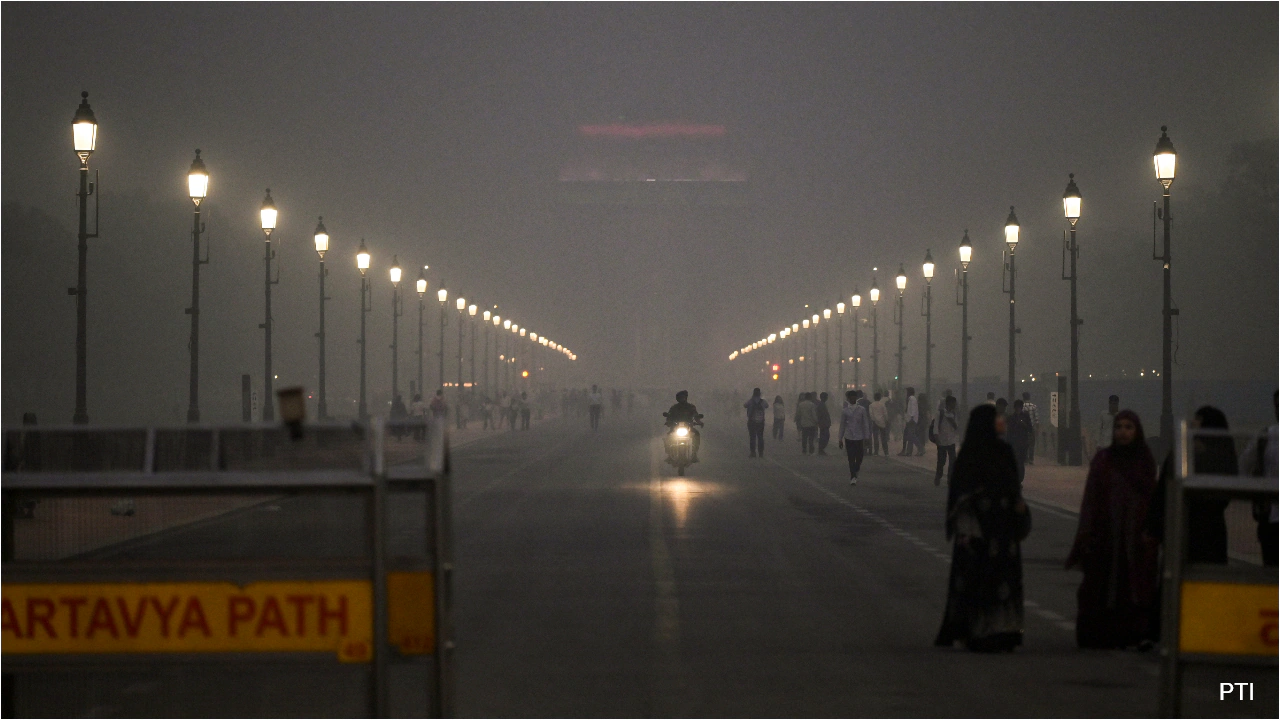
Air quality in the national capital plunged into the 'Severe' category on Friday as Delhi's overall Air Quality Index (AQI) climbed to 403, crossing the 400-mark amid a thick blanket of smog and dropping temperatures.
The sharp deterioration follows Diwali celebrations on November 8, leaving residents waking up to hazy skies and poor visibility during the early morning hours.
Data from the preceding days shows a continuous upward trend in pollution levels leading up to Friday's reading. On November 10, the AQI stood at 299 in the 'poor' category, before worsening to 313 ('very poor') on November 11, and reaching 350 ('very poor') on November 12.
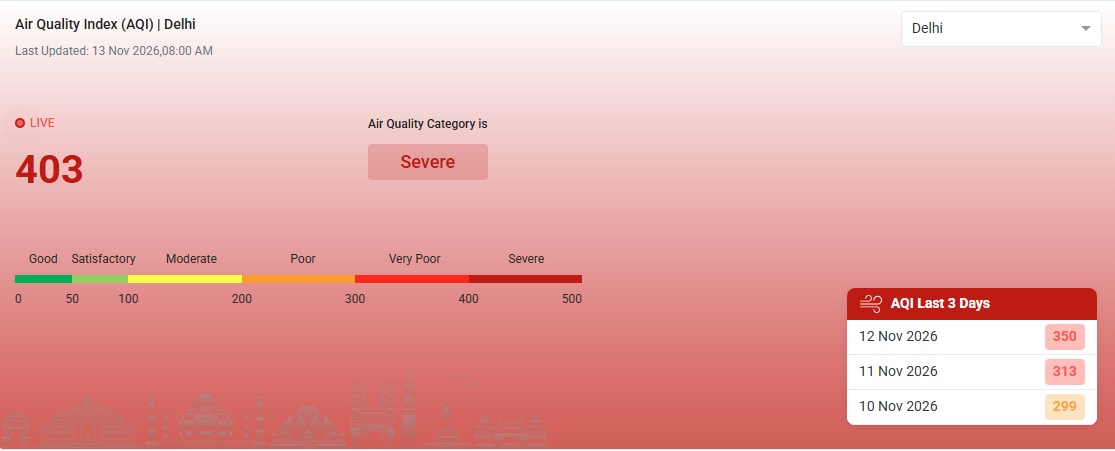
Photo Credit: cpcb.gov
According to the Central Pollution Control Board (CPCB), an AQI between 0 and 50 is classified as 'Good', 51 to 100 as 'Satisfactory', 101 to 200 as 'Moderate', 201 to 300 as 'Poor', and 301 to 400 as 'Very Poor'. Readings between 401 and 500 fall into the 'Severe' category, which affects healthy people and seriously impacts those with existing diseases.
According to CPCB data, 33 out of Delhi's 58 monitoring stations recorded 'severe' air quality, with several locations reporting AQI levels above 450.
IIT Delhi recorded the highest AQI at 487, followed by Chandni Chowk and North Campus at 476 each. Pusa recorded an AQI of 468, while Jaffarpur registered 461.
Individual readings across key stations in the capital were recorded at 488 for IIT, 479 for Chandni Chowk, and 478 for North Campus, DU. Burari Crossing recorded 456, while both ITO and JNU stood at 451.
Other areas in the severe bracket included Jahangirpuri at 430, Wazirpur at 427, Anand Vihar at 419, Rohini at 413, IGI Airport (T3) at 403, and Tikri Kalan at 402.
Meanwhile, Sri Aurobindo Marg recorded an AQI of 392 and Jawaharlal Nehru Stadium stood at 374.
Track Latest News Live on NDTV.com and get news updates from India and around the world

