






The Union Budget holds immense significance in the country's economic framework, with its roots tracing back to the colonial era. This document outlines the government's finances, including revenues, expenditures and fiscal policies. Over the years, the Budget has evolved significantly, adapting to the changing economic landscape of the nation.
The upcoming Union Budget for 2025-26 will be presented by Finance Minister Nirmala Sitharaman on February 1 in Parliament.
History of the Union Budget
Also Read | Layoffs Are Rising In Tech, But These Skills Are Helping People Unlock Better Pay
India's first Union Budget was presented on April 7, 1860, by James Wilson, the finance member of the Indian Council and the founder of The Economist newspaper. At the time, India was under British colonial rule, and the Budget was a response to the financial difficulties faced by the British administration following the First War of Indian Independence in 1857 (Sepoy Mutiny).
-

-
 "Nobel Laureate In Terms Of Brain Power": CIA Ex-Director On AI Role In Warfare
-
 "Miscommunication By Eiffel Tower": BAPS Monk On 'Women Sidelined' Claim
-
 Can AI Become A Substitute For God? Brahmavihari Swamiji On Faith And Technology
-
 BAPS' Brahmavihari Swamiji Explains Why AI Can't Replace Humanity
-
 Exclusive: BAPS' Brahmavihari Swamiji Explains Why AI Can't Replace Humanity
-
 AI Could Be Humanity's First New Species, Says Brahmavihari Swamiji
-
 Yoga, Millets To Vaccines, Jaishankar On How India Is Building Stronger Ties
-
 NDTV World Summit Day 2: Navigating A World In Transition
-
 "US Protecting Its Interest": S Jaishankar On Trump's Oil Deal With Russia
-
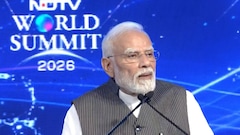 "World That Relied On India's Brainpower Now Trusts Its Mindpower": PM Modi
In the wake of the failed rebellion, Queen Victoria sent James Wilson to India to reform the financial system, introduce a tax structure, and implement a new paper currency. One of his key initiatives was the introduction of income tax, which continues to be a significant source of government revenue today.
The British government first thought about introducing direct taxes but wasn't sure how to carry them out. They also had a plan for a poorly designed licence tax bill. When James Wilson arrived, he cancelled this plan and introduced two clear bills -- an income tax and a revised licence tax. In his financial statement, he said that people earning less than Rs 200 a year would not have to pay taxes.
James Wilson also introduced an appropriation audit, modelled on the English system, to oversee monthly expenditure accounts. Tasked with addressing the financial challenges in post-revolt India, he made significant contributions in a short period.
First Post-Independence Budget
After India gained Independence, the first Union Budget of the newly independent nation was presented on November 26, 1947, by RK Shanmukham Chetty, the first Finance Minister of independent India.
Since 2019, Nirmala Sitharaman has been presenting the Union Budget. This will be her eighth consecutive Budget.
Track Latest News Live on NDTV.com and get news updates from India and around the world

