





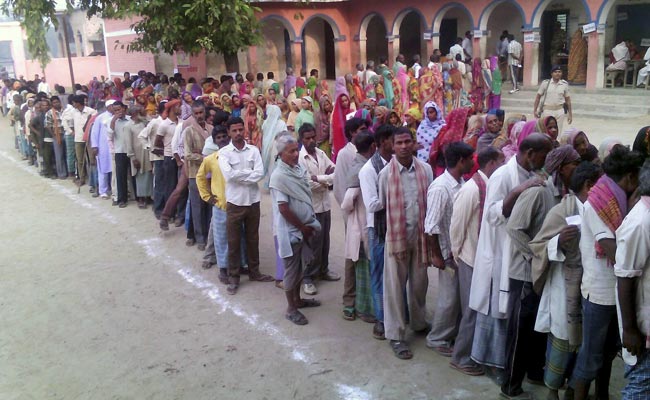
Polling was held in five phases for Bihar Assembly elections. Votes will be counted on November 8. (Press Trust of India file photo)
The Bihar Assembly Exit Poll analysis involved a series of 'Exit Polls' conducted across five election phases in the state.
The analysis is based on Polling Booth Exit Polls: a sample size of 76,020 voters - involves randomly selecting polling booths across Bihar in all 243 assembly constituencies. As voters emerged from these polling booths, a randomised selection of voters were questioned on which party they voted for.
The fieldwork and the tabulation for the Polling Booth Exit Polls was carried out by Hansa Research.
The detailed methodology is set out below:
EXIT POLLS
Overview: Exit Polls were conducted at polling booths on election days. Voters were interviewed as they came out of polling booths.
Constituencies Covered: The Exit Polls covered all 243 constituencies across Bihar.
Coverage and Sampling:
Mode of Data Collection: Computer Aided Personal Interviews (CAPI) were conducted for all Exit Polls to ensure better data quality.
Interview Method: Each booth was covered for 3-4 hours by two interviewers, who then moved to another booth. All interviews were conducted using tablet computers, where the respondents chose the candidate and party symbol displayed on the screen, without exposing their choice to the interviewers.
Sampling:
Sample size: A total of 76,020 interviews were conducted for the Exit Poll.
Phase-wise assembly constituencies covered: All 243 | Sample size: 76,022 interviews
Data Weighting: All data was weighted to reflect the constituency profile on gender and religion/caste.
Salient Features:
Quick facts on Bihar Exit Poll
The analysis is based on Polling Booth Exit Polls: a sample size of 76,020 voters - involves randomly selecting polling booths across Bihar in all 243 assembly constituencies. As voters emerged from these polling booths, a randomised selection of voters were questioned on which party they voted for.
The fieldwork and the tabulation for the Polling Booth Exit Polls was carried out by Hansa Research.
The detailed methodology is set out below:
EXIT POLLS
Overview: Exit Polls were conducted at polling booths on election days. Voters were interviewed as they came out of polling booths.
Constituencies Covered: The Exit Polls covered all 243 constituencies across Bihar.
Coverage and Sampling:
Mode of Data Collection: Computer Aided Personal Interviews (CAPI) were conducted for all Exit Polls to ensure better data quality.
Interview Method: Each booth was covered for 3-4 hours by two interviewers, who then moved to another booth. All interviews were conducted using tablet computers, where the respondents chose the candidate and party symbol displayed on the screen, without exposing their choice to the interviewers.
Sampling:
- In each assembly constituency, 7-10 polling booths were randomly selected and interviews were conducted outside each selected polling booth.
- All exit interviews were conducted during the day of polling.
- Every polling booth was covered for approximately 3-4 hours in a day by a couple of interviewers.
Sample size: A total of 76,020 interviews were conducted for the Exit Poll.
Phase-wise assembly constituencies covered: All 243 | Sample size: 76,022 interviews
- Phase 1 (October 12, 2015): 49 assembly seats | 13,588 interviews
- Phase 2 (October 16, 2015): 32 assembly seats | 10,906 interviews
- Phase 3 (October 28, 2015): 50 assembly seats | 15,412 interviews
- Phase 4 (November 1, 2015): 55 assembly seats | 17,962 interviews
- Phase 5 (November 5, 2015): 57 assembly seats | 18,154 interviews
Data Weighting: All data was weighted to reflect the constituency profile on gender and religion/caste.
Salient Features:
- Computer Aided Personal Interviews conducted with GPRS enabled tablets to ensure the strict norms of quality control.
- Through better monitoring of data collectors.
- Better quality of questionnaire administration by controlling the order in which questions were asked through a pre-programmed script and not leaving it to the discretion of the interviewers.
- Making data collection process less intrusive by replacing the ballot box with a much less conspicuous hand-held device.
- Respondent was invited to show his/her preference for a political party through a simulated EVM (tablet screen that looks like the EVM and respondent could cast his/her vote by touching the screen)
Quick facts on Bihar Exit Poll
- There were more than 110 field interviewers. They were supervised by more than 55 field supervisors.
- Total of 76,020 field-interviews conducted.
- All 243 assembly constituencies covered.
How may i help you today
Show full article
Track Latest News Live on NDTV.com and get news updates from India and around the world

