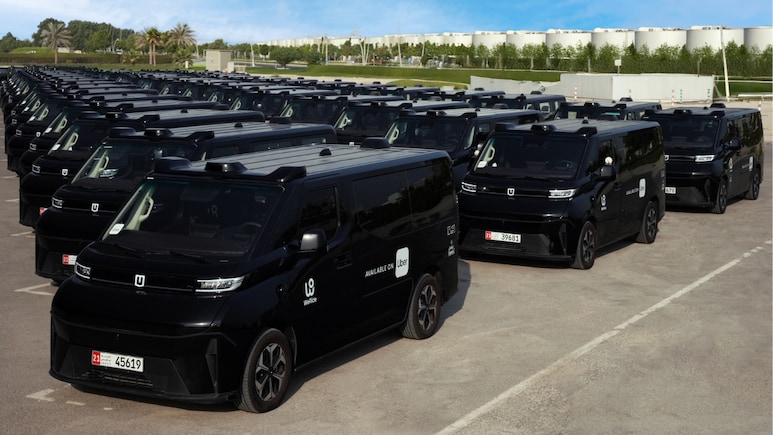
Uber has begun offering driverless autonomous ride services on Yas Island in Abu Dhabi, marking a significant step in the company's global push toward autonomous mobility. We got to experienced one of these rides firsthand and spoke to Sachin Kansal, Chief Product Officer at Uber, to understand how the system works, the safety framework behind it, and the challenges of bringing such technology to developing markets. The booking experience remains familiar for any Uber user. Riders open the app, enter their destination, and alongside the usual options such as UberX, XL, or Black, a new category appears: Autonomous. The option is visible only within the designated operational zone. Once selected, the system searches for an autonomous vehicle operating nearby and pairs the rider with a car much like the process for human-driven rides.
Watch the Full Conversation Here
Once the vehicle arrives, users unlock it through the app. The autonomous car features around 20 sensors, including cameras and LiDAR units, constantly mapping the environment. The driver's seat is blocked off with a physical cover to prevent tampering-an essential safety requirement for Level 4 autonomous operations. Luggage space is available in the front where the traditional driver's seat area would be accessible.
Inside, riders must buckle up before the system allows the journey to begin. The ride can be started either via the app or the in-car touchscreen. "It's normal for first-time riders to feel nervous," Kansal says.
"But the system checks everything before rolling, and safety is always the top priority."
During the ride, the acceleration and braking felt smooth and controlled. Kansal explains that this calibration is intentional. The autonomous system is constantly learning and evolving, much like a "living, breathing organism." Uber's partner for this deployment, WeRide, collects extensive real-world data across different cities to ensure driving behavior remains predictable, safe, and suited to local conditions.
Safety redundancies are built into the user experience. If a passenger feels uneasy or notices something unusual, a support button is available both in the app and on the in-car interface. Pressing it immediately connects the rider to Uber Support. The ride can also be ended early, with the vehicle pulling over safely at the nearest appropriate location.

WeRide Autonomous Taxi's
Photo Credit: Uber
But while the technology is advancing, scaling remains a challenge-particularly in developing countries. Kansal divides the hurdles into two parts. "First, the technology itself," he explains. "Every geography requires extensive testing before we're confident about safety. That's an ongoing journey." The second challenge is commercialization. Autonomous vehicles are expensive to build and deploy, containing complex hardware and software systems. This raises questions about the optimal number of such vehicles that can be deployed in any city.
According to Kansal, Uber's strength lies in its ability to operate a hybrid marketplace.
"Because we have human-driven cars and autonomous cars in the same city, we can offer riders both options,"
Kansal says. "The app can intelligently determine what's best suited for the rider at that time, ensuring reliability while helping us scale autonomous operations sustainably."
The Abu Dhabi pilot reflects Uber's gradual but deliberate approach to autonomous mobility-starting in controlled zones, ensuring safety benchmarks are met, and slowly integrating AVs into the wider mobility ecosystem.
For users on Yas Island, this mixed model means the future of mobility isn't a distant concept-it's a ride that can be booked today.
Track Latest News Live on NDTV.com and get news updates from India and around the world
