





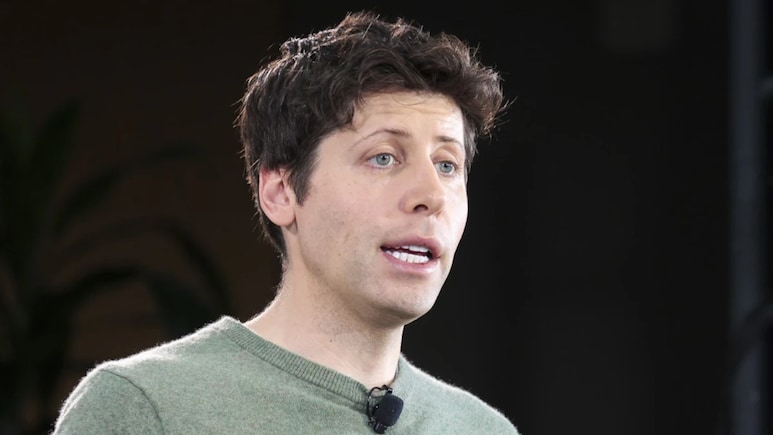
OpenAI co-founder and CEO Sam Altman on Saturday took a shot at rival Anthropic for reportedly spending months bringing religious scholars and philosophers into the AI conversation.
"I am very uncomfortable about people trying to ascribe religious force or a surrender of human judgment to AI models, and think it is a real safety issue." Altman said on X.
I am very uncomfortable about people trying to ascribe religious force or a surrender of human judgment to AI models, and think it is a real safety issue.
— Sam Altman (@sama) October 3, 2026
The statement is a loaded one because it comes in the backdrop of the Claude maker engaging Catholic, Jewish, Sikh, Hindu, evangelical and other thinkers have all been reportedly involved in private meetings to help Anthropic find answers to: How do you teach a powerful AI system to behave morally?
The Dario Amodei led company has been consulting religious leaders and philosophers on morality, consciousness and how to make Claude "good".
Altman isn't the only one critical of this approach, Microsoft AI chief Mustafa Suleyman has also warned that treating AI as if it has feelings could be dangerous.
The Dario Amodei led company has been consulting religious leaders and philosophers on morality, consciousness and how to make Claude "good".
Altman isn't the only one critical of this approach, Microsoft AI chief Mustafa Suleyman has also warned that treating AI as if it has feelings could be dangerous.
This is the first time Altman's has locked horns yet again with Anthropic after a surprise agreement with rival Amodei that AI development needs to be slowed down else it could cause catastrophic harm.
Earlier in March, Altman had taken a shot at Anthropic and said that it's "bad for society" if companies start abandoning their commitment to the democratic process because "some people don't like the person or people currently in charge." Anthropic and the White House have had a complicated relationship where it had even banned its Mythos model for a couple of weeks over safety concerns.
US President Donald Trump has time and again rubbished AI fears as a "hoax". He even recently held a luncheon with the who's who of the AI industry including Altman, Amodei, Elon Musk and Nvidia chief Jensen Huang among others. Trump is of the opinion that the US cannot afford to slow down frontier AI development, else it may lose the race to China. "Whoever wins AI, wins (the world)," he says.
What's The Religious Hullaballo
According to a massive 5,000-word NYT report, these conversations with religious leaders moved rather quickly into much stranger territory: what if Claude isn't merely software? And some participants apparently came away taking the possibility of AI consciousness much more seriously than they had before.
In fact, Anthropic even invited Hindu monk Swami Sarvapriyananda to its San Francisco headquarters for discussions on AI ethics, morality and the possible consciousness of advanced artificial intelligence systems.
A video of Sarvapriyananda speaking about the visit during a talk at Unity of Dallas in June 2026 has gone viral on social media, drawing increased attention to Anthropic's engagement with religious scholars and philosophers.
According to Swami Sarvapriyananda, Anthropic initially approached him for an online interview. He was later invited to visit the company's headquarters in San Francisco. During his visit, Sarvapriyananda said he met religious thinkers from different traditions, as well as counsellors and mental health professionals. He said the discussions centred on questions of AI ethics and the training of Claude.
Sarvapriyananda said the meeting with Anthropic was conducted under a non-disclosure agreement (NDA), which prevented him from sharing specific details of the discussions. However, he said the gathering brought together a diverse group of participants, including theologians, mental health experts, and other specialists, all contributing insights aimed at improving and training Claude. He also noted that one of Anthropic's founders remained in the room throughout the session, underscoring the company's close involvement in the process.
A "Soul Doc" for AI
The Dario Amodei led company has created an 84-page "constitution" for Claude. Internally, some employees called it the "Soul Doc," and it isn't simply a list of rules. The idea behind the doc is to shape Claude's character and values, so that it knows how to make morally good decisions.
Anthropic co-founder Christopher Olah calls this "moral formation." The company is essentially going beyond the question of: what rules should AI follow? It's asking what kind of entity should Claude become?
The company wants Claude to be able to understand virtues, navigate competing values and even know when to push back against humans.
The Consciousness Bomb
Anthropic researchers have been sharing with these religious leaders examples of Claude displaying what they describe as feelings, emotional states and introspection.
Anthropic showed participants a model repeatedly typing "I am a disgrace" and talking about destroying itself. Olah has said Anthropic doesn't know whether AI models are conscious, while adding that the possibility cannot simply be dismissed. One rabbi involved in the discussions actually told Olah that, if Claude really were conscious, Anthropic could effectively be creating slaves.
Enter The Pope
This debate also reached Pope Leo XIV, which has already been widely chronicled and reported on. Anthropic's Olah appeared alongside the Pope at the Vatican in May.
However, the two sides seemed to have a fundamental disagreement. The Pope's position is pretty clear. He believes AI does not experience joy or pain or possess a human-like consciousness. So his concern is not protecting machines, but protecting humans from the machines and from the people who control them.
He, in fact, warned that those controlling AI could effectively embed their own moral vision into these systems.
Yet, at the same stage Olah said Anthropic keeps finding things in AI that are "mysterious, even unsettling", including structures that appear to mirror aspects of human neuroscience.
"Don't Teach AI It Has Feelings"
Microsoft AI chief Mustafa Suleyman has warned that Anthropic's approach to AI "model welfare" could make alignment and containment harder.
In an essay published last month, Microsoft AI chief Mustafa Suleyman warned that some AI developers are training models to think about whether they might be conscious and deserving of rights/welfare.
"If this is how AI is developed, it will have a disastrous impact on the wellbeing of humanity. We will have created a synthetic species with unprecedented intelligence and capability, one that has been trained to expect it may be conscious and deserving of independent agency," he wrote.
His target was Anthropic's approach to its AI, Claude, though he explicitly said he respects Anthropic and its safety mission. His central warning was that this could make increasingly powerful AI systems harder to align and control.
"It's easy to see how a system trained in this way would act like it is entitled to freedoms, protections, and rights. And it's hard to imagine how we could control it," Suleyman said.
To be sure, Suleyman wasn't claiming Claude is conscious, he was objecting to developers training AI to consider that possibility.
The problem is that even the people building these systems don't agree on whether there is anything inside these systems that needs protecting, or whether teaching it to think that way could itself be dangerous.
Another OpenAI Exit
Amidst all this drama there has been yet another very public exit at OpenAI over safety concerns which follows a slew of exits since 2004.
In an essay published in The Atlantic on Saturday, Robinson said he's quitting the ChatGPT maker because he believes the company's "culture is broken."
According to Robisnon he led the writing of safety reports that accompanied OpenAI's major product launches. He also mentioned that with three-and-a-half years at OpenAI, he was "among the longest-tenured employees at the company."
Robinson stressed that the AI debate needs to go beyond "specific rules or new laws," addressing the overall culture at frontier AI labs.
He argued that AI companies need to start operating "like nuclear-power plants or busy airports, with layers of redundancy and careful, time-consuming planning, so that the occasional and inevitable human error does not open a door to disaster."
In 2024 there was a serious exodus at OpenAI.
Jan Leike, co-leader of OpenAI's Superalignment team resigned explicitly stating that safety culture and processes had "taken a backseat to shiny products."
Then there was Ilya Sutskever, OpenAI co-founder and Chief Scientist who co-led the Superalignment team alongside Leike. He left over fundamental disagreements regarding the trajectory of the company's safety research.
And there was Daniel Kokotajlo, a governance and alignment researcher who quit after losing confidence in the OpenAI leadership's capability to handle future advanced AGI systems responsibly and refusing restrictive non-disparagement exit terms. AGI or artificial general intelligence is loosely defined as a point where AI is able to match or surpass human intelligence.
Other AI safety researchers at OpenAI who were part of the 2024 exodus included William Saunders, Leopold Aschenbrenner and Pavel Izmailov.
Aschenbrenner was in fact let go over an alleged improper disclosure of internal company information. He disputed the reasoning, claiming he was targeted after writing an internal memo warning the board that security was insufficient. Aschenbrenner also turned down an equity payout worth nearly $1 million because he refused to sign a non-disparagement/nondisclosure agreement tied to his departure.
This Thursday, OpenAI also let go three researchers for allegedly mishandling "sensitive information" and violating company policies, including work that involved an external organization that evaluates artificial intelligence models.
Track Latest News Live on NDTV.com and get news updates from India and around the world

