





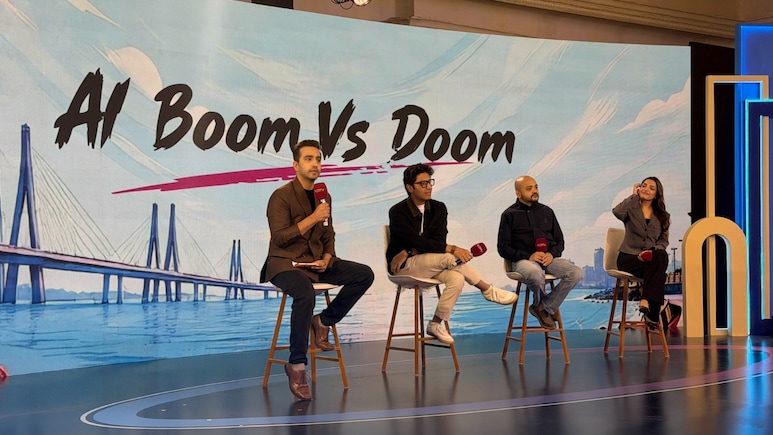
Despite the recent gloom and doom around AI, most of us realise that the technology has the potential to dramatically increase productivity and open up possibilities that previously seemed impossible. However, there are also serious concerns around how growing dependence on AI could also weaken some very human skills, particularly independent thinking, judgement and problem-solving. And that very tension was palpable at the "AI Boom VS Doom" session at NDTV Yuva. The session featured AI Educator Ishan Sharma, Gayatri Agarwal, Founder, ALTRD - a Bengaluru-based AI transformation company that helps enterprises build custom systems and automated workflows to fix daily operational bottlenecks, and Samyak Chakrabarty, Co Founder, Nimaya Foundation - a not-for-profit career accelerator in India that empowers young women from underserved and disadvantaged backgrounds to thrive in the modern, AI-driven workforce.
Sharma reiterated that AI can indeed create opportunity, but over-reliance is a problem among the youth. His central argument was that AI may be making some people less capable of doing things themselves.
"People are increasingly asking ChatGPT, Gemini or Claude for answers instead of developing the ability to arrive at those answers themselves," he said.
He spoke of an instance where he asked his young team to make a reel from a report without using any AI tools in two hours. The same team that produces reels in a jiffy struggled badly, he said.
"For people in their 20s, taking ownership is key," he said. While using AI, "humans still need to be willing to put their reputation on the line and take responsibility for the final outcome."
Agarwal highlighted that in today's AI age human judgement becomes more valuable than ever before. She called out two skills that will hold the youth in good stead that's entering the workforce and worried about AI eating up jobs - 1) Depth of understanding and 2) Judgement: knowing what is good, what is bad and what actually works.
She also spoke about how AI can produce an answer much faster than a human in most situations and that makes human judgement more important, not less - especially because it's important to tell the bad answer from the good and as we all know AI can make mistakes.
Commenting on her work with organisations on AI transformation she mentioned that demonstrating ROI (return on investment) becomes the real key.
"Many companies now know they need to use AI, but don't know where to begin, which department should start, or how much they should spend," she said. She noted that AI budgets are not always clearly defined even as companies feel pressure to adopt the technology.
Nimaya Foundations's Chakrabarty stressed on the fact that AI and human creativity together can create things we couldn't before. He said his foundation has trained thousands of women in AI and shared an example involving a farming community. He mentioned a girl who used their training to create a chatbot called "dadi-dada bot" inspired by grandparents. Her idea was to recreate some of the storytelling experience children would otherwise experience from grandparents, in a village where the elders were less in numbers.
Chakrabarty's broader argument was that AI's processing power combined with human creative power is where the real opportunity lies for young India. Commenting on two skills that'll stand out in the AI age, he said - 1) Knowing yourself and 2) Retaining curiosity and creativity while having fun.
The "Doom" Question
Sharma spoke about how AI agents are increasingly becoming capable of acting on a user's behalf while mentioning tools such as Grok's bot and Meta's Muse. He shared a personal example of using an Muse while buying a bed and having it help obtain a refund.
However, he pointed out concerns around how much access we are willing to hand over to AI. If an AI agent can access files, accounts, browsers and other information on your computer, what happens to that data? The more capable AI becomes, the more consequential questions around privacy, security and control become.
In fact, Sharma mentioned a recent incident where a Meta Muse user complained on X that it let Muse sell something on their behalf on Facebook Marketplace and the AI agent happened to share the human's address and had people show up at his house.
Chakrabarty said the the bigger question is what humans want AI to do.
"There is enormous commercial incentive for companies to keep developing AI," he said. He's basically alluding to the fact that the incentive makes it difficult for AI companies alone to determine where the boundaries should lie.
He said the more important question to ask in the AI age is: "What is the purpose of human life, and what do we actually want AI to do for us?"
His takeaway was that AI can be almost limitless so humans have to define the boundaries. Knowing your own purpose helps you decide what you want AI to do and what you don't want it to do, he said.
Follow NDTV Yuva 2026 live updates here.
Track Latest News Live on NDTV.com and get news updates from India and around the world

