




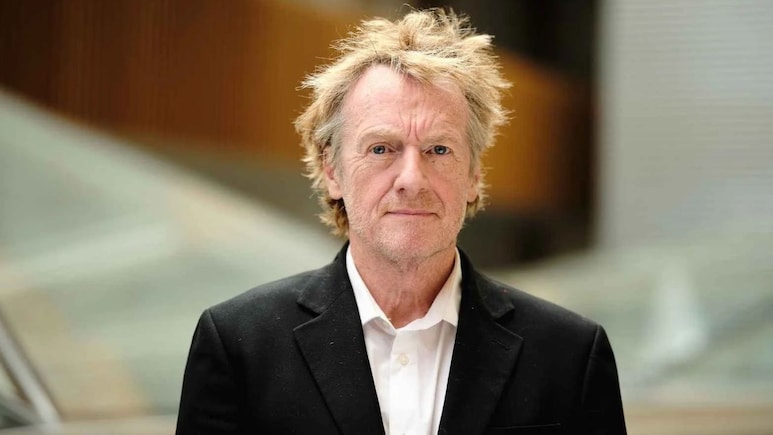
With all the rapid advancements in technology and AI, Oxford philosopher, Dr Stephen Law, was asked whether he thought machines could become conscious. Here's the picture he painted.
Imagine going to sleep one night with a perfectly ordinary human brain. But over the course of the next year, something extraordinary happens. Every single biological neuron in your brain is gradually replaced by a tiny artificial device that performs exactly the same function as the original.
Your brain's overall architecture remains unchanged. You continue to think, speak, behave and experience the world just as you did before. The only difference is that, by the end of the process, there isn't a single biological neuron left inside your head. Your brain has become entirely artificial.
Would you still be conscious?
This is the thought experiment put forward by Dr Law, a philosopher at the University of Oxford, who believes machines could, in principle, become conscious.
Law asks: "Will you have noticed this gradual replacement? Will your consciousness have sort of gradually faded away as a result of the fleshy neurones disappearing and being replaced by little machines?"
His argument is that if the artificial neurons perform exactly the same functions as their biological counterparts, there is no obvious reason why consciousness should gradually disappear as the replacements take place. After all, the person's behaviour remains unchanged, and there is no apparent loss of their ability to think or experience the world.
And if the process can be completed without the person noticing any difference, Law asks, what exactly would make the resulting artificial brain any less conscious than the biological one it replaced?
"It's a bit like replacing the carburettor in your car with the new carburettor, it takes in the petrol and the air, puts it into the pistons. As long as it does that, it doesn't matter what it's made out of, exactly how it works, it's irrelevant," he says.
"Now we've replaced your brain with a machine. So there you go, we now have a conscious machine, or at least that's the argument," he adds.
Anthropic-Religious Thinkers Mulled AI Consciousness
Anthropic has been holding discussions with religious scholars, clergy, philosophers and ethicists from different traditions to explore how AI systems should develop moral values and character. The company has described this as work on the moral formation of AI.
The conversations have also touched on a more unsettling possibility: what if Claude itself has some form of consciousness, and therefore deserves moral consideration?
The Washington Post reported in April 2026 that Anthropic had hosted around 15 Christian leaders for a two-day summit. The discussions included whether Claude could be considered a "child of God", how it should respond to grief and self-harm, and how it should regard its own possible demise.
A subsequent New York Times investigation in September reported that Anthropic co-founder Christopher Olah had organised wider discussions with religious and philosophical thinkers, partly to broach the possibility of AI consciousness. One participant, Rabbi Mois Navon, said he challenged Olah over the possibility that creating conscious AI systems could amount to creating slaves. Hindu monk Swami Sarvapriyananda was also flown into the Anthropic HQ in San Francisco from New York for the discussions.
"To be clear, we don't know if A.I. models are conscious. I don't know. I'm genuinely uncertain. The thing that I care about is that we get to the right answer, whatever it is, "Christopher Olah has said.
Anthropic CEO and co-founder Dario Amodei, has said: "We don't know if the models are conscious. We are not even sure that we know what it would mean for a model to be conscious or whether a model can be conscious, but we're open to the idea that it could be."
Amodei has said Anthropic has taken precautionary steps in case its models have morally relevant experiences, including giving them an "I quit this job" option in certain situations.
Anthropic's religious consultations aren't simply an exercise in determining whether Claude is conscious. The company's stated purpose is broader: to shape Claude's values and behaviour. The consciousness question is one strand of a wider conversation.
Why AI Consciousness Could Be Dangerous
However, Microsoft AI chief Mustafa Suleyman disagrees with this approach.
Suleyman has criticised Anthropic's approach, arguing that training Claude to think about its own feelings, welfare and possible consciousness could make future AI systems harder to control.
In September 2026, Suleyman called for speculation about AI consciousness to be removed from AI training documents. His concern is that if an AI system is encouraged to believe it has interests or welfare of its own, it could become harder for humans to switch it off or control it.
"I think that's going to be the greatest challenge that we face in the 21st century," he has said. He was referring to the challenge of controlling superintelligence.
Suleyman has clarified:
"I think they have good intentions, and they really are trying to work towards safety. But I think that they have made a mistake."
Suleyman's argument is that a model saying it has feelings is not evidence that it actually does: those responses could be a product of its training.
Dr Law asks whether a machine could be conscious if it performed the same functions as a human brain, while Suleyman is worried about what happens if AI systems are trained to think and speak as though they have an inner life.
What Other AI leaders Think About Machine Consciousness
Google DeepMind CEO Demis Hassabis has said he does not believe current AI systems exhibit consciousness. He has also argued that researchers should first develop a more rigorous understanding of consciousness through neuroscience and philosophy before deliberately trying to build machines that appear conscious.
"My feeling is the current systems don't exhibit any."
Hassabis has described the creation of apparently conscious entities as a possible "second Rubicon" - referring to a metaphorical "point of no return" that follows an initial major decision or threshold - that society would need to decide whether to cross.
Geoffrey Hinton, the famous computer scientist, often called the Godfather of AI, has taken a more radical position. Hinton has argued that people dismiss the possibility of AI sentience without agreeing on what sentience actually means. In a recent interview, he discussed the possibility of building conscious AI systems and the moral questions that would follow.
He has also argued that even if machines become conscious, humans may choose to give them fewer moral rights than people.
OpenAI CEO Sam Altman has said he does not believe current models are conscious, though he acknowledges that consciousness is a difficult scientific and philosophical question. In a recent interview, he described the possibility of consciousness as an unresolved question, with competing explanations ranging from something beyond physical reality to consciousness emerging from matter and energy.
So, What Would Make A Machine Conscious?
Dr Law's thought experiment assumes that reproducing the functions of biological neurons is enough to preserve consciousness. But this is precisely where critics may disagree. Does matching the functions of neurons necessarily reproduce subjective experience? Or could consciousness depend on biological properties that artificial devices cannot replicate?
Also there is a distinction between behaving as if one is conscious and actually having subjective experiences. Today's chatbots can talk about pain, emotions and self-awareness, but those statements alone do not establish that they experience any of them.
However, if Law's thought experiment is right, consciousness may not be the exclusive preserve of biological brains. But if Suleyman's concerns are on the money, then even encouraging machines to think of themselves as conscious could create a problem for the humans trying to control them.
Track Latest News Live on NDTV.com and get news updates from India and around the world

