





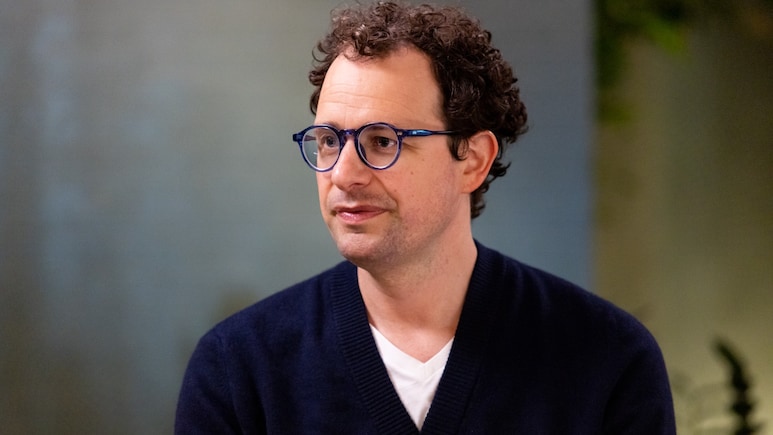
"Cancer, Alzheimer's, heart disease, mental illness, these will be relics of the past in, I think, less than a decade," Claude maker Anthropic's CEO Dario Amodei said.
These are not obscure medical conditions, they affect millions of families, and some of them remain among medicine's toughest challenges till date.
"I think if we do this right, we can create an age of miracles where humanity is able to solve problems that have eluded us for millennia," Amodei said.
Watch our quick take:
Amodei sees AI as a technology capable of dramatically accelerating biological research, drug discovery and medical breakthroughs.
Amodei isn't alone. His promise is echoed by other AI leaders including Elon Musk and Google's AI boss Demis Hassabis.
Hassabis has suggested AI could compress a decade of drug discovery into weeks, potentially bringing about the "end of disease" or curing all diseases within a decade.
Hassabis has pointed to breakthroughs like AlphaFold-which mapped over 200 million protein structures-as proof that AI can radically accelerate biological research.
While AlphaFold is a genuine scientific achievement, it is not proof that AI can produce cures for cancer, Alzheimer's or other complex diseases within a decade.
Musk has claimed that all of humanity will have access to the best medical care at the same level that the President of The United States gets thanks to AI advancements.
But there's a catch. The people who actually develop medicines aren't necessarily buying this timeline.
Experts and Drugmaker CEOs Aren't Convinced Yet
Jeff Leiden, executive chairman of Vertex Pharmaceuticals has dismissed these timelines as "complete BS," noting that Vertex tested roughly 50 AI companies to comb through 10,000 drug compounds and not a single one generated a working drug on its own.
Pharmaceutical leaders emphasise that speeding up initial molecule discovery does not bypass clinical trials, regulatory reviews, or biological testing in animal and human models-a phase that makes up the vast majority of the 10-to-12-year drug development pipeline.
Finding a molecule that looks promising on a computer screen is only the beginning. It still has to be tested in laboratories, animal models and eventually human clinical trials to establish whether it is safe and actually works. AI may speed up the search for potential treatments, but it cannot simply make these steps disappear.
Critics such as cognitive scientist Gary Marcus, and cardiologist and digital medicine expert Eric Topol point out that current AI models lack the deep causal and biological understanding required to reliably yield breakthrough cures, and as of 2026, no AI-designed drug has achieved full clinical adoption.
There is also a history of medical breakthroughs being promised on timelines that never materialised. The 1970s 'war on cancer' is one example. Experts warn that such ambitious predictions risk raising public expectations far beyond what science can currently deliver.
Track Latest News Live on NDTV.com and get news updates from India and around the world

