





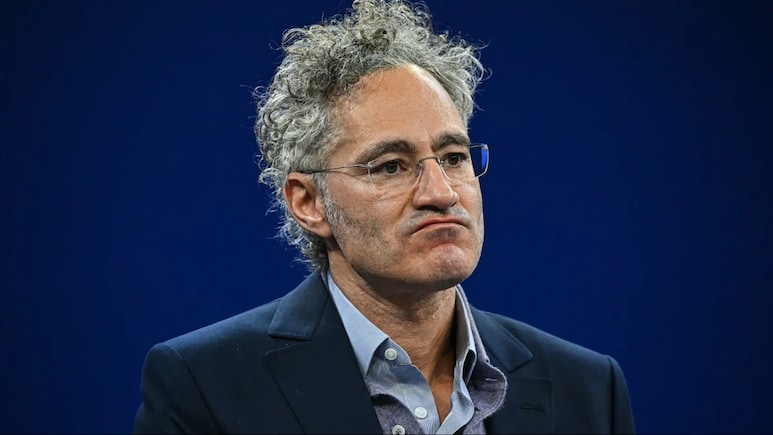
- Palantir CEO Alex Karp accused AI firms Anthropic and OpenAI of fostering dependency on their technology
- Karp criticized AI firms for encouraging investment without control over data or intellectual property
- He supports open-weight AI models for greater business control and customization of AI deployment
Palantir CEO Alex Karp recently said that AI companies like Anthropic and OpenAI are trying to "drug addict" us.
"We have people trying to drug addict us to a future they (frontier AI companies like Anthropic, OpenAI) believe they control," he said in an interview to CNBC.
"Now, I've spent a lot of time with Dario (Amodei, CEO of Anthropic) and the Anthropic crew. They want to tell you we have to march into a future where we own nothing, where our businesses aren't profitable, where none of us have jobs, and where our adversaries win."
Karp's "drug addict" comment appears to be a reference to what he sees as growing dependence on frontier AI companies. His argument is that businesses are being encouraged to pour money into AI models and compute without necessarily retaining control over their data, intellectual property or the value created by those systems.
Palantir is a US-based technology major that provides AI and data analytics software to businesses and governments.
This is not the first time Karp has criticised the business models of frontier AI companies. He has repeatedly argued that enterprises risk becoming dependent on AI labs while giving up control over their intellectual property and spending heavily on AI systems without a clear return.
Last month, Karp lashed out at OpenAI and Anthropic on live television, calling the AI Industry 'effing insane.' In a scathing interview with CNBC early July, the Palantir co-founder and CEO slammed the token-based business models of ChatGPT maker OpenAI and Claude maker Anthropic.
Also read: Palantir CEO Calls AI Industry 'Effing Insane', Slams OpenAI, Anthropic
Both Anthropic and OpenAI have clarified over the past month that customer data is secure and they don't use it to train the AI models. In fact, OpenAI has pointed out that per their policy, businesses must explicitly opt in if they want their data used for model improvement.
However, Karp is not convinced.
"Every enterprise we interact with, and that includes some of the biggest and most important government enterprises in the world, is saying, 'Why would we tokenmaxx... pay people for something that's not useful and then not control the means that allow us to advance our business while keeping the value of the business inside?" Karp said.
"Tokenmaxxing" refers to the practice of using large amounts of AI compute, often through extensive prompting or autonomous AI agents, without a clear indication that the additional spending is translating into meaningful business value.
Karp has also backed open-weight AI models, which give businesses and developers greater control over how AI systems are deployed.
Also read: Big Tech's AI Cost Panic: Uber, Microsoft And The Burn Problem
Late last month, Palantir joined Nvidia, Microsoft and several other companies in signing an open letter that argued open-weight AI models are critical to national security.
Open-weight models give developers access to the model's underlying weights, making it possible to customise and run them independently rather than through the company's own service. A recent study by the UK's AI Security Institute suggests China's leading open-weight AI models are catching up with America's frontier systems faster than before. Frontier models are basically the most advanced AI systems currently available.
According to the research, Chinese models such as Z.ai's GLM-5.2 and DeepSeek V4-Pro perform at a level comparable to frontier closed models that were released just four to seven months earlier. For most of 2025, the gap was estimated to be around six to ten months.
The findings reflected a broader trend that AI experts have been tracking over the past few months.
"The gap between open-weight and frontier closed models is collapsing exponentially. What took 10 months now takes four, and soon there won't be a gap at all," Srinivas Padmanabhuni, CTO of AiEnsured, told NDTV.
Sagar Vishnoi, co-founder of Future Shift Labs, echoed that view. "The gap between frontier closed models and leading open-weight models is shrinking, indicating that breakthroughs are diffusing far more quickly across the global AI ecosystem than they did even a year ago."
Track Latest News Live on NDTV.com and get news updates from India and around the world

