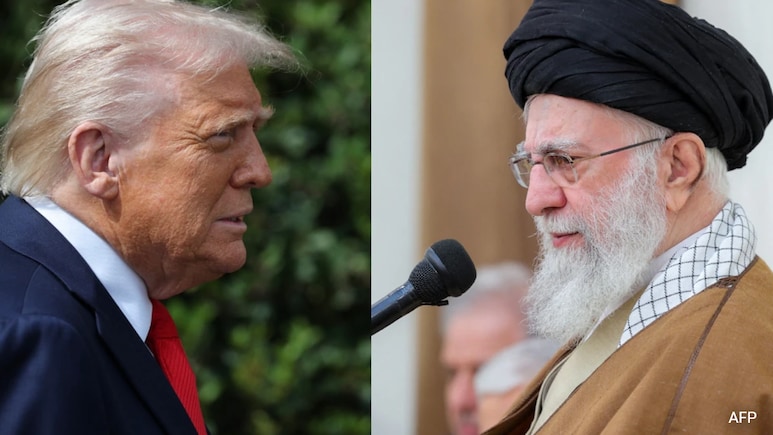
- US President Trump warned Tehran of severe consequences if no nuclear deal is reached
- US strikes could weaken Iran's regime or strengthen military control by IRGC
- Collapse of Iran's regime risks regional chaos, civil war, and humanitarian crises
US President Donald Trump has issued a stark warning to Tehran, saying that failure to reach an agreement on nuclear weapons would invite consequences far more severe than anything seen before. Iranian officials have responded by reiterating their openness to negotiations, but only on what they describe as "mutually beneficial, fair and equitable" terms.
At the same time, Iran's foreign minister struck a sharply defiant tone, declaring that the country's armed forces have their "fingers on the trigger" and stand ready to "powerfully respond" to any aggression.
With tensions rising, a BBC analysis outlines a range of scenarios that could unfold if the standoff tips into open conflict.
Regime Falls, Democracy Emerges
In the most optimistic reading, US military action could weaken Iran's ruling establishment enough to trigger its collapse. American air and naval power could focus on key assets of the Islamic Revolutionary Guard Corps (IRGC), the Basij paramilitary force, missile depots, launch facilities, and components of Iran's nuclear programme.
Already strained by economic sanctions and persistent public unrest, the regime could buckle under the pressure, potentially opening the door to a democratic transition. History, however, offers caution. While the 2003 invasion of Iraq sought regime change, and Libya's intervention removed Muammar Gaddafi, neither resulted in a stable democracy.
Survival With Strings Attached
Another possibility mirrors the Venezuelan experience under Nicolas Maduro. In this scenario, US pressure stops short of dismantling the system entirely, instead forcing policy concessions while leaving the Islamic Republic intact.
Iran could be compelled to rein in its backing of violent militias across the region, curb or abandon parts of its nuclear and ballistic missile programmes, and loosen its grip on domestic protests. Yet after 47 years of resistance to external pressure, Iran's leadership has shown little inclination toward compromise, making this path unlikely.
Regime Replaced By Military State
A more plausible outcome may be the emergence of an even harder regime. US strikes could further weaken civilian authority, allowing a military-dominated government that is heavily influenced or outright controlled by the IRGC, to take over.
Iran Strikes Back
Iran may choose retaliation. While it cannot match the US Navy and Air Force head-on, it has a sizeable arsenal of ballistic missiles and drones, many hidden in underground facilities or remote mountainsides.
US military bases line the Gulf, including Bahrain and Qatar. Iran could also target infrastructure in countries it views as allies, such as Jordan. The 2019 missile and drone strike on Saudi Aramco's facilities, attributed to an Iranian-backed militia, exposed just how vulnerable regional energy infrastructure can be.
Gulf states allied with Washington are deeply concerned that any US action against Iran could quickly spill over onto their territory.
Iran Lays Mines In The Gulf
Another response would see Iran laying mines in the Gulf. This tactic dates back to the Iran-Iraq war of 1980-88, when shipping lanes were mined and the Royal Navy was deployed to clear them.
The narrow passage between Iran and Oman, known as the Strait of Hormuz, is one of the world's most critical energy corridors. Roughly 20 per cent of global LNG exports and around 20-25 per cent of oil and petroleum products pass through it annually. Iran has repeatedly rehearsed rapid mine-deployment drills, and any attempt to block the strait would likely jolt oil markets and disrupt global trade.
A US Warship Is Hit
One of the gravest risks would be the loss of an American naval vessel. A US Navy captain once described a key concern as a potential "swarm attack", in which Iran deploys waves of explosive drones and fast attack boats in overwhelming numbers.
The IRGC Navy, which has largely supplanted Iran's conventional naval force in the Gulf, specialises in asymmetric warfare designed to offset US technological superiority.
The sinking of a US warship, particularly if crew members were captured, would be a profound humiliation for Washington. Though unlikely, precedent exists. The USS Cole was crippled by an Al-Qaeda suicide attack in 2000, killing 17 sailors, and in 1987 the USS Stark was mistakenly struck by Iraqi missiles, killing 37.
Regime Falls, Chaos Ensues
Neighbouring states such as Qatar and Saudi Arabia fear that the breakdown of authority in Iran could unleash civil war, similar to the devastation seen in Syria, Yemen, and Libya.
In such chaos, ethnic tensions could erupt as Kurds, Baluchis, and other minorities move to protect themselves amid a national power vacuum. While many in the region, especially Israel, would welcome the end of the Islamic Republic, no one wants to see a country of roughly 93 million people spiral into disorder, triggering mass displacement and a humanitarian catastrophe.
Track Latest News Live on NDTV.com and get news updates from India and around the world


