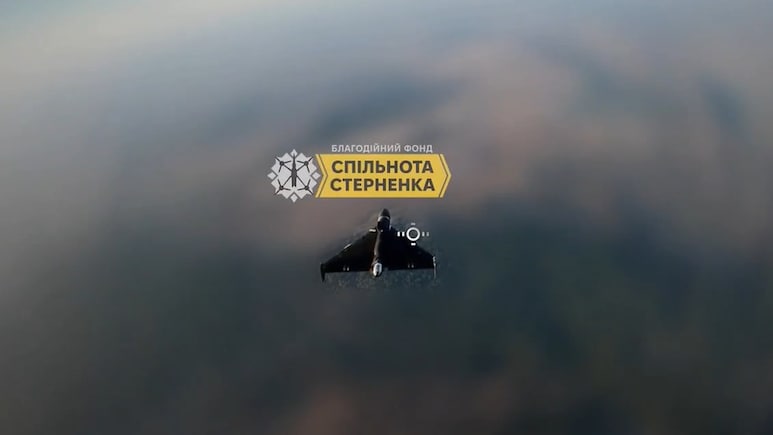
A video posted online captures the moment a small, fast-moving Ukrainian interceptor drone closes in on -- and destroys -- a Russian jet-powered Shahed suicide drone at altitude. The interceptor seen in the footage is known as the STING, a compact, domestically produced system designed specifically to counter long-range Russian attack drones.
The video was shared by Wild Hornets, the Ukrainian manufacturer behind the STING programme, and shows the interceptor accelerating towards its target before impact. The Shahed drone, adapted by Russia and now reportedly operating at higher speeds and altitudes, is struck mid-air.
The Active Operations Department of the HUR of Ukraine's Ministry of Defense shot down a jet-powered Shahed. All thanks to your donations to the Shahedoriz fundraiser.
— Wild Hornets (@wilendhornets) December 22, 2025
Thank you for supporting our military! pic.twitter.com/xWwClzfRh7
Ukraine has been racing to deploy these interceptor drones as Russia intensifies strikes on cities and critical energy infrastructure. Unlike conventional air-defence missiles -- which can cost hundreds of thousands or even millions of dollars per launch -- interceptor drones are built to be cheap, modular and expendable.
In field conditions, technicians work at speed. Antennas and sensors are mounted on light stands, monitors and control systems are pulled from ruggedised cases, and launch equipment is assembled close to the front lines or near vulnerable urban centres. The emphasis is on rapid deployment and flexibility, allowing operators to respond quickly to incoming threats.
The STING drone itself has a distinctive, almost utilitarian design. Operators describe it as resembling a thermos flask -- a narrow cylindrical body optimised for speed and altitude rather than endurance. The system has been designed to counter the evolving profile of Russian suicide drones, which now fly faster and higher than earlier versions.
Wild Hornets has said its interceptor is capable of reaching altitudes of up to 11 kilometres, placing it well within range of the jet-powered Shahed variants now being used by Russian forces.
The release of the video comes amid one of the heaviest waves of Russian aerial attacks in recent months. Ukrainian President Volodymyr Zelensky said Russian forces launched what he described as a "massive attack" on Monday night, targeting 13 regions across the country.
According to Zelensky, Russia deployed 650 drones and 30 missiles during the overnight assault. At least three people were killed. Among the dead was a four-year-old girl in the central Zhytomyr region.
In the Vyshhorod district of Kyiv region, Russian drones and missiles killed a woman and injured three others, according to Governor Mykola Kalashnyk. Further west, in Khmelnytskyi region, one person was killed by Russian shelling, Governor Serhii Tiurin said.
Kyiv itself was again targeted. Drone strikes hit the capital's Sviatoshynskyi district, injuring five people, according to Tymur Tkachenko, head of the Kyiv City Military Administration. Photographs from the city showed shattered windows and damaged apartment buildings, including images of an elderly woman standing inside her broken home after a drone strike.
Ukraine's Ministry of Energy said Russian attacks had forced the introduction of emergency power outages in several regions. Electricity supplies were disrupted in Rivne, Ternopil and Odesa regions, with repair work ongoing.
The ministry described the situation as "most difficult" in border regions, where continuous fighting complicates restoration efforts. Russia has repeatedly targeted Ukraine's energy infrastructure since the early months of the war, aiming to strain civilian morale and undermine industrial capacity, particularly during winter.
Track Latest News Live on NDTV.com and get news updates from India and around the world


