US tariff rates announced Wednesday put pressure on India to agree to a trade deal or face a higher levy, leaving exporters and investors with little clarity on the trade outlook.
The US plans to impose a 17 per cent tariff on Indian goods, lower than regional peers like Vietnam, Malaysia and Bangladesh. The rate would be hiked to 25 per cent if India fails to secure a trade deal with the US, its biggest export market, according to a statement from the US Trade Representative.
Analysts said the US proposal amounts to coercion and creates more uncertainty about the trade outlook.
"By deploying a dual-rate structure -- threatening steep baseline tariffs against countries that refuse a pact while offering lower rates to those that sign -- Washington reclaims the bargaining power to impose duties at will and extract unilateral concessions," said Ajay Srivastava, founder of the New Delhi-based Global Trade Research Initiative.
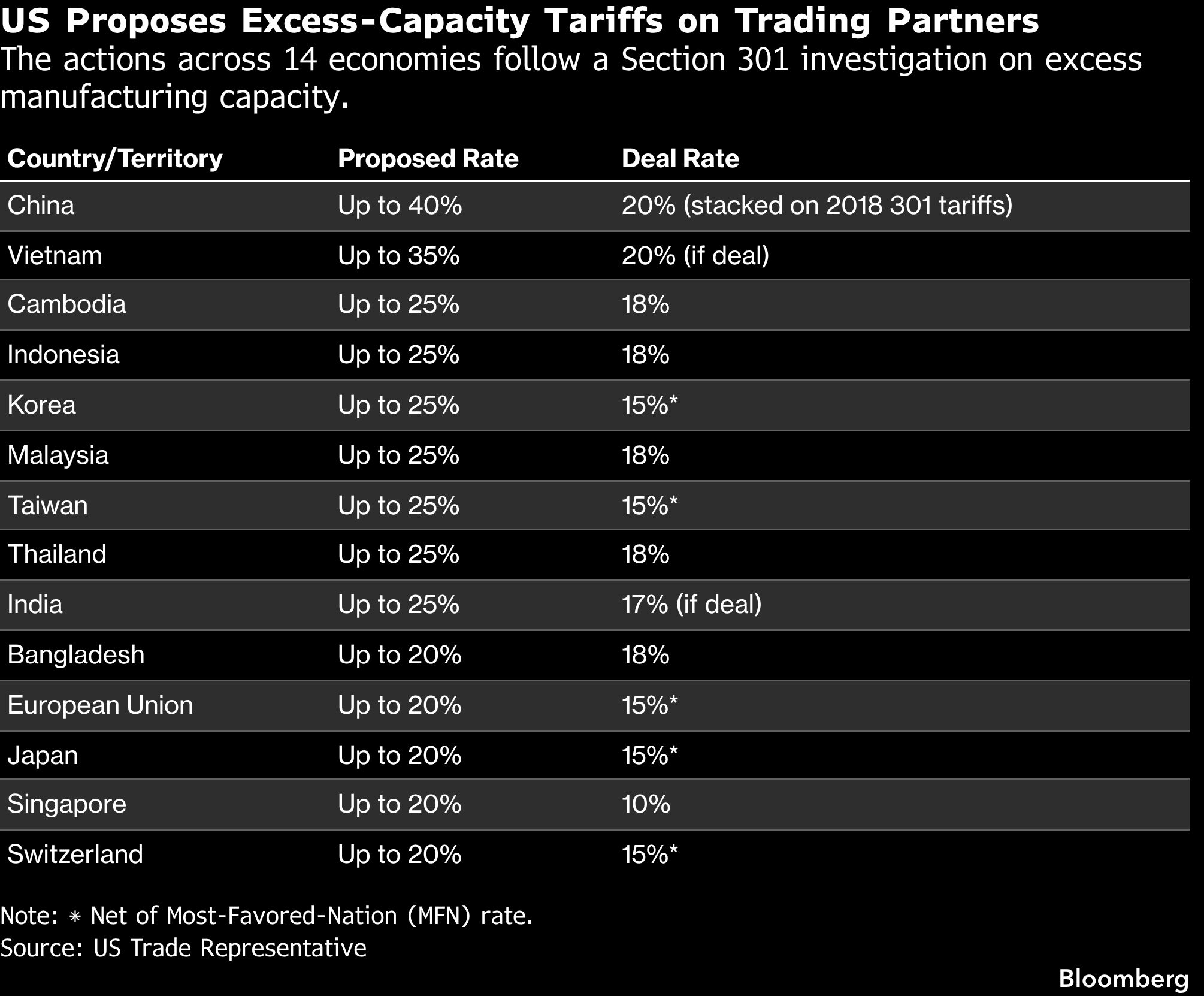
The tariffs, which are subject to a public comment process, apply to the US's main trading partners, including China and the European Union, and are intended to address concerns over excess manufacturing capacity. They mark the latest effort by the Trump administration to reinstate its tariff agenda after being thwarted by the courts.
India's Ministry of Commerce and Industry said late Wednesday that it had "engaged constructively" during the investigation and that any trade-related concerns should be addressed through US-India talks for the bilateral deal.
Negotiators from the US and India have been locked in talks over a trade deal since agreeing to a framework in February. The US trade probes, as well as a recently passed law on Russian oil sanctions, have complicated the negotiations. The legislation gives President Donald Trump the ability to impose tariffs of as much as 100 per cent on the top buyers of Russian oil, like India.
With the US accounting for about a fifth of India's exports, some exporters may front-load shipments and diversify further to cushion the tariff impact, while "growing US tariff backlash and upcoming public hearings could still lead to some moderation," Madhavi Arora, an economist at Emkay Global Financial Services, said in a note. The levies would hit labour-intensive sectors, including textiles, gems and jewellery and marine products, she wrote, adding that progress on the trade deal remains crucial.
Despite the tensions, both sides have in recent months expressed optimism that a trade deal was close to being finalised. India's Commerce Secretary Rajesh Agrawal said last week that "every aspect of the deal has been more or less finalised," but greater clarity was needed on the tariffs.
The latest US proposal "adds to the uncertainty surrounding India-US trade relations," said Manoj Mishra, a partner and tax controversy management leader at Grant Thornton Bharat. The possibility of a competitive 17 per cent tariff rate "underscores the need to expedite bilateral trade negotiations", he said.
(This story has not been edited by NDTV staff and is auto-generated from a syndicated feed.)
Track Latest News Live on NDTV.com and get news updates from India and around the world


