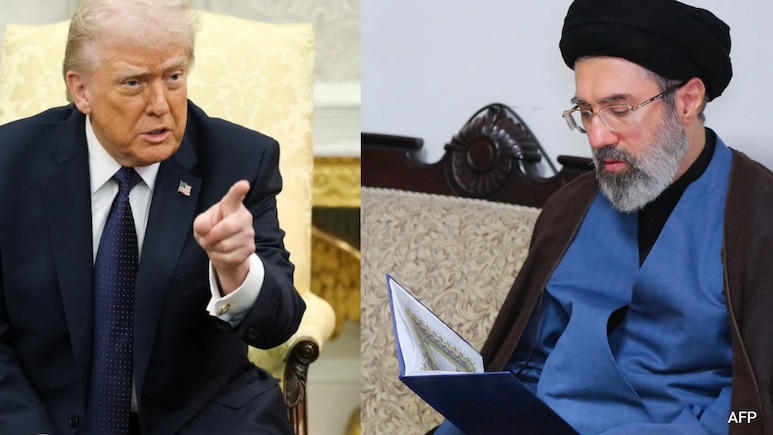
The US launched strikes on Iran early Tuesday, hours after President Donald Trump vowed to reinstate an American blockade of Iranian ports and charge ships for safe passage through the Strait of Hormuz. Iran responded with attacks on Middle East allies of the US.
The actions leave in tatters an interim deal meant to pause the fighting, reopen a waterway that is a crucial passage for the world's energy supplies, and give negotiators time to hammer out a permanent end to the war. Instead, fighting has once again engulfed the region and threatened the global economy. Unless a diplomatic solution is found quickly, it could intensify into all-out war.
The focus of the conflict now is the strait, through which a fifth of all traded crude oil and natural gas passed in peacetime. Iran effectively shut the passage during the war by attacking and threatening ships - a tactic that proved its greatest strategic advantage since it sent the price of oil, fertilizer and other goods soaring at a time when world leaders were already struggling to address a rising cost of living.
The interim deal was supposed to reopen the waterway, but Iran has attacked some ships moving through the strait.
The US has now threatened to reopen the strait by force - but experts say that will require a much bigger armada if not tens of thousands of American troops on Iranian soil. It's possible Trump will back down, as he has previously.
The US military's Central Command said it struck several areas in Iran, targeting "coastal defense systems, missile and drone sites and maritime capabilities." Iran acknowledged the strikes, but provided no immediate casualty or damage assessments.
"These strikes will continue imposing a heavy cost on Iranian forces and degrade their ability to attack innocent civilians and commercial shipping in the Strait of Hormuz," the US military said.
Moments after the military announced the new strikes, Trump called it "another major attack" and said the US was "putting the blockade back."
Iran responded with attacks targeting Bahrain, Jordan and three tankers that traveled through the strait.
Two of the ships were associated with the United Arab Emirates and were set ablaze for a time. The Emirati Defense Ministry said the attack on the tankers Mombasa and Al Bahiyah killed one mariner and wounded eight others. The Emirates threatened to retaliate.
Dutch shipping firm Stolt Tankers said that one of its ships came under attack around the time. The attack on the Stolt Magnesium off Oman in the Arabian Sea sparked a fire in the engine room, but the company said all the mariners aboard were safe.
Iran's paramilitary Revolutionary Guard claimed the attack on the Mombasa and Al Bahiyah, saying the vessels "ignored repeated warnings." Iran has targeted ships that use a route through the strait that passes near Oman outside of its territorial waters.
Hours after the US said it ended its campaign of strikes, the Iranian city of Bushehr on the Persian Gulf was hit in at least four locations, the state-run IRNA news agency reported. It again raised the possibility that Gulf Arab states were launching unclaimed attacks on Iran to try to deter it from targeting them.
Bahrain also came under renewed attack early Tuesday morning as Iran retaliated over the latest round of US airstrikes. Bahrain, home to the US Navy's 5th Fleet, sounded its missile alert sirens three times, urging people to seek shelter.
Jordan's military separately said it intercepted four missiles from Iran. Jordan hosts US forces and has come under attack by Tehran in recent days.
Exchanges of fire in recent days had already cast doubt on the interim peace deal - now almost halfway through the 60-day period in which negotiators were supposed to agree to a final accord, which also was meant to address Iran's disputed nuclear program and other issues.
But Trump's vow to impose a blockade further imperils it. Washington lifted a blockade it imposed in mid-April as part of the deal. The US military said it will resume it at midnight in Dubai.
"We are reinstating the THE IRANIAN BLOCKADE," Trump said on social media. "All other countries will have fair and open use of the Strait."
But the president said the US would impose a fee for protecting other ships: 20% of the value of cargo to help cover "any and all costs necessary to do the job of providing safety and security."
That's a change to longstanding US policy. The US Navy has fought for freedom of navigation on the seas since the Barbary Wars in the early 19th century and the War of 1812. It's also a departure from recent US promises that the strait would remain open to all without tolls - recently offered by US Secretary of State Marco Rubio on a trip to the region.
Under the interim deal, Iran agreed that passage through the strait would remain free of charge for 60 days - but the agreement left open what would happen after. Iran asserts it has the right to manage traffic through the strait and potentially charge fees.
The US has disputed that.
Any attempt by the US or Iran to charge fees would violate global norms on freedom of navigation and raise tensions, likely causing further economic disruption far beyond the region.
The price of Brent crude oil, the international standard, rose to a one-month high of over $87 in trading Tuesday, still well below the nearly $120 reached at the height of the war but threatening to make costs everywhere higher.
Lebanese and Israeli delegations were expected to meet in Rome on Tuesday to continue US-mediated negotiations. Shortly after the US and Israel launched the war on February 28, the Lebanese militant group Hezbollah joined the conflict in support of its ally, Iran, and began attacking Israel. Israel responded with a ground invasion of Lebanon.
Last month, Lebanon and Israel announced a "framework agreement" outlining the withdrawal of Israeli forces from southern Lebanon in exchange for the disarmament of Hezbollah. On the ground, however, the agreement has stalled.
Before the fighting around the strait intensified, Israel's war against Hezbollah in Lebanon repeatedly threatened to derail the interim deal. A truce now exists in Lebanon, but it remains unclear whether it will hold if the US and Iran return to full-scale war.
(Except for the headline, this story has not been edited by NDTV staff and is published from a syndicated feed.)
Track Latest News Live on NDTV.com and get news updates from India and around the world


