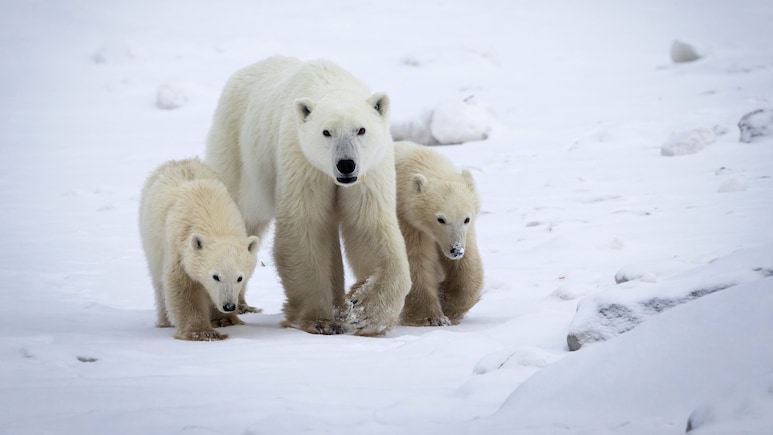
In the icy wilderness of Svalbard, the Norwegian archipelago in the Barents Sea, polar bears have been entangled in the politics of climate change. Their surprising resilience has drawn US President Donald Trump, billionaire Bill Gates, as well as climate activists into a clash of narratives regarding how humanity should deal with it.
What To Know?
In a post on X (formerly Twitter), Donald Trump wrote in 2014, "Just out — the POLAR ICE CAPS are at an all-time high, the POLAR BEAR population has never been stronger."
Back then, Trump's claims were disputed by climate specialists, since a part of it was not true, Newsweek reported.
Earlier this week, scientists who have been weighing polar bears in Svalbard for nearly three decades came out with a long-running study, which got published in Scientific Reports.
It highlights that the bears on an average are fatter and healthier compared to what they were a generation ago. This happened despite nearly 100 more ice-free days than the early 1990s.
Switching to opportunism, some of the bears are scavenging walrus carcasses, catching reindeer or even targeting bird colonies. Scientists have warned that this resilience might be temporary. But in some ways it does go on to support Trump's view of climate policy, the Newsweek reports.
Bill Gates' View
Last year, the Microsoft co-founder in a memo called for prioritising adaptation by focusing on reducing human suffering rather than chasing strict temperature targets.
However, environmentalist Bill McKibben warned that adaptation-first rhetoric risks downplaying tipping points and further weakens the urgency of emissions reduction. "Maybe we don't need billionaire opinions on everything," McKibben had said.
Campaign for Nature's Brian O'Donnell said the memo was "wrongheaded" for urging a pivot from temperature targets toward reducing human suffering through adaptation.
The point here was not not "about zoology, but politics," Newsweek report states, while highlighting that the "Svalbard bears are an inconvenient truth and Exhibit A for the adaptation-first view of the world."
According to Vox, the latest study from Svalbard suggests that "the loss of sea ice from warming is indeed linked to ailing polar bear populations" in other regions. It added that the findings are a "wrinkle of hope" and not a reversal of the broader threat.
Notably, the Trump administration later backed an Arctic aid plan, which earmarked $50 million for polar bear conservation in Greenland.
The recent Svalbard research suggests that polar bears are not a single story, but 20 distinct subpopulations that face different combinations of sea-ice loss and human pressure.
In Svalbard, the bears stay in one of the fastest-warming Arctic basins. Still, their average body condition rose between 1992 and 2019, even when the ice-free days increased.
Gates thought reframe how Americans weigh such contradictions. In his memo, he wrote that there is a "doomsday view" of the climate problem that is "wrong".
On the other hand, Trump's position remains skeptical of catastrophic narratives and insists that "life goes on".
Track Latest News Live on NDTV.com and get news updates from India and around the world


