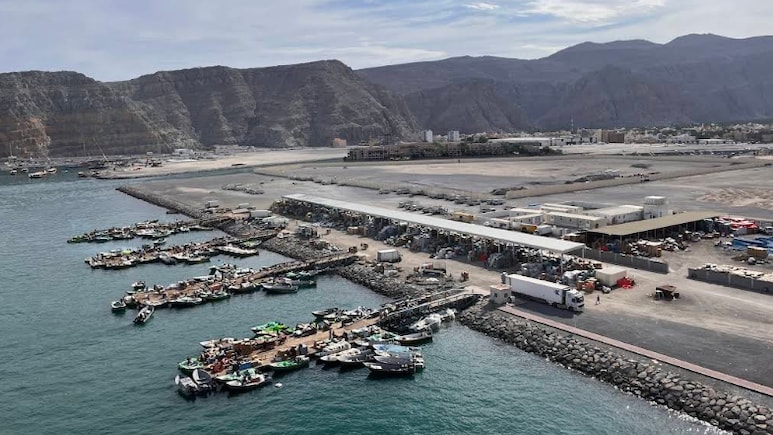
In the first major action to reopen the Strait of Hormuz, the US military has said it had hit Iranian missile sites near the critical waterway with some of the most powerful bombs in the American arsenal. The US Central Command announced that it had fired multiple 5,000-pound (approx. 2,268-kilogram) deep penetrator bombs on hardened Iranian missile sites along Iran's coastline near the Strait.
"US forces successfully employed multiple 5,000-pound deep penetrator munitions on hardened Iranian missile sites along Iran's coastline near the Strait of Hormuz," Central Command said in a statement on X.
Hours ago, U.S. forces successfully employed multiple 5,000-pound deep penetrator munitions on hardened Iranian missile sites along Iran's coastline near the Strait of Hormuz. The Iranian anti-ship cruise missiles in these sites posed a risk to international shipping in the… pic.twitter.com/hgCSFH0cqO
— U.S. Central Command (@CENTCOM) March 17, 2026
"The Iranian anti-ship cruise missiles in these sites posed a risk to international shipping in the strait."
The bombing raid comes after Iran closed off the Strait of Hormuz, through which one-fifth of the world's supply oil flows, in retaliation for the war on the country by the United States and Israel. The chokehold has massively disrupted maritime traffic and caused a global surge in energy prices.
US Allies Reject Trump's Call
The US move came after most US allies, including NATO, rejected President Donald Trump's calls to help secure the Strait of Hormuz to ease a blockade on the region's oil exports. Grousing that he has been unable to rally support behind his war of choice in Iran, Trump insisted he was conducting the war for the good of the world, even if the world doesn't appreciate his efforts.
He fumed that the US is not getting support "despite the fact that we helped" NATO "so much," and said that it was in the allies' interest to prevent Iran from securing a nuclear weapon.
Iran has insisted that it does not intend to develop nuclear weapons and maintains its nuclear programme for peaceful purposes like energy generation.
"You would have thought they would have said, 'We'd love to send a couple of minesweepers.' That's not a big deal," Trump said. "It doesn't cost very much money. But they didn't do that."
While he expressed resentment at traditional US allies, Trump insisted he's 'okay' with the solidifying dynamic of the conflict, which, for better or worse, will rest largely on his shoulders alone.
While Israeli Prime Minister Benjamin Netanyahu had been urging him on this path for months, Trump has increasingly made the case that the road to conflict was chosen by one man. It started based on what Trump described as a "feeling" about the threat posed by Iran, and he has said it will end when his gut says it's time.
About 5,000-Pound Deep Penetrator Bombs
The bombs called 'bunker buster' -- which, according to an Air Force Times report in 2022, cost an estimated $288,000 each -- are still less powerful than the 30,000-pound bombs dropped by the United States against Iranian nuclear sites last year.
These are used to take strike targets which are hardened or buried deep.
Track Latest News Live on NDTV.com and get news updates from India and around the world


