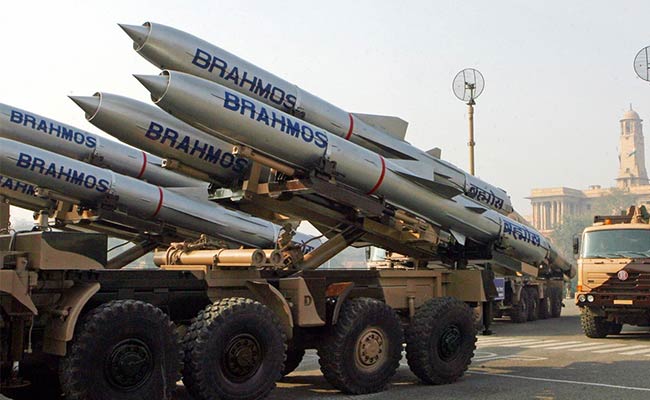
The government is currently in high-level talks with the United Arab Emirates (UAE) to sell some of its flagship defence systems, including the deadly BrahMos supersonic cruise missile and the Akashteer air defence system.
But this raises an interesting question: The UAE has traditionally bought its weapons from Western countries. So, why are they suddenly so interested in Indian defence technology?
A Safe Haven Under Threat
For decades, Dubai and the wider UAE have cultivated an image of absolute stability in a highly volatile region.
Dubai isn't just a city; it's a collection of world records. From the world's tallest building, the Burj Khalifa (which stands as tall as two-and-a-half Qutub Minars stacked together), to the world's most luxurious hotels and largest malls, it is a booming hub for global business and tourism.
People from all over the world go there seeking a safe, tax-free, and prosperous life.
While conflicts have reshaped much of the Middle East over the years, the UAE largely remained untouched. However, recent geopolitical tensions have seriously tested this image.
Between February and early June 2026, the Gulf states faced over 7,000 attacks from Iran, involving over 1,700 missiles and 5,300 drones. Among all the Gulf nations, the UAE took the hardest hit, facing 2,846 of these strikes.
The Heavy Cost of War
These attacks proved incredibly costly for the UAE, resulting in billions of dollars in infrastructure and tourism losses. The reality of the threat hit home when Dubai International Airport, one of the busiest in the world, was forced to completely shut down passenger flights for three days following a barrage of strikes in late February.
Unplanned closures at the Dubai International Airport cost roughly $1 million for every minute the airport is shut, causing a massive domino effect on global airlines, cargo, and local businesses.
The situation became so desperate that, according to multiple reports, the UAE allegedly agreed to unlock up to $20 billion in funds for Iran in exchange for a halt to the attacks.
While the UAE foreign ministry has categorically denied these reports, the fact remains that the UAE desperately needs to protect its cities and the crucial Strait of Hormuz, the main route from where its 50-55 per cent of energy exports takes place.
Why Look At Indian Weapons?
Historically, the UAE has relied heavily on the US (42 per cent), France (18 per cent), and South Korea (10 per cent) for its military hardware. In fact, the Arab states of the Gulf account for almost 20 per cent of all global arms imports.
But the recent "Operation Sindoor" changed how the world looks at Indian weaponry. The operation put the Indo-Russian BrahMos supersonic cruise missile firmly in the global spotlight, showcasing its devastating combat power and pinpoint accuracy.
Unlike standard subsonic missiles (like the American Tomahawk) that travel just below the speed of sound, the BrahMos is a beast.
It travels at a top speed of Mach 2.8 to 3.0, roughly one kilometre per second. Because of this extreme speed, it generates nine times more kinetic energy. While many militaries rely on massive, heavy bombs to pierce through bunkers, the BrahMos uses its sheer speed and impact force to completely obliterate targets.
Beyond sheer firepower, there is another major parameter drawing global attention: cost-effectiveness.
A Western subsonic weapon like the American Tomahawk costs roughly $3.6 million (around Rs 36 crore). In comparison, each BrahMos unit costs approximately Rs 25 to Rs 35 crore, depending on the variant. For a very similar price tag, buyers get a missile that is three times faster, significantly harder to intercept, and packs nine times the destructive energy.
During the strike on Pakistan's Nur Khan Airbase in Rawalpindi, two BrahMos-A missiles were launched from Indian Su-30MKI fighter jets safely within Indian airspace. Flying as low as 10 metres off the ground to perfectly dodge enemy radar, the missiles hit the underground Command and Control Node with an error margin of less than 5 metres. The strike severed vital communication lines, entirely blinding the base's air defence network.
As US warfare expert Colonel (Retd) John Spencer noted, the missile easily penetrated advanced Chinese and Pakistani air defences, sending a clear message that India can hit anywhere, anytime.
Akashteer: The Brains Of The Operation
While the BrahMos provides unmatched offensive firepower, the UAE also needs to tighten its defence. This is where India's Akashteer comes in.
Developed by Bharat Electronics Limited (BEL), Akashteer is an advanced air defence control and reporting system. Think of it as a smart brain for the battlefield. It automatically gathers information from various radars and sensors, allowing the military to detect and shoot down enemy drones or missiles much faster.
The UAE already uses advanced US-made systems like THAAD and Patriot, but integrating Akashteer will vastly improve the coordination between these existing systems, creating an impenetrable shield over the Gulf nation.
India's Rise As A Defence Exporter
Apart from the UAE, over 17 nations, including Indonesia, Malaysia, Saudi Arabia, and Brazil, have shown interest in the BrahMos.
While the Philippines made waves by purchasing the missile system back in 2022, India has officially sealed a major deal this year to supply the BrahMos to Vietnam.
This marks a massive shift for India. Once known primarily as the world's largest arms importer, India is now a global seller. Between the financial years 2014-15 and 2025-26, India's defence exports skyrocketed over 55-fold, growing from just Rs 686 crore to a record high of Rs 38,424 crore. Today, Indian defence products are shipped to over 80 countries, with total indigenous defence production reaching an impressive Rs 1.78 lakh crore.
Track Latest News Live on NDTV.com and get news updates from India and around the world


