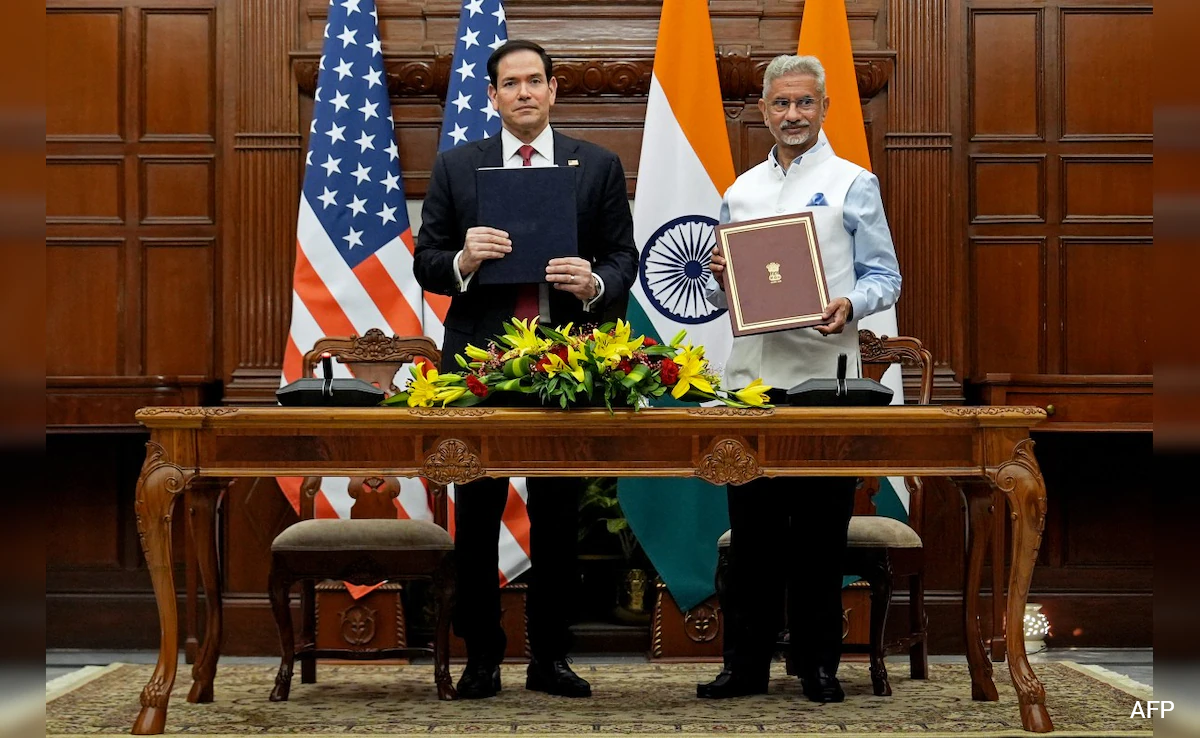
During US Secretary of State Marco Rubio's four-day India tour, New Delhi and Washington signed a framework agreement to secure supplies of critical minerals and rare earths, including their mining and processing. The move came amid growing concerns over China's export controls on rare earth elements and strategic metals vital for global technology supply chains.
"It is something very timely and critical," Foreign Minister S Jaishankar said after the framework was signed.
"This framework aims to deepen our cooperation across the entire critical minerals and rare earth supply chain, including mining, processing, recycling and related investment," he added.
In his remarks, Rubio highlighted the strategic partnership between the US and India and how important it is for the respective national interests of both countries.
"We are two countries that have strategic interests in ensuring reliable long-term access to critical minerals and supply chains that are important for our innovation economy," he said.
What Are Critical Minerals? Why Do They Matter?
Critical minerals are nonfuel minerals used in the manufacturing of high-end technology products, including batteries, drones, wiring, military hardware, and semiconductors, among others. The US describes them as "essential to the economic or national security of the United States" and having "a supply chain vulnerable to disruption".
According to the US Energy Act of 2020, critical minerals serve an essential function in the manufacturing of a product, the absence of which would have significant consequences for the economic or national security of the US.
The United States' 2025 list of critical minerals/elements includes Aluminium, Cobalt, Hafnium, Metallurgical Coal, Rhodium, Thulium, Antimony, Copper, Holmium, Neodymium, Rubidium, Tin, Arsenic, Dysprosium, Indium, Nickel, Ruthenium, Titanium, Barite, Erbium, Iridium, Niobium, Samarium, Tungsten, Beryllium, Europium, Lanthanum, Palladium, Scandium, Uranium, Bismuth, Fluorspar, Lead, Phosphate, Silicon, Vanadium, Boron, Gadolinium, Lithium, Platinum, Silver, Ytterbium, Cerium, Gallium, Lutetium, Potash, Tantalum, Yttrium, Cesium, Germanium, Magnesium, Praseodymium, Tellurium, Zinc, Chromium, Graphite, Manganese, Rhenium, Terbium, Zirconium.
For 12 of these critical minerals, the US depends entirely on imports. Washington also imports at least half its demand of 29 additional critical minerals.
The China Factor
Critical minerals include 17 rare earth elements -- processing costs for which are high, and mining them generates toxic waste. China has deposits of 12 of these. The Asian country accounts for around 70 per cent of global rare earth mining, making it a very dominant player in the global supply chain of the critical minerals. China is home to 60 per cent of these minerals and processes 90 per cent of the world's supply.
The United States and other nations depend heavily on China for these minerals. But in recent years, especially under President Donald Trump's administration, Washington has pushed to diversify its sourcing to reduce reliance on Beijing.
Although China was not directly named during the announcement of the deal, the move comes amid widening global concerns over excessive global dependence on Beijing for strategically important materials. Both Washington and New Delhi have been urgently seeking to develop alternative supply networks, and the new framework puts their bilateral partnership at the center of that effort.
Which Critical Minerals Does India Have?
According to the July 2023 report of the Ministry of Mines, India has reserves of 30 critical minerals. These minerals are Antimony, Beryllium, Bismuth, Cobalt, Copper, Gallium, Germanium, Graphite, Hafnium, Indium, Lithium, Molybdenum, Niobium, Nickel, PGE, Phosphorous, Potash, Rare Earth Elements, Rhenium, Silicon, Strontium, Tantalum, Tellurium, Tin, Titanium, Tungsten, Vanadium, Zirconium, Selenium and Cadmium.
India also possesses a substantial reserve of rare-earth minerals. According to an official release, India holds 13.15 million tonnes of monazite, containing an estimated 7.23 million tonnes of rare-earth oxides (REO). These deposits occur across Odisha, Kerala, Andhra Pradesh, Tamil Nadu, West Bengal, Gujarat, Maharashtra, and Jharkhand, primarily in coastal beach sands, teri/red sands, and inland alluvium.
In the 2026-2027 national budget, the government of India has also introduced a policy measure to create "rare earth corridors" in Odisha, Tamil Nadu, Kerala and Andhra Pradesh to mine and process rare earth minerals. These corridors will also be used for research and manufacturing high-performance rare earth magnets used in electric vehicles, wind turbines and other advanced technologies.
Inside India-US Pact
According to the Foreign Ministry, the framework aims to deepen India-US cooperation across the critical minerals and rare earths supply chain, including mining, processing, recycling and related investments.
"It seeks to strengthen resilient and diversified supply chains while promoting collaboration in financing and effective management of critical minerals and rare earths scrap," the ministry said in a statement.
The US embassy said that through this framework, Washington and New Delhi "will engage in international efforts to protect sensitive supply chains from coercive market practices and reduce our collective vulnerability to single-source monopolies".
Both nations did not expand on the specific terms of the framework deal or how the cooperation would take place.
The Quad Critical Minerals Initiative
During Rubio's India visit, the Quad grouping of India, the US, Japan and Australia also announced energy security and critical minerals frameworks to mitigate supply chain disruptions and unveiled major measures to upgrade maritime surveillance and port infrastructure across the Indo-Pacific.
As part of the critical minerals cooperation framework, the Quad pledged up to USD 20 billion in public and private capital to bolster supply chains while voicing "grave concerns" over "economic coercion", widely seen as a reference to China's export control regime in the sector.
"We reiterate our grave concerns over the use of economic coercion and non-market policies and practices, including arbitrary export restrictions, price manipulation and disruptions, particularly on critical minerals that impact global supply chains and critical industrial sectors," the joint statement said.
"We underscore the importance of diversified and reliable global supply chains and the need to avoid reliance on any one country," it said in an oblique reference to China.
Track Latest News Live on NDTV.com and get news updates from India and around the world


