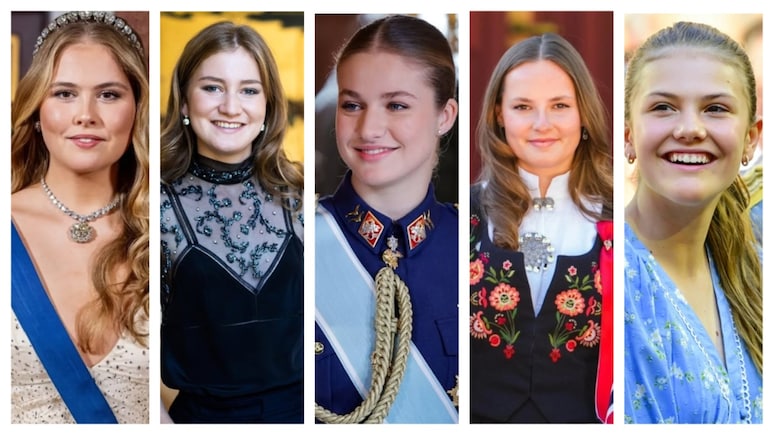
- Europe's royal families are embracing gender-neutral succession laws favoring birth order over gender
- Princesses Elisabeth, Catharina-Amalia, Leonor, and Ingrid Alexandra exemplify future female monarchs
- Absolute primogeniture began with Sweden in 1980 and is now common in Belgium, Netherlands, and Norway
Europe's royal landscape is undergoing a significant transformation, with a new wave of Gen-Z princesses poised to take the throne. Thanks to gender-neutral succession laws adopted over the past few decades, daughters now stand first in line to their thrones, not because there are no sons but because birth order, not gender, determines the heir. Princess Elisabeth of Belgium, Catharina-Amalia of the Netherlands, Leonor of Spain, and Ingrid Alexandra of Norway are just a few examples of the future queens leading the charge.
These Gen Z princesses are breaking barriers and paving the way for female leadership in European monarchies. They are expected to be more media-savvy, socially conscious, and connected to modern issues like climate change and equality.
The Era of Absolute Primogeniture
This shift is largely thanks to laws adopting absolute primogeniture. Notably, absolute primogeniture, or equal primogeniture, is a system of hereditary succession where the firstborn child inherits the throne or estate, regardless of their gender. It eliminates the preference for male heirs, ensuring that daughters have equal rights to succession as sons do. Sweden was the first country to adopt this system in 1980.
"Sweden was the first country in the world to adopt a gender-neutral order of succession, in 1980, when Princess Victoria bumped her younger brother down and she became crown princess retroactively," Swedish royals expert Roger Lundgren told AFP.
Belgium, the Netherlands, and Norway have also adopted absolute primogeniture. Spain still follows male-preference succession, but as of now, its future monarch is also a daughter.
Here are the young women poised to become Europe's next queens:
Princess Estelle of Sweden
Princess Estelle Silvia Ewa Mary, born on February 23, 2012, is the eldest child of Crown Princess Victoria and Prince Daniel. She's second in line to the Swedish throne, after her mother. Estelle's been in the public eye since birth and has already started her education at Campus Manilla in Stockholm.
Estelle represents Sweden's long-standing commitment to gender-equal succession, introduced in 1980, making it the first European monarchy to adopt the reform. Though still in school, Estelle is gradually appearing at official events, national celebrations, and family engagements.
Princess Leonor of Spain
Princess Leonor de Todos los Santos, born on October 31, 2005, is first in line to the Spanish throne. She is the elder daughter of King Felipe VI and Queen Letizia. Currently holding the title Princess of Asturias, Leonor has already stepped confidently into public life.
Leonor has been trained in military education and has started her three-year program at the General Military Academy in Zaragoza. She's fluent in Spanish, Catalan, and English and has studied French, Galician, and Basque.
In recent years, she has delivered speeches at national ceremonies and represented Spain abroad. Her poised public appearances have earned widespread praise, marking her as one of Europe's most visible future monarchs.
Princess Elisabeth of Belgium
Princess Elisabeth Theresia Maria Helena, born on October 25, 2001, is the heir apparent to the Belgian throne. She's the eldest child of King Philippe and Queen Mathilde. The country adopted gender-neutral succession in 1991, ensuring Elisabeth's position as the first future queen regnant in Belgian history.
Educated internationally, including studies in politics and history, Elisabeth reflects a globally minded monarchy. She's known for her support of LGBTQ+ rights and has been praised for her progressive views.
Princess Ingrid Alexandra of Norway
Princess Ingrid Alexandra, born in 2004, is the daughter of Crown Prince Haakon and Crown Princess Mette-Marit. She's second in line to the Norwegian throne, after her father. Norway introduced gender-equal succession in 1990.
Known for her athletic interests and relatively down-to-earth public persona, Alexandra represents a Norwegian royal family that values accessibility and simplicity. She's known for her interest in environmental issues and has participated in various public engagements.
Princess Catharina-Amalia of the Netherlands
Princess Catharina-Amalia, born in 2003, is the eldest child of King Willem-Alexander and Queen Maxima. The Netherlands embraced absolute primogeniture in 1983, making her position secure regardless of younger siblings.
Catharina-Amalia has been educated in state primary schools and has completed her degrees in politics, psychology, law, and business. She has already begun taking on official duties and recently addressed the Dutch parliament on her 18th birthday -- a constitutional milestone.
Track Latest News Live on NDTV.com and get news updates from India and around the world


