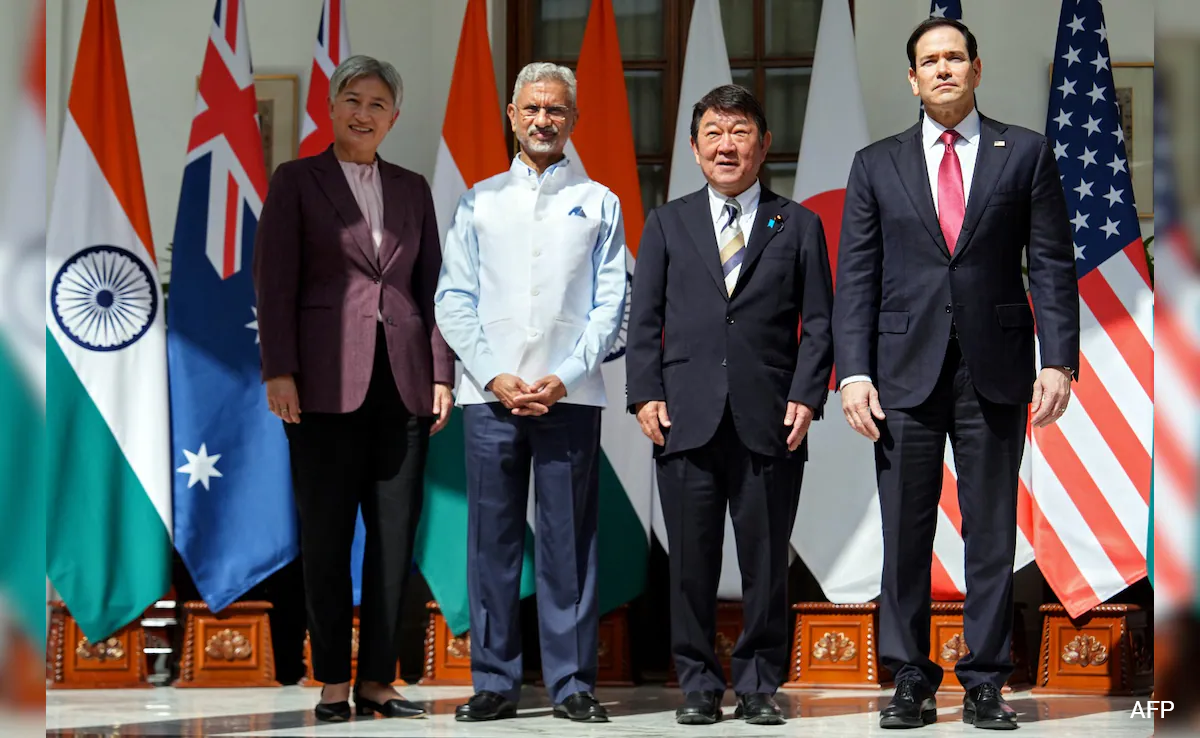
- Foreign ministers of the US, Japan, India, and Australia meet in New Delhi to revive Quad momentum
- Focus areas include maritime security, supply chains, critical technologies, and Indo-Pacific coordination
- Quad has been beset by tension after Trump last year raised tariffs on Indian goods
Foreign ministers from the US, Japan, India and Australia are meeting in New Delhi as the Quad grouping seeks to revive momentum after a high-profile clash between President Donald Trump and Prime Minister Narendra Modi.
The four nations are expected to focus on maritime security, supply chains, critical technologies and Indo-Pacific coordination, according to the Japanese Foreign Ministry. The ministers "will exchange views on advancing Quad cooperation" and discuss recent developments in the Indo-Pacific, India's Ministry of External Affairs said ahead of Tuesday's meeting.
The Quad, formed to counter China's growing influence in the Asia-Pacific region, has been beset by tension after Trump last year raised tariffs on Indian goods to 50% due to purchases of Russian oil, which was subsequently lowered after talks.
Secretary of State Marco Rubio has been visiting India over the past few days in a bid to bolster the relationship, which has suffered after Trump claimed to have brokered a ceasefire between India and Pakistan last year - an assertion PM Modi rejected.
The Quad grouping's leaders have not met since 2024, raising fears that it has lost some of its earlier traction. The meeting also follows talks last week between Trump and Chinese President Xi Jinping to stabilise ties, even as Beijing continues to pressure Taiwan and assert its territorial claims throughout the region.
"It is important for the US to sustain and maintain regional mechanisms and institutions to ensure that further strategic drift in the region is avoided," said Meera Shankar, India's former ambassador to the US.
The grouping gained prominence during Trump's first term as part of a tougher US stance on China, though his preference for bilateral deal-making raised questions about Washington's commitment to allies and defense partners in Asia. The meeting takes place as the US and Iran are inching close to a deal to extend ceasefire and reopen the Strait of Hormuz, a crucial waterway that is key to energy supplies to most Asian countries, particularly India.
India has traditionally adopted a non-aligned stance, positioning itself as a bridge between rival global powers. Following PM Modi's dust-up with Trump last year, he visited Beijing for a regional summit and held a friendly chat with both Xi and Russian leader Vladimir Putin.
Foreign Affairs Minister S Jaishankar said cooperation among the four Quad countries would continue to grow as the Indo-Pacific gains greater strategic importance.
"We are maritime powers and democratic powers," Jaishankar told reporters on Sunday.
For India, hosting the gathering underscores its effort to deepen strategic ties with Western partners through the Quad while maintaining its role in BRICS, which New Delhi will host in September at a summit likely to include Xi and Putin.
Ahead of the talks, Australian Foreign Minister Penny Wong described the Quad partnership as "vital" for maritime security, critical mineral supply chains, infrastructure development and disaster relief.
"One should not expect major announcements from the Quad meeting," said Pramit Pal Chaudhuri, South Asia practice head at Eurasia Group.
Track Latest News Live on NDTV.com and get news updates from India and around the world


