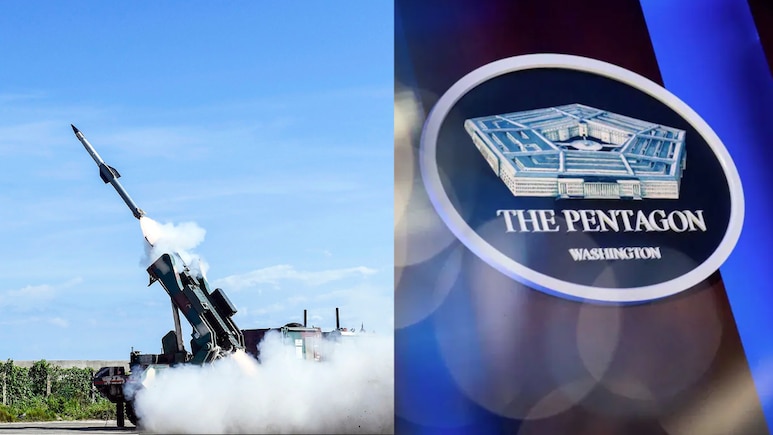
The Pentagon wants to shift roughly $1.5 billion in previously approved funding to buy critical missile interceptors from Lockheed Martin Corp. and RTX Corp., according to the acting comptroller - weapons that are in short supply as the war in Iran consumes vast amounts of the munitions.
The Pentagon's comptroller Jules Hurst didn't peg the Pentagon request to the ongoing conflict in Iran in a formal "reprogramming" note he sent to Congress on March 13.
But the move comes after the US, Israel and Gulf monarchies used up significant quantities of interceptors to knock down Iranian drones and missiles following the US and Israeli attacks that opened the ongoing war in the Middle East.
The volleys fueled worries about US and allied stockpiles, prompting President Donald Trump to write on social media that the US has a "virtually unlimited supply of these weapons" and can use them to wage war "forever."
A Pentagon official told Bloomberg News that the request is separate from munitions replenishment related to the war, and is part of the Defence Department's attempt to provide longer-term purchasing guidance that would allow defense contractors to confidently boost manufacturing capacity - particularly for interceptors for the in-demand Patriot and Terminal High Altitude Area Defence, or THAAD, systems.
The reprogramming request supports multi-year procurement agreements finalized earlier this year and reflect a new acquisition approach authorized in this year's defence policy and appropriations bills, according to the official, who asked not to be identified discussing private deliberations.
At a Senate Armed Services Committee hearing on Tuesday, the committee's top Democrat, Senator Jack Reed of Rhode Island highlighted growing concern about the furious munitions burn rate since the start of the war.
US forces "have fired thousands of Tomahawks, Precision Strike Missiles, and other long-range offensive weapons into Iran, while also using Patriot, THAAD, and Standard Missile interceptors at an alarming rate to defend against Iran's retaliatory attacks," he said.
Hurst, Defence Secretary Pete Hegseth's top adviser on budget issues, requested authority to shift $352 million from lesser priority programs to put on contract 85 additional Patriot-3 Missile Segment Enhancement missiles made by Lockheed Martin. He also requested shifting $771 million for 65 additional THAAD interceptors to buy this year.
The Pentagon is also requesting to shift $373 million to buy 23 additional Standard Missile-3 IB interceptors from RTX "to increase the Department's inventory of this critical munition," the Pentagon's March 13 document said.
It also requested to shift $6 million for an additional single Standard Missile-6, or SM-6 - an unusual request for just one missile that signals the weapon's importance. The SM-6 is the only US missile for anti-air warfare, anti-surface warfare and sea-based terminal ballistic missile defence.
Munitions expenditures for the ongoing conflict with Iran will likely be at least partially covered in a recent $200 billion supplemental budget request from the Pentagon, which is being reviewed by the White House's Office of Management and Budget.
The size of US munitions stockpiles is classified, but military experts have warned the US is using up some of its most expensive, advanced and hard-to-replace weapons, such as Tomahawk missiles and Patriot PAC-3 interceptors.
"Defeating Iran's military at the cost of massive munition expenditures will not help our deterrence efforts," said Tom Karako, an expert on missile defense at the Center for Strategic and International Studies in Washington. "Somewhere in Beijing, there's a guy with a hand counter clicking for each Tomahawk and PAC-3 we're expending."
The Pentagon's new budget request to Congress dovetailed with announcements on Wednesday of frameworks for long-term agreements with Lockheed Martin and BAE Systems to stabilize production of key seekers, or sensors, for Patriot and THAAD interceptors, which help spot a target and guide the warhead toward it.
The Defence Department said it had struck new agreements to quadruple the current production of seekers used to guide THAAD interceptors.
In a separate framework deal, Honeywell Aerospace Inc. will invest $500 million over several years "to surge production of critical components for America's munitions stockpile," including navigation systems and other products, the department announced.
Those framework deals - which are separate from formal contract awards - were negotiated by the Munitions Acceleration Council led by Deputy Defence Secretary Steve Feinberg, which aims to tackle supply chain constraints, increase production and reduce delivery times for key weapons systems.
"It's unusual to be announcing a framework of a deal before they actually have a deal," said Todd Harrison, an expert on defense budgeting at the American Enterprise Institute think tank. "It doesn't really matter much until a contract is signed and money is obligated."
(Except for the headline, this story has not been edited by NDTV staff and is published from a syndicated feed.)
Track Latest News Live on NDTV.com and get news updates from India and around the world


