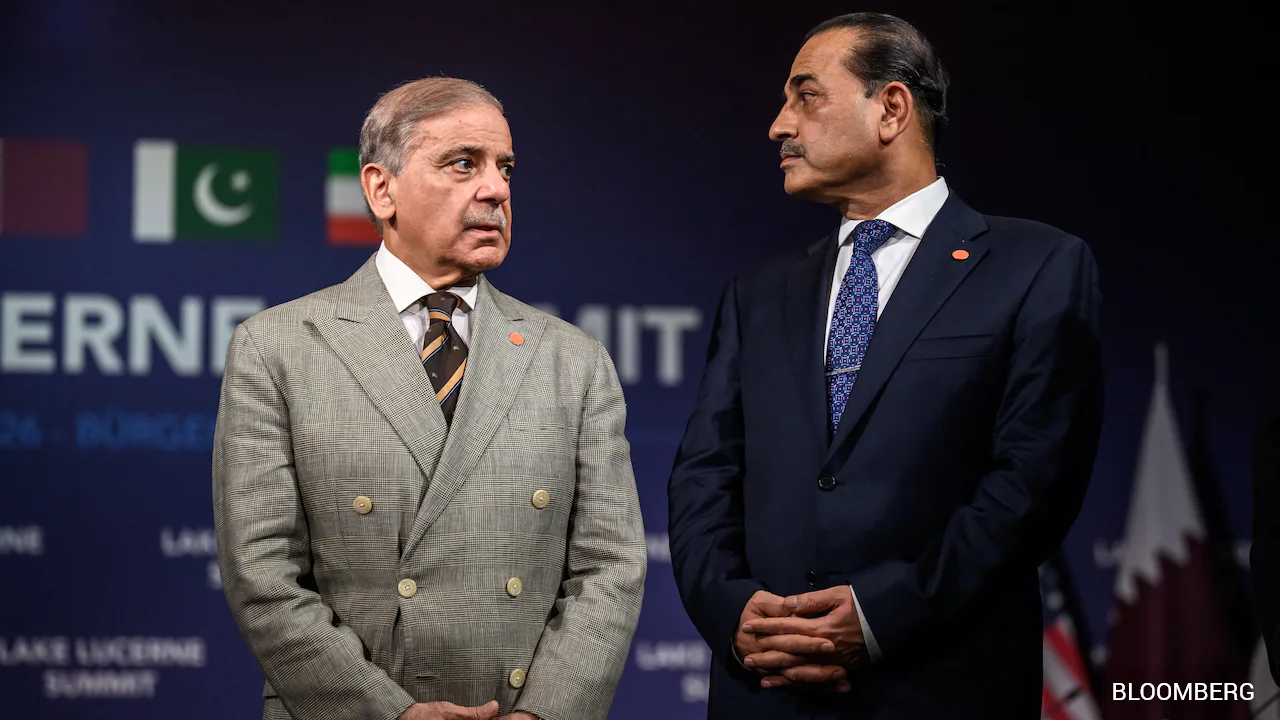
US Vice President JD Vance heaped praise on Pakistan's prime minister and army chief on Sunday as peace talks with Iran finally kicked off.
Standing alongside both men in the Swiss resort of Burgenstock, Vance called Prime Minister Shehbaz Sharif a "dear friend" of President Donald Trump and commended him for his negotiation skills. Turning to Field Marshal Asim Munir, Vance joked that he'd probably spoken to the army chief more than anyone else in the past three months.
Prime Minister Muhammad Shehbaz Sharif and COAS & CDF Field Marshal Syed Asim Munir meeting with Vice President of the United States J.D. Vance and the US delegation on the sidelines of US-Iran technical level talks as a follow -up of Islamabad MoU being held in Burgenstock,... pic.twitter.com/WVHdyIHGgP
— Prime Minister's Office (@PakPMO) June 21, 2026
"We wouldn't be here without his statesmanship," Vance said. He's a military leader "but I think he's shown himself to be a great diplomat."
Throughout the nearly four-month Iran war, Pakistan has come to be the unlikely mediator in the conflict, thrust into the spotlight by Trump. Sharif and Munir emerged as central figures in the drama, hosting peace talks and passing messages between Iranian and American negotiators via complex back channels.
It was Sharif who was first to announce in a social-media post last week that the US and Iran had struck a truce now known as the "Islamabad Memorandum of Understanding." The prime minister's signature is on the document alongside those of Trump and Iran's President Masoud Pezeshkian.
The spotlight gives Pakistan political heft on the global stage it hasn't had in decades. It also helped pull the country out from the shadow of India, and potentially smoothed the way for greater foreign and business investment at a time when its war-shattered economy badly needs it.
"Pakistan went from having virtually no influence in the Middle East in early 2025 to being a diplomatic and military player of consequence in the region today," said Christopher Clary, associate professor of political science at the University at Albany and a former Defense Department official.
Although it was a last-minute intervention from Qatar that helped to get the US-Iran interim deal over the line, that doesn't change "this relative upgrade in Pakistani stature," said Clary.
Pakistan expects its peace-making role to deliver in several ways. For one, it helps cement Islamabad's influence not just with Washington, but with the Gulf states it partnered with during the talks, and with its longtime partner Beijing, all of whom have publicly praised Pakistan's actions.
"A Pakistan that can pick up the phone and call its partners in parallel - whether Tehran, Washington, Riyadh or Beijing - is a Pakistan that has created strategic flexibility and the means to generate momentum around high-value international initiatives," said Jay Truesdale, former chief of staff at the US Embassy in Islamabad who is now CEO of the risk-intelligence firm TDI.
Pakistan's path to being a central actor in the US-Iran mediation began around a year ago, in the wake of its own four-day conflict with India. Trump rushed to claim credit for brokering the truce that ended that clash.
India vehemently denied US involvement, but Munir and Sharif embraced Trump's claim again and again - going as far as to back him for a Nobel Peace Prize. They were rewarded with a stream of praise from Trump and several meetings with the US president, including at the White House.
In the past year, the Trump administration has sought to steer new business investment to Pakistan in key areas including cryptocurrency, via a Trump-linked firm, as well as in critical minerals. The investments remain largely confined to memoranda of understanding rather than inked contracts, though their backers have touted their value in the billions of dollars.
The closer links are a reversal from even just a few years ago, when the country was all but isolated from Washington. Pakistan and the US were partners during the Cold War and the early War on Terror years, but relations soured after a US raid on a compound in Pakistan killed Osama bin Laden in 2011.
Ties remained strained for years, with President Joe Biden referring to Pakistan as "maybe one of the most dangerous nations in the world" over its nuclear program. The remarks were later walked back after a rebuke from Islamabad, but ties remained icy throughout his term.
Given Trump's unpredictable nature, Pakistan's biggest challenge will now be to turn its newfound diplomatic status into an enduring relationship with the US.
"Trust will ultimately be shaped by sustained engagement and consistency rather than symbolic gestures or short-term diplomatic successes," said Sheharyar Khan, executive director of the National Dialogue Forum, an Islamabad-based think tank. "Longer-term engagement is necessary."
Track Latest News Live on NDTV.com and get news updates from India and around the world


