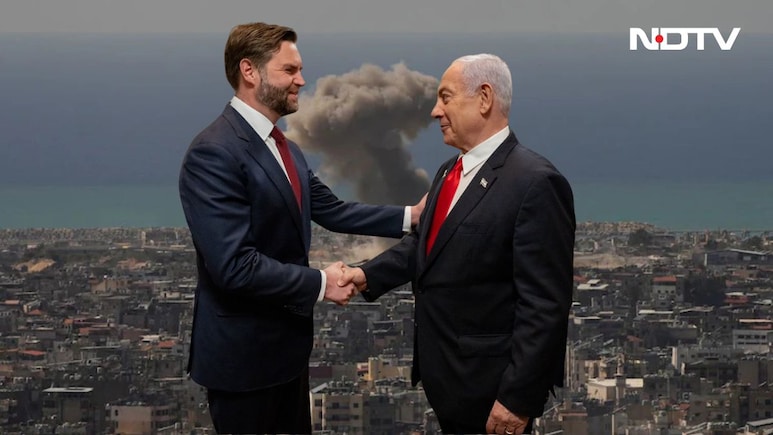
US Vice President JD Vance and Israeli Prime Minister Benjamin Netanyahu held a private meeting in Washington on Tuesday, using the face-to-face conversation to address months of growing disagreements over the Iran war, according to a report by Axios.
The meeting, held at Blair House, was described by officials from both sides as 'direct and frank'.
A senior Israeli official said Netanyahu raised concerns over Vance's recent criticism of Israel and the Israeli government, as well as the country's standing among Republicans.
"It was a frank and candid conversation," the Israeli official said.
A US official echoed that assessment, saying, "The conversation was direct."
How The Relationship Turned Sour
While the Trump administration has remained publicly supportive of Israel, Vance has emerged as one of the most sceptical voices on Netanyahu within Trump's inner circle since the war began.
As the conflict dragged on, Vance became increasingly critical of the Israeli prime minister, especially over the handling of the war and Washington's diplomatic efforts with Iran.
He also assumed a larger role in shaping US policy, particularly during negotiations with Tehran. Vance became one of the strongest defenders of the US-Iran memorandum of understanding, an agreement Netanyahu opposed privately, although he chose not to criticise it publicly, hoping it would eventually fail, according to the report.
Public Criticism, Private Resentment
Netanyahu was frustrated by Vance's public remarks, particularly after the vice president accused him of encouraging opposition to the Iran agreement and questioned his loyalty to US President Donald Trump. The Israeli leader also privately expressed dissatisfaction with Vance's growing influence over US war policy.
Vance, on the other hand, believed Netanyahu's allies in both Israeli and American pro-Netanyahu media were working to damage him politically.
Tuesday's meeting helped ease those tensions before they worsened further.
During a tense phone call in March, Vance challenged Netanyahu's assessment of the war, arguing that several of the prime minister's predictions, including the possibility of a popular uprising bringing down the Iranian regime, had proved overly optimistic.
Following the April 8 ceasefire, Vance became the administration's strongest advocate for diplomacy with Iran. He repeatedly argued that Trump's objective should be stopping Iran from acquiring a nuclear weapon without dragging the United States into another prolonged military conflict.
Sharp Warnings Over Israel's Criticism
As debate over the Iran agreement intensified, Vance publicly warned Israeli officials against attacking Washington's diplomatic efforts.
"If I was in the cabinet of the Israeli government, I might not be attacking the only powerful ally that I have anywhere left in the entire world," Vance said in June.
A month later, during an appearance on Joe Rogan's podcast, Vance accused some members of the Israeli government of trying to influence US policy in order to keep the conflict going instead of pursuing diplomacy.
On the same podcast, Vance also claimed Jeffrey Epstein had connections to "the highest levels of Israeli intelligence". He did not provide evidence for the allegation, prompting criticism that he was amplifying conspiracy theories involving Israel.
Track Latest News Live on NDTV.com and get news updates from India and around the world


