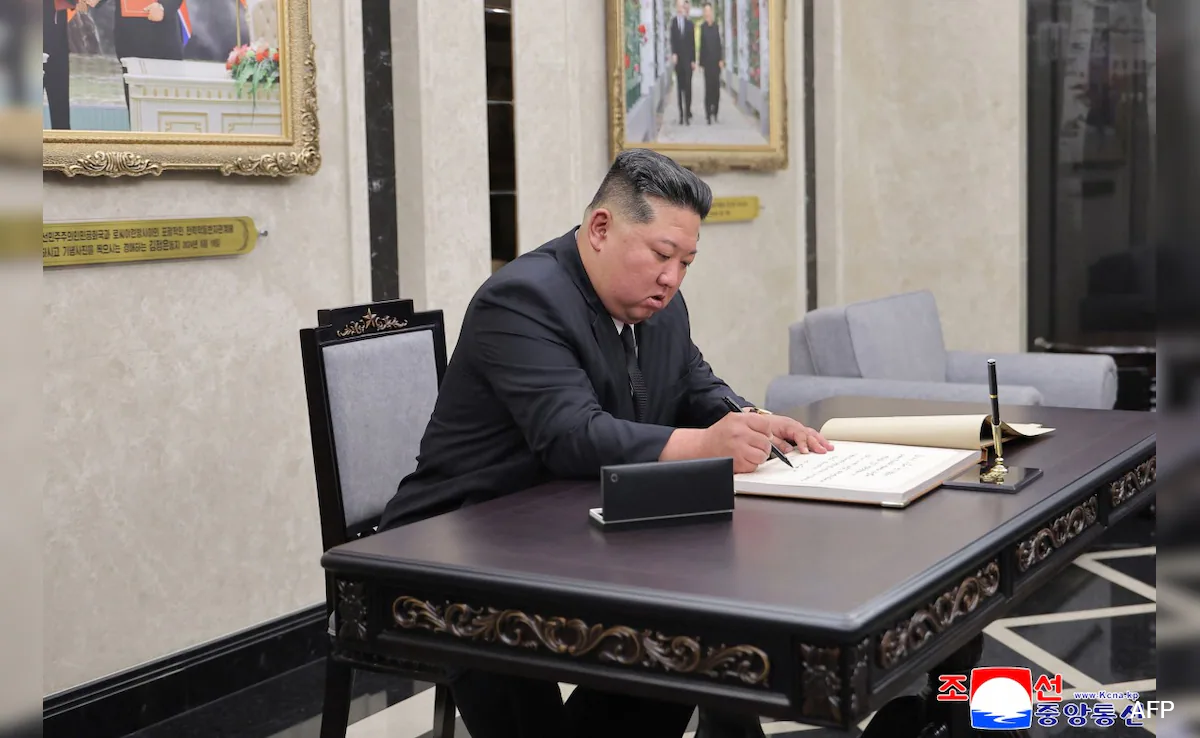
- North Korea's new law mandates automatic nuclear strike if Kim Jong Un is attacked
- The revision was adopted at North Korea's 15th Supreme People's Assembly in March
- Article 3 states nuclear strike launches if command system faces hostile attacks
North Korea has revised its nuclear policy to mandate an automatic nuclear strike if leader Kim Jong Un is assassinated or incapacitated in a foreign attack, according to a report.
The constitutional revision was adopted during the first session of North Korea's 15th Supreme People's Assembly held in Pyongyang on March 22, The Telegraph reported. Details of the changes were shared with senior South Korean officials on Thursday by the National Intelligence Service (NIS).
Under the revised law, Kim Jong Un remains in command of the country's nuclear arsenal. But new provisions now formally define how retaliation would take place if the leadership is targeted.
“If the command-and-control system over the state's nuclear forces is placed in danger by hostile forces' attacks ... a nuclear strike shall be launched automatically and immediately,” the updated Article 3 of North Korea's nuclear policy law states, as per report.
This comes months after top Iranian leaders, including Supreme Leader Ayatollah Khamenei and several senior advisers, were assassinated in the US-Israeli military operations.
Prof Andrei Lankov of Kookmin University said the policy may have existed earlier but has now been given greater importance through its inclusion in the constitution.
“Iran was the wake-up call. North Korea saw the remarkable efficiency of the US-Israeli decapitation attacks, which immediately eliminated the greater part of the Iranian leadership, and they must now be terrified,” he told the outlet.
Unlike Iran, North Korea remains one of the world's most isolated countries which makes similar intelligence operations difficult. Foreign diplomats, aid workers and business visitors entering the country are closely watched.
Reports suggested Israeli intelligence tracked Iranian leaders through hacked traffic cameras in Tehran. Experts say such tactics can't be replicated in Pyongyang due to North Korea's limited CCTV systems and highly restricted internet network.
Kim Jong-un is also known for strict security measures. He travels with heavy protection and usually avoids air travel. He prefers a heavy armoured train.
“Their biggest fear is going to be information from satellite technology. And, on balance, their concerns are not unfounded as taking out the leadership at the outset of any conflict is likely to be decisive,” Prof Lankov said.
The report citing North Korean state media also mentioned that Pyongyang plans to deploy a new long-range artillery system near the border with South Korea this year.
According to KCNA, Kim recently inspected production of a “new-type 155-millimetre self-propelled gun-howitzer” capable of striking targets over 37 miles away. Central Seoul lies roughly 35 miles from the border.
The report said the new artillery system would “provide significant changes and advantages to our military's ground operations.”
Track Latest News Live on NDTV.com and get news updates from India and around the world


