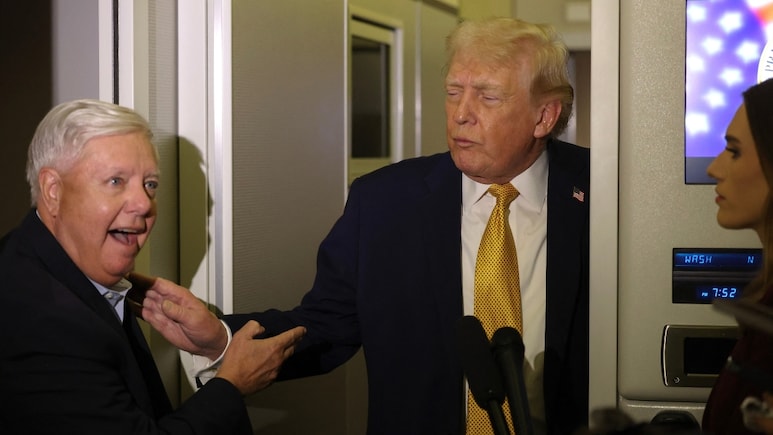
US Senator Lindsey Graham has died after a "brief and sudden illness" at the age of 71, his office said on Sunday. Graham, who was a close aide of US President Donald Trump and was eyeing his fifth term in the Senate, died on Saturday evening, his office said in a statement on X.
"Senator Graham's family appreciates prayers at this time and asks for privacy during this incredibly difficult period," it said.
Statement from the Office of U.S. Senator Lindsey Graham (R-South Carolina). pic.twitter.com/CQ5yVvqTH1
— Lindsey Graham (@LindseyGrahamSC) July 12, 2026
Trump paid tribute to Graham, saying he was "one of the greatest people and Senators I have ever known".
"He was always working, and was a true American Patriot. Lindsey will be greatly missed... So sad," he wrote on Truth Social.
Lindsay Graham's Senate Journey Began In 2002
A member of the Republican Party, Lindsay Graham was first elected to the United States Senate in 2002 and was re-elected in 2008, 2014, and 2020.
A resident of South Carolina, he was the first person in his state to get over one million votes in the 2008 general election.
The first member of his family to go to college, Graham earned his undergraduate and law degrees from the University of South Carolina. He then served about six years as a US Air Force lawyer.
When I was young, my sister and I lost both of our parents far too soon. I promised her that no matter what, we would get through it together.
— Lindsey Graham (@LindseyGrahamSC) May 4, 2026
It wasn't easy, but I kept that promise. Today, I'm stronger because of what we endured, and I'm ready to fight for your family just… pic.twitter.com/RQyUHxODsm
After leaving the active duty Air Force in 1989, he joined the South Carolina Air National Guard, where he served until his election to the US House of Representatives in 1994.
In 1994, Graham became the first Republican to represent South Carolina's Third Congressional District in Washington since 1877.
Lindsey Graham Was A Leading Hawk On Iran
In Donald Trump's second term, Lindsey Graham had become an influential member on foreign policy. He was also one of the Republicans who had advocated for the war against Iran.
He had been advocating for direct confrontation between Washington and Tehran for more than a decade and had rejected the Iran nuclear deal negotiated under President Barack Obama.

As a member of the US House in the 1990s, he backed policies aimed at isolating Iran and limiting its missile and nuclear programs.
He was also skeptical of the agreement signed between the US and Iran to end the war that began on February 28.
After the agreement was released last month, he issued a tepid statement of support, saying, “Whether or not the United States can reach an acceptable, verifiable deal with Iran regarding its nuclear program and other issues is yet to be determined, but I see little downside to trying.”
Last year, he had also criticised India, China and other nations involved in the Russian oil trade, claiming their purchases were fueling Moscow's war machine in Ukraine.
He had this week met Ukrainian President Volodymyr Zelensky in Kyiv and discussed Ukraine's urgent air defence needs and the Russian sanctions bill.
Good meeting with U.S. Senator Lindsey Graham @LindseyGrahamSC in Kyiv. This is already his 10th visit to our country, and we appreciate this support.
— Volodymyr Zelenskyy / Володимир Зеленський (@ZelenskyyUa) July 10, 2026
I'm grateful to Lindsey for recognizing our warriors. The stronger Ukraine is on the battlefield, the greater the chances that… pic.twitter.com/bgZjjgIqu1
He said China could play a decisive role in pressuring Russia towards peace talks, helping end its war in Ukraine.
"The road to ending this war, the road to peace, passes through Beijing more than it does (through) Washington, Kyiv, or Moscow. China has an oversized influence. I'd like them to use their influence for the good of the world," he had told reporters at Mykhailivska Square in the heart of Kyiv.
Track Latest News Live on NDTV.com and get news updates from India and around the world


