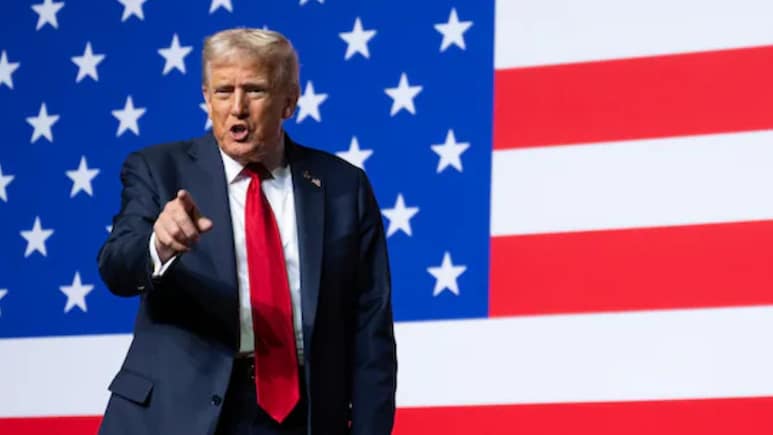
Iran has appointed hardline cleric Mojtaba Khamenei as the country's new supreme leader. He succeeds his father, Ayatollah Ali Khamenei, who was assassinated by Israel and the US last month. Before the leadership transition was finalised, US President Donald Trump claimed that Washington should have a say in who leads Iran next.
“They are wasting their time. Khamenei's son is a lightweight. I have to be involved in the appointment, like with Delcy [Rodriguez] in Venezuela,” Trump told Axios last week. He added that Mojtaba Khamenei was “unacceptable” and said the United States wanted a leader who would bring “harmony and peace” to Iran.
The US has historically meddled in the domestic affairs of other nations to serve its interests. It has backed leadership changes, fomented divisions, created crises and then installed preferred figures.
A 2016 study found that between 1946 and 2000, the US carried out at least 81 interventions in foreign elections.
Iran (1953)
In 1953, the CIA and Britain's intelligence service MI6 orchestrated a coup against Iran's democratically elected prime minister, Mohammad Mosaddegh, after he nationalised the country's oil industry.
The covert operation, known as Operation Ajax, led to Mosaddegh's removal and brought back the rule of Mohammad Reza Pahlavi, Iran's shah. With US backing, the shah consolidated power and ruled as an authoritarian monarch for the next 25 years until the Iranian Revolution of 1979.
Guatemala (1954)
In 1954, the CIA organised a coup against Guatemala's president, Jacobo Arbenz, whose land reform programme had targeted large estates, including land owned by the US-based United Fruit Company. The operation, known as Operation PBSUCCESS, involved arming and training rebel forces led by exiled officer Carlos Castillo Armas. Following a US-backed invasion, Arbenz resigned in June 1954, and Castillo Armas took power.
Congo (1960s)
After independence from Belgium in 1960, the newly formed Democratic Republic of the Congo descended into political turmoil known as the Congo Crisis.
The US opposed Prime Minister Patrice Lumumba, whom American officials feared might align with the Soviet Union. Lumumba was captured and assassinated in 1961.
In 1965, military officer Mobutu Sese Seko seized power in a coup with backing from Western powers including the US, and ruled the country, later renamed Zaire, for more than three decades.
Brazil (1964)
The US supported the 1964 military coup that removed Brazil's president, João Goulart, whose left-leaning policies alarmed Washington during the Cold War. The US government provided diplomatic support and prepared logistical assistance through Operation Brother Sam, which involved positioning naval forces near Brazil in case they were needed by the coup leaders. The takeover led to a military dictatorship that governed Brazil until 1985.
Chile (1973)
In Chile, socialist president Salvador Allende was democratically elected in 1970. The US government feared his policies would push the country toward the Soviet bloc. Through a covert CIA programme known as Project FUBELT, Washington funded opposition groups and sought to destabilise Allende's government.
On September 11, 1973, the Chilean military led by Augusto Pinochet seized power in a violent coup. Pinochet ruled Chile for nearly two decades, during which thousands of political opponents were imprisoned, tortured, or killed.
Venezuela (2026)
In January, the US kidnapped the sitting Venezuelan President, Nicolas Maduro. US forces launched a large-scale operation targeting military infrastructure across northern Venezuela. Maduro and his wife, Cilia Flores, were seized by US forces and flown to New York to face criminal charges, including narcoterrorism and drug-trafficking conspiracies.
Venezuela's top court declared his absence temporary and installed Vice President Delcy Rodríguez as acting president.
Cuba?
Cuba is “going to fall too,” Trump told Politico earlier, suggesting US pressure has weakened the Cuban government. He added, “For 50 years, that's icing on the cake,” and compared it to his administration's actions in Venezuela.
Track Latest News Live on NDTV.com and get news updates from India and around the world


