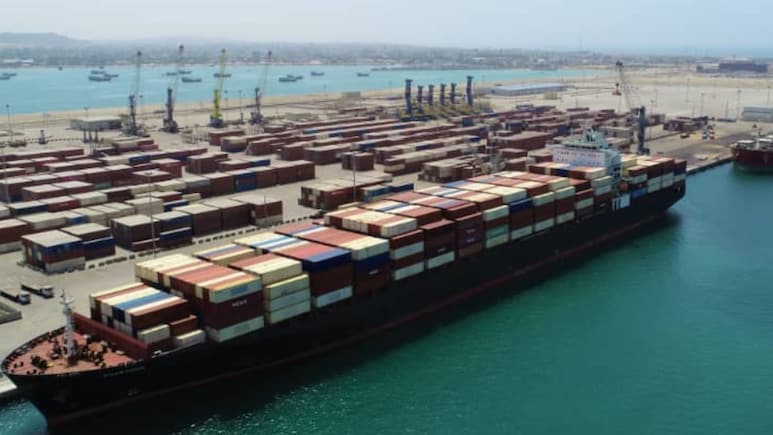
India is in touch with the United States to implement the short-term sanctions waiver to continue its work at Iran's strategically located Chabahar port, the Foreign Ministry said. The clarification came after reports claimed that India might exit the Chabahar port under pressure from the US amid the Trump administration's threat of a 25 per cent additional tariff on countries doing business with Tehran.
But, with Pakistan blocking India's overland routes to Afghanistan and Central Asia, the Iranian port has long been New Delhi's only viable western corridor. India is also a major partner in the development of the Chabahar port, located in the Sistan-Balochistan province on Iran's southern coast.
"As you are aware, on Oct 28, 2025, the US Department of Treasury had issued a letter outlining the guidance on the conditional sanctions waiver valid till 26 April 2026. We remain engaged with the US side in working out this arrangement," said Foreign Ministry spokesperson Randhir Jaiswal.
In September last year, the US imposed crippling economic sanctions on Iran but had granted India a six-month exemption from the punitive measures on the Chabahar port project. The waiver will come to an end on April 26.
Earlier sources said, after negotiations with the US, a six-month waiver till April 2026 was granted "as a special case" to wind up operations, but that pathway is "not an option as far as New Delhi is concerned".
"India continues to engage with the US side to work out modalities. Exiting the port is not an option, as it's of strategic importance to India. India is keen to show the US that New Delhi will work on the conditions of the sanctions. So the negotiations are a bit complicated," the sources added.
Why Chabahar Port Matters for India
A uniquely located port at Chabahar, which means 'four springs', is about 550 nautical miles from Kandla port in Gujarat, giving India easy access to Afghanistan, Central Asia, and Europe. The port is strategically positioned beyond the Strait of Hormuz, one of the three so-called choke points in the Indian Ocean, and is unaffected by any West Asian conflicts. The port is also part of the proposed multimodal route known as the International North-South Transport Corridor, a 7,200-km-long multi-mode transport project that will link the Indian Ocean and Persian Gulf to the Caspian Sea and to northern Europe via Saint Petersburg.
The project is being built for moving freight among India, Iran, Afghanistan, Armenia, Azerbaijan, Russia, Central Asia and Europe. It is estimated that shipments through the proposed corridor will take 15 days less than through the Suez Canal.
In 2024, India signed a 10-year contract with Iran under which the state-run India Ports Global Ltd (IPGL) committed investments of $370 million in Chabahar, underscoring the long-term nature of New Delhi's plans at the port.
India aims to grow its economy to $10 trillion by 2030 and $15 trillion by 2034. For that, it needs foreign investment and stable trade routes. Chabahar is crucial in this context, as it serves as the cornerstone of India's geopolitical and economic strategy, especially in the wake of emerging geostrategic challenges.
For India, Chabahar is far more than a commercial venture. The port is central to New Delhi's connectivity strategy, offering access to the Indian Ocean and providing a crucial route to Afghanistan and Central Asia while bypassing Pakistan. It has also been a key hub for India's humanitarian assistance to the people of Afghanistan.
India's Plan For Chabahar Port Project
Quoting people familiar with the development, news agency PTI reported that India is in the process of transferring approximately USD 120 million -- the amount it committed for the project -- as part of a move to end its direct exposure to the Chabahar port project.
A possibility to create a new entity to carry forward the development of the Chabahar port is also being considered, sources said.
This option will end the Indian government's exposure to the project, but in a way, it will ensure continuation of New Delhi's support, the people explained.
Trump's Iran Sanctions
The strategic logic is not new: in 2018, during the first Trump administration, the US had issued a rare exemption to allow Indian companies to continue developing Chabahar even as sweeping unilateral sanctions were imposed on Iran, whose main port at Bandar Abbas was then facing overcapacity.
But in September last year, the Trump administration announced its decision to revoke the 2018 sanctions waiver with regard to the Chabahar port in Iran. Weeks after announcing the revocation of the sanctions, Washington said it is extending the six-month waiver from the punitive measures to India.
As tensions between Washington and Tehran escalated again, President Donald Trump announced a fresh 25 per cent tariff on countries doing business with Iran. The new tariff is likely to have a "minimal impact" on India, government sources said on Tuesday.
India-Iran Trade
Jaiswal said the volume of two-way trade between India and Iran was USD 1.6 billion last year. Out of the total, India's exports were to the tune of USD 1.2 billion, and import was of USD 0.4 billion.
The current negotiations come at a time when New Delhi is also navigating a complex global sanctions landscape. The Foreign Minister had earlier said it was studying the implications of US sanctions on Russian oil companies.
Track Latest News Live on NDTV.com and get news updates from India and around the world


