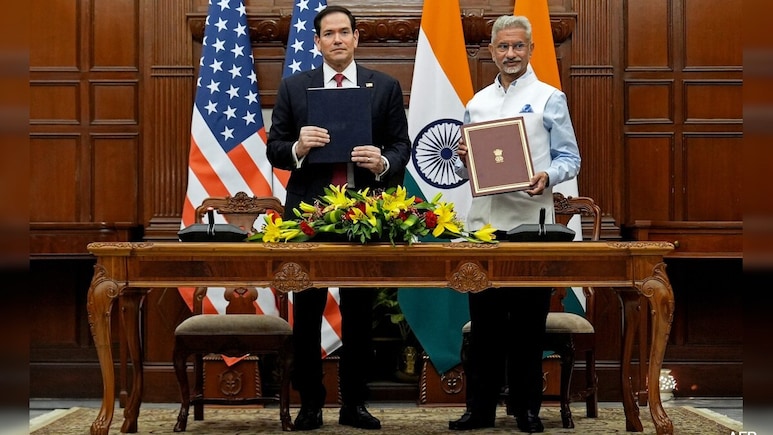
Before leaving India earlier this week, US Secretary of State Marco Rubio commented that New Delhi has "committed" to purchasing "$500 billion" worth of American goods over the next five years, focusing on energy, technology, and agriculture. The remarks have invited scrutiny not just from political circles in New Delhi but also from global media and trade experts, who questioned why exactly India may have agreed to what seems like a one-sided deal and whether it stands to gain enough in return.
A Financial Times report noted that it was "puzzling why India would make such a commitment at this stage." It stressed that the fundamentals have changed since the time both nations reached the deal, and "it would be foolish for India to sign an agreement that appears to take far more than it gives.
What Changed?
The $500 billion figure was first mentioned in February this year, when India and the US announced their interim trade deal. At the time, US President Donald Trump slashed tariffs on Indian goods to 18 per cent from 50 per cent, sparking relief in India. But the White House, at the time, said in exchange for the lowered tariffs, New Delhi "intends" to more than double its annual imports of US goods in information and communication technology, coal, and other products.
In its communication of the deal, the Ministry of Commerce buried this as the penultimate point and added aircraft and aircraft parts to the purchase list. When concerns were raised over the clause, Commerce Minister Piyush Goyal said the number was very conservative, given the rapid growth of the Indian economy. He said the demand from the aviation sector alone would account for $100 billion of trade over the next five years, implying that this was a reasonable exchange for lower tariffs.
But the circumstance changed later that month, when the US Supreme Court ruled that Trump's sweeping reciprocal and fentanyl-related tariffs were illegal. The Trump administration then invoked Section 122 of the Trade Act of 1974 to impose a uniform tariff of 10 per cent on all its trading partners, irrespective of whether they had a trade deal or not.
Experts' Concerns
"Under these circumstances, it is rather bizarre that India is not only continuing with the plan to buy $500 billion worth of American goods over the next five years but is also not challenging Rubio's assertion that this now constitutes a 'commitment'," the FT report said.
The article referred to Goyal's earlier statement and questioned why, irrespective of whether the Indian economy can absorb big-ticket items such as aircraft and aviation engines, the country would not keep its supplier options open to secure the best deal.
The concerns gain significance because India is already struggling to preserve its foreign reserves due to a weakening currency and rising oil prices due to the US-Iran war.
Trade experts and economists also questioned whether $100 billion a year in imports was feasible without an explicit policy push that steers companies towards American suppliers.
"The math doesn't add up," Madhavi Arora, an economist at Emkay Global, told news agency Reuters. She called the target "more aspirational than realistic".
The US is India's top export destination, accounting for nearly a fifth of New Delhi's entire shipments in the fiscal year 2024-25.
If exports hold near pre-tariff levels and imports rise sharply, India's largest bilateral surplus could shrink and widen its overall trade deficit. India had a total goods trade deficit of $283.5 billion in 2024-25.
"If it is a $100 billion every year, it would completely upset India's trade balance," independent trade expert Biswajit Dhar told Reuters earlier. He added that the current terms mainly preserve access to India's key market rather than boosting exports.
Possible Reason Behind India's Move
Rubio's visit to India came at a particularly sensitive time in India-US ties, when many Indians are also worried about Trump's recent outreach towards China and Pakistan.
Moreover, India has also been defensive about a trade deal with Washington since Trump came into office. It was believed that New Delhi would be among the first to secure one, but things soured, and India ended up among the most heavily tariffed countries.
According to a New York Times report, from the early 2000s until now, "Republican and Democratic administrations, including Mr Trump's first one, sought to forge closer ties with India, the world's most populous nation."
But Trump's tariff policy and his insistence on claiming a share in the India-Pakistan peace deal last year have upended more than two decades of Washington's policy toward Delhi.
The NYT noted that Trump's punitive tariffs on India came after Prime Minister Narendra Modi refused to nominate the American president for a Nobel Peace Prize.
But addressing a press conference in New Delhi, Rubio claimed, "The US-India relationship has not lost any momentum...the relationship continues to be strong."
When asked about Trump's tariffs on India, Rubio urged India not to take it personally. "There's a huge imbalance that's built up, and it needs to be addressed. This is not about India," he said.
Standing next to Rubio, Finance Minister S Jaishankar said, "The Trump administration has been very forthright in putting forward its foreign policy as 'America First.'"
He added, "We have a view of 'India First'."
Track Latest News Live on NDTV.com and get news updates from India and around the world


