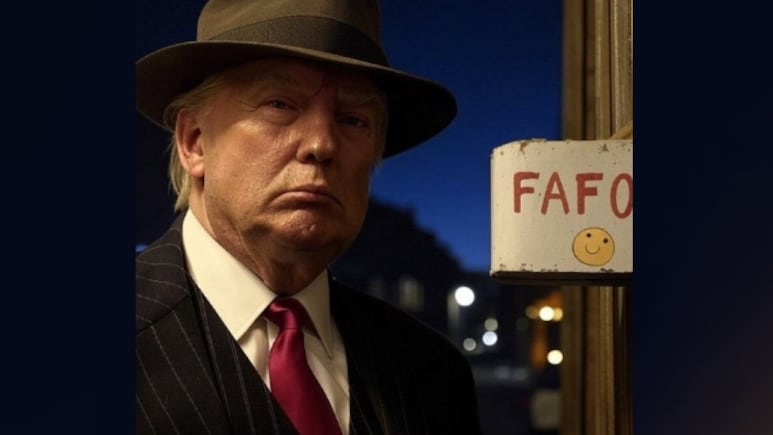
Scroll through the White House's social feeds for the past year, and you will notice Donald Trump as a gangster, a king, a Jedi, and a pope. Arrests rendered in animation. Deportations framed as punchlines.
On January 20, the US President completed a year of his second term in office. Over the past twelve months, memes have been how the administration communicated its policies, projected authority, and responded to critics.
It began in January 2025, when Trump shared an AI-generated image of himself dressed as a 1920s-style gangster, with the letters “FAFO”, short for “f**k around and find out”, behind him. It was one of the many AI portraits he would post during the year.
Within weeks, federal agencies adopted the same approach. On February 14, 2025, the White House account posted a Valentine's Day rhyme, “Violets are blue, come here illegally, and we will deport you.”
Happy Valentine's Day ♥️ pic.twitter.com/6d7qmo7gtz
— The White House (@WhiteHouse) February 14, 2025
In March, the White House used a popular AI trend mimicking the animation style of Studio Ghibli to show the arrest of an alleged undocumented immigrant.
In July, the White House posted a meme template of a train colliding with a bus to promote Trump's decision to ban tuition benefits for undocumented immigrants.
The following day, it posted an image mocking critics who questioned the administration's reliance on memes. "Nowhere in the Constitution does it say we can't post banger memes," the White House said.
Nowhere in the Constitution does it say we can't post banger memes ???? pic.twitter.com/nwH7NziRBD
— The White House (@WhiteHouse) July 11, 2025
“The entire ethos and aesthetic of this administration is spectacle and subversion of norms,” Dannagal Young, director of the Center for Political Communication at the University of Delaware, told CNN. “You don't do that through deliberation or argument, but through symbols.”
In August, the Department of Defence's Rapid Response account joined online discourse around the Sydney Sweeney-American Eagle jeans campaign with a meme referencing Defence Secretary Pete Hegseth's clothing. "Defence secretary has great jeans," the post read.
. @secdef has great jeans pic.twitter.com/XlqOydBEmO
— DOW Rapid Response (@DOWResponse) August 4, 2025
On October 1, during a government shutdown that left thousands of federal workers without paychecks, the White House Instagram account posted a graphic reading, “our social media manager was furloughed, but make America great again.”
That same day, Trump shared AI-modified videos of House Minority Leader Hakeem Jeffries and Senate Minority Leader Chuck Schumer from the Brady Press Briefing Room, a space traditionally associated with formal communication.
In November, The Washington Post reported that US forces had killed two survivors after attacking a civilian boat in the Caribbean, allegedly on orders from Pete Hegseth to “kill everybody.”
Days later, Hegseth posted a fake Franklin the Turtle book cover on X called “Franklin Targets Narco Terrorists,” showing the cartoon turtle firing a grenade launcher from a helicopter at boats below.
For your Christmas wish list… pic.twitter.com/pLXzg20SaL
— Pete Hegseth (@PeteHegseth) December 1, 2025
“This is not just about appealing to supporters,” said Audrey Halversen, a political communication scholar at the University of Michigan. “It's also about provoking opponents, which drives attention.”
The White House also used memes to promote Trump. In February, it posted a fake Time magazine cover with Trump wearing a crown to oppose congestion pricing in Manhattan. In May, Trump reposted AI-generated images of himself as pope and later as a Star Wars Jedi for ‘May the Fourth.'
The administration defended the strategy. “Through engaging posts and banger memes, we are successfully communicating the President's extremely popular agenda,” White House spokeswoman Abigail Jackson said in a statement to CNN.
Track Latest News Live on NDTV.com and get news updates from India and around the world


