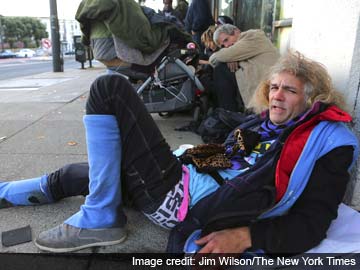
Bobbie Ingalls, who is homeless and transgender, rests in line for breakfast outside St. Francis Lutheran Church in San Francisco
San Francisco:
There were times - after he told his parents he was gay, for example, and his mother wept, and his father tried to hit him - when Fredy Bolvito curled up on a bench in Union Square here and cried because he had AIDS and no job and no place to stay, and he felt, he said, that "my life was over."
But there were also days when he sat on the bench in the square and sang "The Star-Spangled Banner," looking up at the flags atop the Westin St. Francis hotel and thinking, "That's breathtaking, that's my American dream." Or he mingled with tourists, giving them directions to the cable cars, or gazed through the windows at the shoppers in Macy's and was saddened by how rich and healthy they looked.
He scavenged for meals in garbage bins. He avoided the homeless shelters, where he had heard that gays were taunted or worse. His "angel," he said, was in the center of the square: the statue "Victory," a trident in one hand, a wreath in the other.
"I would look at it at night and think, 'Oh my God, that's my hope,'" he said.
San Francisco is often viewed as a mecca for gay people. But the warmth of this city's welcome can quickly vanish for those who are poor.
City leaders were startled this year when a survey revealed that 29 percent of the homeless population - about 2,100 of the 7,350 people counted - identified themselves as gay, lesbian, bisexual or transgender.
Bevan Dufty, the director of the city's homelessness initiatives, said he was surprised the percentage held true for all age groups, even adults and the elderly. "What was really staggering was to see that it didn't change as you got older," he said.
The survey found more disability among that community than among homeless heterosexuals and more who were homeless when they arrived in the city. Some were older gay men with AIDS who had been evicted from their apartments or people who had been cast out by their families in other states. Others, like Bolvito - a native of Guatemala, who graduated from college in Hayward, Calif., with a degree in political science and worked as a real estate agent - had good jobs that disappeared during the recession.
In response to the findings, Dufty and Kara Zordel, a coordinator of Homeless Connect, organized an event in October that offered medical and dental services and other assistance to gay, lesbian, bisexual and transgender people who are homeless. And, in August, the city's planning commission approved permits for a 24-bed shelter with a focus on that community. The shelter was expected to open in the coming months. Other cities have shown interest in San Francisco's efforts, Dufty said. Officials from Santa Clara and Phoenix attended the Homeless Connect event.
Brian Basinger, a co-founder of the AIDS Housing Alliance, said the harassment of gays is common in the city's shelters. People there "do not have a lot of status in society to begin with, and so the way they protect or generate status in these social environments is to step on the queers," Basinger said.
Gay and transgender residents have their shoes stolen, he said. They are robbed or beaten up in line.
Basinger, whose partner was homeless for 10 years and who came close to being homeless himself after he developed AIDS, brought in an architect to design the new shelter.
"I really wanted to think about how does the built environment impact people's experiences," he said. "So we spent a lot of time thinking that through and talking to people and designing something that was going to be functional and respect people's dignity."
But the shelter will house only a fraction of those who are without homes.
On a recent evening in the Castro District, Hjalmar Bjorkman, 48, sat cross-legged in a doorway. He has lived in the Bay Area for years.
But two months ago, he said, he lost his job at a bar, and his partner kicked him out. Since then, Bjorkman has been sleeping on the sidewalk behind an old theater, he said, or at the home of a friend, who charges him $20 a night for the couch.
"My ex-partner walks by me every day," Bjorkman said.
Bobby Spencer, 47, arrived in San Francisco from Atlanta in May, thinking he had a job as a nanny with a former co-worker at the company where he had worked as an executive assistant.
He was excited about the move. "Being gay in the South is still a lot different than being gay here, even in Atlanta," he said. "I moved here to be queer, that was part of the plan."
But the job did not work out, and Spencer, who had volunteered in soup kitchens in Atlanta, abruptly found himself without a place to stay. He bunked for a while with people he had met, but then ended up on the streets. He was hungry and sick. He is HIV-positive, and the virus in his body rose to a high level after his medication ran out, he said.
Spencer said the gay community he had expected to open its arms to him was less than gracious.
"It's a mad, cold world out there, even in your own family," he said. "My own community treats most queers that are homeless as pariahs; they want nothing to do with them."
He eventually found a clinic where he can get his medication, and he moved to a shelter, where he has settled in for now, taking cooking classes and living on food stamps.
But he said he is constantly alert for trouble. On his first night in the shelter, a man in the next bed became abusive.
"It makes you anxious, and it makes you nervous to have things like that going on and knowing that it's absolutely being directed at you," Spencer said.
Supervisor David Campos, who held hearings on the shelter problem, said that even though the homeless population may not have grown, homelessness has become more visible in San Francisco recently, perhaps because of an increase in evictions.
Basinger and other advocates held a "sleep in" in Dolores Park in October to protest a proposed ordinance that would close city parks, where many homeless people sleep, between midnight and 5 a.m. The proposal narrowly passed on Nov. 5.
For Bolvito, Union Square, with its tourists and constant stream of pedestrians, provided a sense of safety for the months he spent there. But he is happy now to have enough to eat and a roof over his head; in September he moved into a single-room-occupancy hotel that he found with the assistance of Basinger's housing alliance. Bolvito earned a cosmetology degree while he was homeless and is looking for a job. His mother, who lives in Oakland, helps him out when she can.
"I wanted people to know that poverty is not just the addicts," he said. "It's people who are educated like me. It is so many."
But there were also days when he sat on the bench in the square and sang "The Star-Spangled Banner," looking up at the flags atop the Westin St. Francis hotel and thinking, "That's breathtaking, that's my American dream." Or he mingled with tourists, giving them directions to the cable cars, or gazed through the windows at the shoppers in Macy's and was saddened by how rich and healthy they looked.
He scavenged for meals in garbage bins. He avoided the homeless shelters, where he had heard that gays were taunted or worse. His "angel," he said, was in the center of the square: the statue "Victory," a trident in one hand, a wreath in the other.
"I would look at it at night and think, 'Oh my God, that's my hope,'" he said.
San Francisco is often viewed as a mecca for gay people. But the warmth of this city's welcome can quickly vanish for those who are poor.
City leaders were startled this year when a survey revealed that 29 percent of the homeless population - about 2,100 of the 7,350 people counted - identified themselves as gay, lesbian, bisexual or transgender.
Bevan Dufty, the director of the city's homelessness initiatives, said he was surprised the percentage held true for all age groups, even adults and the elderly. "What was really staggering was to see that it didn't change as you got older," he said.
The survey found more disability among that community than among homeless heterosexuals and more who were homeless when they arrived in the city. Some were older gay men with AIDS who had been evicted from their apartments or people who had been cast out by their families in other states. Others, like Bolvito - a native of Guatemala, who graduated from college in Hayward, Calif., with a degree in political science and worked as a real estate agent - had good jobs that disappeared during the recession.
In response to the findings, Dufty and Kara Zordel, a coordinator of Homeless Connect, organized an event in October that offered medical and dental services and other assistance to gay, lesbian, bisexual and transgender people who are homeless. And, in August, the city's planning commission approved permits for a 24-bed shelter with a focus on that community. The shelter was expected to open in the coming months. Other cities have shown interest in San Francisco's efforts, Dufty said. Officials from Santa Clara and Phoenix attended the Homeless Connect event.
Brian Basinger, a co-founder of the AIDS Housing Alliance, said the harassment of gays is common in the city's shelters. People there "do not have a lot of status in society to begin with, and so the way they protect or generate status in these social environments is to step on the queers," Basinger said.
Gay and transgender residents have their shoes stolen, he said. They are robbed or beaten up in line.
Basinger, whose partner was homeless for 10 years and who came close to being homeless himself after he developed AIDS, brought in an architect to design the new shelter.
"I really wanted to think about how does the built environment impact people's experiences," he said. "So we spent a lot of time thinking that through and talking to people and designing something that was going to be functional and respect people's dignity."
But the shelter will house only a fraction of those who are without homes.
On a recent evening in the Castro District, Hjalmar Bjorkman, 48, sat cross-legged in a doorway. He has lived in the Bay Area for years.
But two months ago, he said, he lost his job at a bar, and his partner kicked him out. Since then, Bjorkman has been sleeping on the sidewalk behind an old theater, he said, or at the home of a friend, who charges him $20 a night for the couch.
"My ex-partner walks by me every day," Bjorkman said.
Bobby Spencer, 47, arrived in San Francisco from Atlanta in May, thinking he had a job as a nanny with a former co-worker at the company where he had worked as an executive assistant.
He was excited about the move. "Being gay in the South is still a lot different than being gay here, even in Atlanta," he said. "I moved here to be queer, that was part of the plan."
But the job did not work out, and Spencer, who had volunteered in soup kitchens in Atlanta, abruptly found himself without a place to stay. He bunked for a while with people he had met, but then ended up on the streets. He was hungry and sick. He is HIV-positive, and the virus in his body rose to a high level after his medication ran out, he said.
Spencer said the gay community he had expected to open its arms to him was less than gracious.
"It's a mad, cold world out there, even in your own family," he said. "My own community treats most queers that are homeless as pariahs; they want nothing to do with them."
He eventually found a clinic where he can get his medication, and he moved to a shelter, where he has settled in for now, taking cooking classes and living on food stamps.
But he said he is constantly alert for trouble. On his first night in the shelter, a man in the next bed became abusive.
"It makes you anxious, and it makes you nervous to have things like that going on and knowing that it's absolutely being directed at you," Spencer said.
Supervisor David Campos, who held hearings on the shelter problem, said that even though the homeless population may not have grown, homelessness has become more visible in San Francisco recently, perhaps because of an increase in evictions.
Basinger and other advocates held a "sleep in" in Dolores Park in October to protest a proposed ordinance that would close city parks, where many homeless people sleep, between midnight and 5 a.m. The proposal narrowly passed on Nov. 5.
For Bolvito, Union Square, with its tourists and constant stream of pedestrians, provided a sense of safety for the months he spent there. But he is happy now to have enough to eat and a roof over his head; in September he moved into a single-room-occupancy hotel that he found with the assistance of Basinger's housing alliance. Bolvito earned a cosmetology degree while he was homeless and is looking for a job. His mother, who lives in Oakland, helps him out when she can.
"I wanted people to know that poverty is not just the addicts," he said. "It's people who are educated like me. It is so many."
© 2013, The New York Times News Service
Track Latest News Live on NDTV.com and get news updates from India and around the world


