
West Asia's turmoil is triggering global anxiety across commodities, and it's not just oil, but fertilisers, chemicals, feedstocks, and energy-intensive materials.
At the heart of this ripple stands the Strait of Hormuz, the narrow maritime chokepoint through which a significant share of global hydrocarbons and petrochemical feedstocks transit.
When it destabilises, the world feels it.
Why Hormuz Matters
A major share of Middle Eastern crude, LNG and petrochemical cargoes routes through the Strait. The global seaborne commodity data by Kpler shows that 33% of total fertiliser exports move via the waterway, followed by 32% of methanol and 31% of crude and condensate.
Other commodities that also pass through the strategic route are natural gas liquids (23%), LNG (18.6%), and a steady share of refined fuels, covering both clean petroleum products (12.6%) and dirty petroleum products (13%).
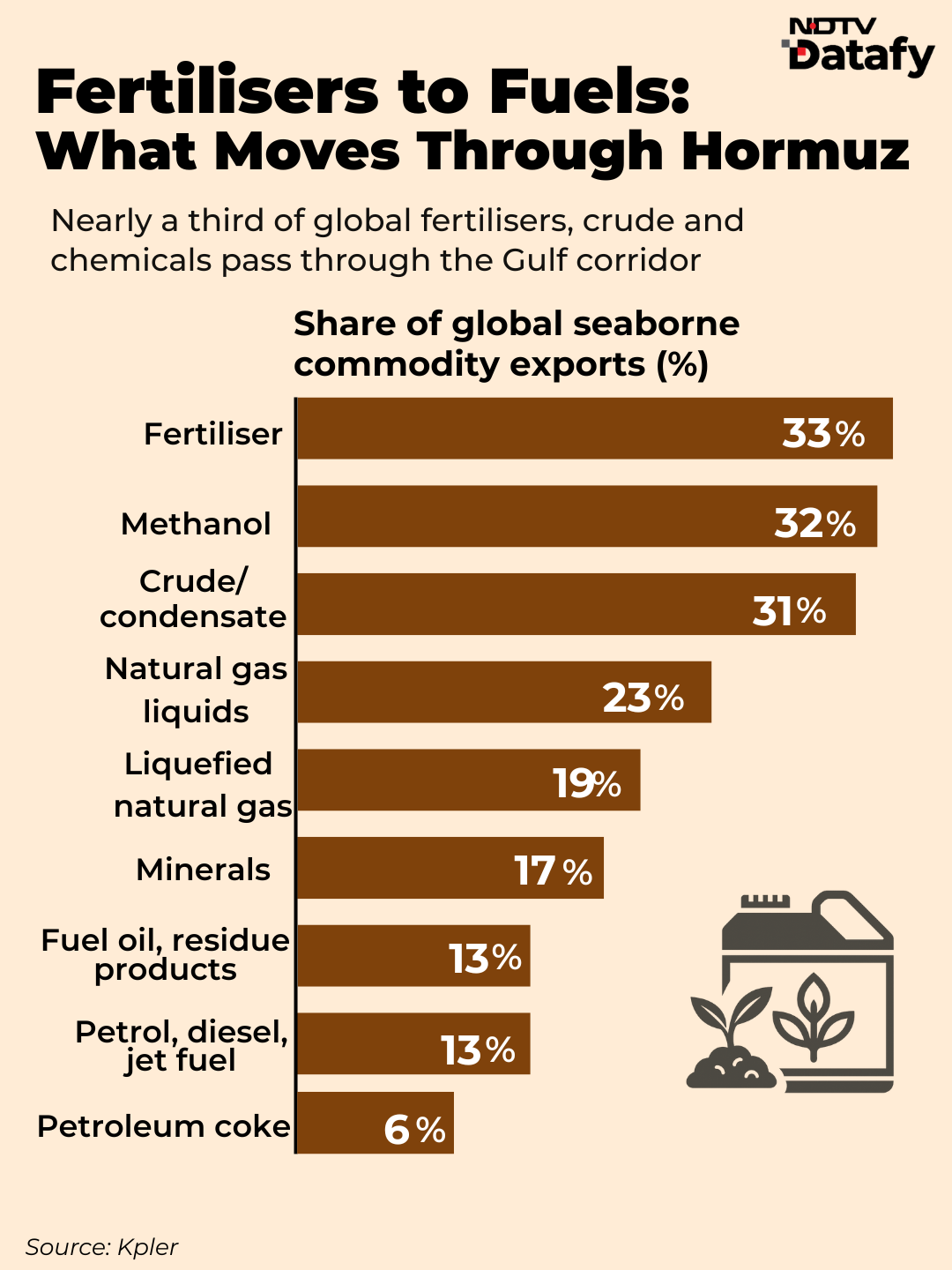
Beyond energy and chemicals, the strait also sees global transit of minerals (17.2%), petcoke (6.1%), and smaller amounts of agricultural-related cargo.
When the region destabilises, it isn't only the oil markets that seize up; fertiliser for farms, feedstocks for chemical industries, energy for power grids, and key industrial materials all feel the impact.
Will India See Fertiliser Stress?
The Fertiliser Association of India (FAI) says urea and phosphatic fertiliser supplies remain adequate for the upcoming Kharif season. The association notes that, although geopolitical tensions in West Asia raise concerns about disruptions to global fertiliser trade, India's current inventories and supply arrangements are sufficient to meet demand.
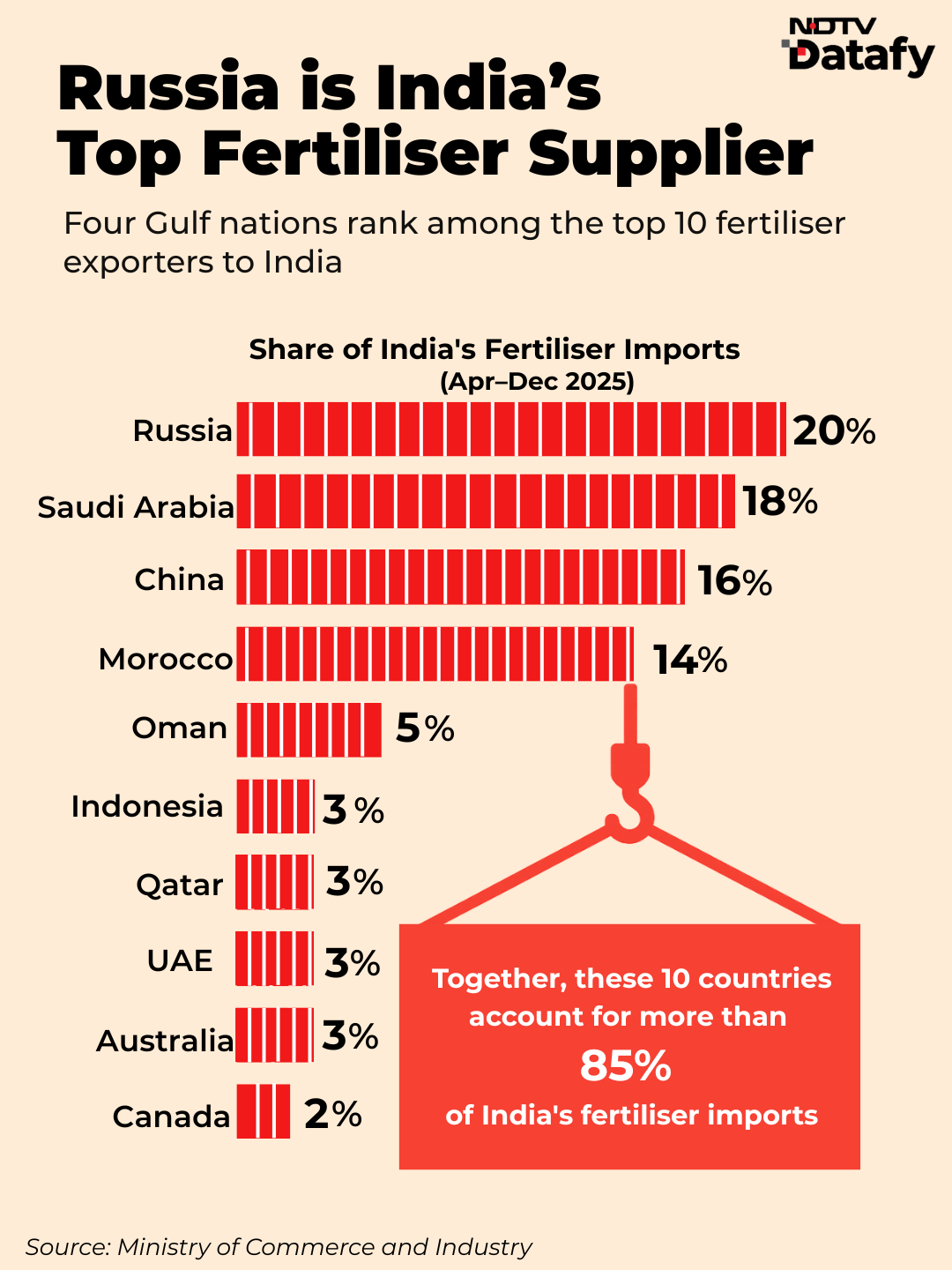
India's fertiliser import data for April to December 2025 shows that the top 10 supplying countries account for 87% of total arrivals.
Russia provides 20%, Saudi Arabia 18%, China 16%, and Morocco 14%. Oman contributes 5%, while Indonesia, Qatar, the UAE, and Australia each supply 3%, followed by Canada at 2%. These ten countries together form the core of India's fertiliser sourcing.
Which Ports Matter Most?
Mundra and Kandla (Gujarat) handle the largest fertiliser volumes, with about $2.7 billion worth of fertilisers arriving at Mundra, followed by $2.5billion for Kandla benefiting from deep berths and bulk-cargo infrastructure.

Visakhapatnam, Kakinada, Krishnapatnam, Paradip, Gangavaram are key eastern gateways.
Track Latest News Live on NDTV.com and get news updates from India and around the world


