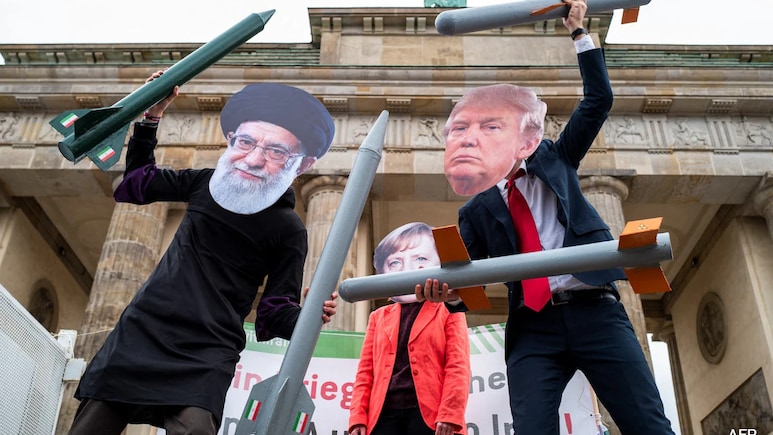
Emboldened by the seizure of the erstwhile Venezuelan leader Nicolas Maduro, US President Donald Trump has been threatening military action against Iran as the Islamic Republic's clerical rulers face the biggest wave of dissent in years. The repeated warning has revived a familiar question in Washington -- what exactly would US intervention in Iran look like, especially considering the fact that past American actions in the region have hardly been successful.
Despite the President's bellicose rhetoric, the Pentagon has not mobilised any aircraft carriers towards the region. America's Gulf allies, still reeling from Iranian air strikes during last year's 12-day war with Israel, have also shown little to no appetite for hosting a US attack on Iran. Experts also believe that any US military attack would likely help Supreme Leader Ayatollah Ali Khamenei and the Iranian government to mobilise domestic support, delegitimise internal protests, and strengthen regional alliances against an external threat.
The Logistical Problem
Trump has talked about military intervention against the Iranian regime, but no military prepositioning has taken place in the region. In fact, there has been a drawdown in the last few months, British publication The Guardian reported, reducing military options further.
The US has had no aircraft carriers deployed in the Middle East since October, after the USS Gerald R Ford was sent to the Caribbean in the summer and the USS Nimitz was moved to a port on the US West Coast in the autumn. This means that any air or missile strikes on Iranian targets, and perhaps at Supreme Leader Ayatollah Ali Khamenei, would probably have to come from or involve US and allied airbases in the Middle East.
In such a case, the US would have to ask permission to use bases in countries such as Qatar, Bahrain, Iraq, the UAE, Oman and Saudi Arabia (perhaps even the UK's Akrotiri base in Cyprus) - and protect them and their host countries against retaliation.
The second alternative could be a strike similar to June's long-range B-2 bombing mission against the underground Iranian nuclear site of Fordow. But such an attack against an urban, highly populated site could turn out to be dangerous overkill.
Even if the US does not use its assets in the Middle East, Iranian leaders have threatened to strike its bases and ships if the country is attacked.
Although Iran's military capabilities were badly degraded in the 12-day war with Israel, Tehran has reportedly retained a limited missile capability. Iran's key launch sites remain buried in the mountains, with Tehran rebuilding them, and as per a report by The Guardian, Iran has around 2,000 heavy ballistic missiles, capable, if launched in numbers, of evading US and Israeli air defences.
To Bomb Or Not To Bomb?
The other problem that the US is facing is identifying the targets for the strike. Though it won't be difficult to identify military and civilian sites used by the Iranian regime, the protests and the regime's bloody crackdown on demonstrators are taking place across the country.
Even if the sites are identified, ensuring the accuracy of the target is always a challenge, and civilian casualties in urban locations would be an evident risk.
Iran Can Turn Tides
Further, experts believe that the Iranian regime could easily use any US attacks as a rallying point for what is left of its support, given the long history of US meddling dating back to the 1953 US coup. The Khamenei regime might be unpopular among the ordinary people at the moment, but the government does not appear to be weak, having already survived Israel's sustained attack in June.
"There is clearly a cohesive government and military and security service in Iran," Roxane Farmanfarmaian, a senior associate at the Royal United Services Institute think tank, told The Guardian.
"The government is showing it doesn't have any red lines: it is going to secure its borders and streets, and the extraordinary number of body bags reveals its determination to do so," she added.
The US might also consider a direct attack on Khamenei, but killing the leader of another country would raise a host of legal concerns and invite a sustained military response. Also, it's unlikely that this would lead to regime change, as the Iranian leader had also lined up three senior clerics on a shortlist to replace him.
Track Latest News Live on NDTV.com and get news updates from India and around the world


