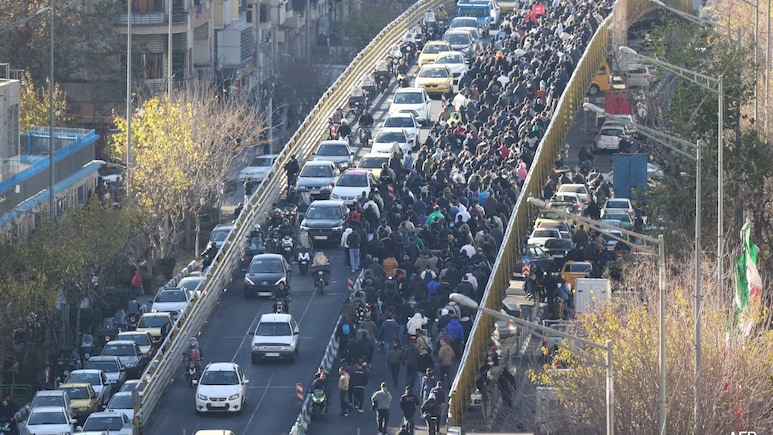
At least seven people have been reportedly killed in Iran as protesters and security forces clashed in several cities during demonstrations in the Islamic Republic's rural provinces over the ailing economy and rising cost of living. The deaths are believed to mark the start of a heavier-handed response by Iran's theocracy over the demonstrations against Iran's Islamic regime led by the Supreme Leader Ayatollah Ali Khamenei, which have slowed in the capital, Tehran, but expanded elsewhere over the days.
In Tehran, Iranian authorities have also arrested 30 suspects accused of public order offences, as protests against high prices raged across the nation. "After a coordinated operation by the security and intelligence services, 30 people accused of disturbing public order in the Malard district of western Tehran were identified and arrested last night," news agency Tasnim reported.
Several videos emerged from Iran, where protestors were heard shouting slogans like "Until the mullah is shrouded, this homeland will not be free" and "Mullahs must leave Iran".
The latest demonstrations are the biggest in Iran since 2022, when the death of 22-year-old Mahsa Amini in police custody triggered nationwide protests. However, the cost-of-living demonstrations have yet to be countrywide and have not been as intense as those surrounding the death of Amini, who was detained over not wearing her hijab, or headscarf, to the liking of authorities.
What's Happening In Iran
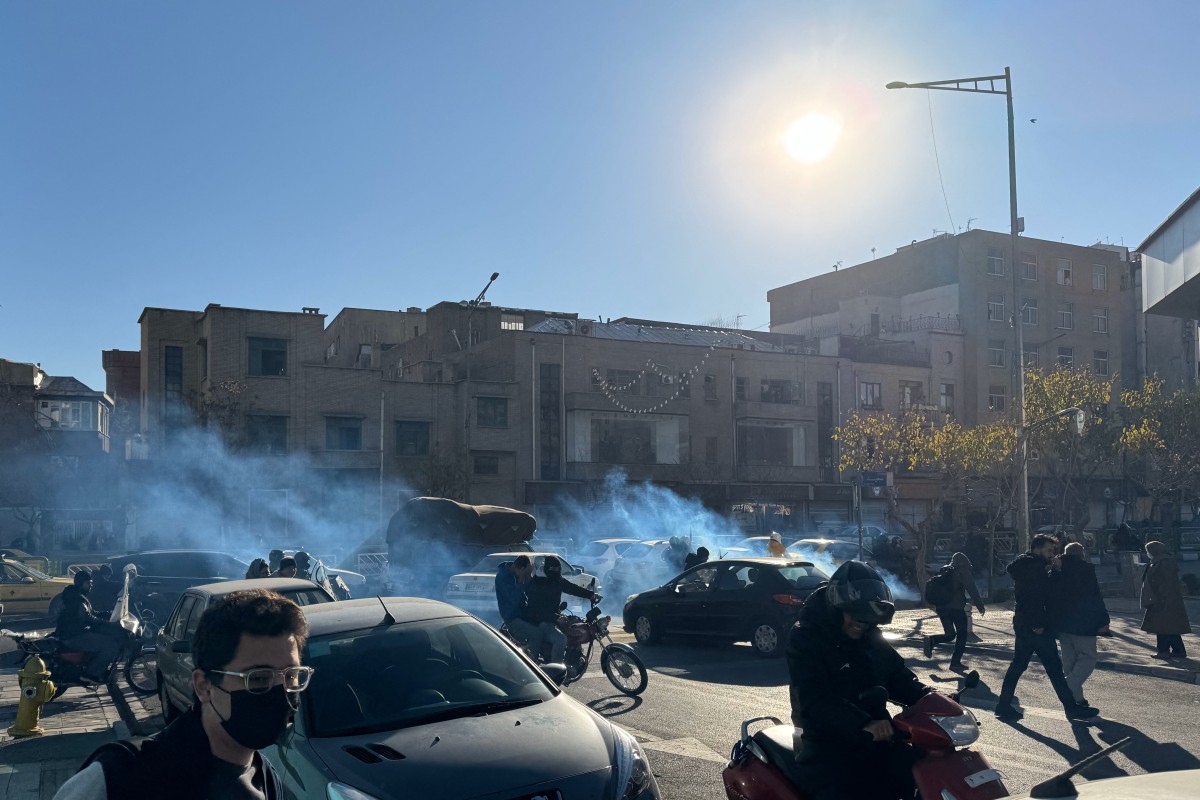
Photo Credit: AFP
The protests began on Sunday (December 27, 2025) in Tehran, where shopkeepers went on strike over high prices and economic stagnation, and have since spread to other parts of the country. The fatalities, two on Wednesday and five on Thursday, occurred in four cities largely home to Iran's Lur ethnic group, according to a report by the Associated Press.
The most intense violence appeared to strike Azna, a city in Iran's Lorestan province, some 300 kilometres (185 miles) southwest of Tehran. There, online videos purported to show objects in the street ablaze and gunfire echoing as people shouted, "Shameless! Shameless!"
🔴Urgent#Kalantari Azna Lorestan was captured
— Alexkennedy (@Alexkennedy310) January 1, 2026
The oppressors' vehicles were set on fire
The great protest of the Iranian people pic.twitter.com/yPAxJ3qQcb
The semiofficial Fars news agency reported three people had been killed.
In Lordegan, a city in Iran's Chaharmahal and Bakhtiari province, online videos showed demonstrators gathered on a street, with the sound of gunfire in the background. The footage matched known features of Lordegan, some 470 kilometres (290 miles) south of Tehran.
14/ Protest activity today appeared more limited & geographically uneven, potentially shaped by a cold front.
— Sina Toossi (@SinaToossi) December 31, 2025
The most notable unrest was reported in Fasa, Fars province, where a governorate building was attacked & clashes reportedly followed security force intervention. pic.twitter.com/lwZ7onbqoM
Fars, citing an anonymous official, said two people had been killed during the protests on Thursday.
"Some protesters began throwing stones at the city's administrative buildings, including the provincial governor's office, the mosque, the Martyrs' Foundation, the town hall and banks," Fars said of Lordegan, adding that police responded with tear gas.
The report said that buildings were "severely damaged" and that police arrested several people described as "ringleaders".
On Thursday, the state television reported that a member of Iran's security forces was killed overnight during protests in the western city of Kouhdasht.
Iranian Protest in Kouhdasht, western Iran.#Shah#Pahlavi#GenZ#GenZRevolution#Khamenei#AliKhamenei#Iran#Tehran#IranianProtest#Israel#Mossad#IranProtests #IranProtest pic.twitter.com/5b1aoWx8NQ
— WorldGeopolitics25 (@WGeopolitics25) December 31, 2025
"A 21-year-old member of the Basij from the city of Kouhdasht was killed last night by rioters while defending public order," the channel said, citing Said Pourali, the deputy governor of Lorestan Province. The Basij are a volunteer paramilitary force linked to Iran's Revolutionary Guards, the ideological branch of the Islamic Republic's army.
In Fuladshahr in Iran's Isfahan province, state media reported on the death of a man there that activist groups attributed to the police opening fire on demonstrators.
The protests also took place in the city of Kouhdasht, over 400 kilometres (250 miles) southwest of Tehran. Local prosecutor Kazem Nazari said 20 people had been arrested after the protests and that calm had returned to the city, the judiciary's Mizan news agency reported.
Iranian-American journalist and author Masih Alinejad also took to X and posted several videos of protest. "Youth in Babol Burn the Islamic Republic's Flag in the Streets Young people in Babol set the Islamic Republic's flag on fire in the middle of the street. They chant: “Until the mullah is shrouded, this homeland will not be free," she wrote.
Youth in Babol Burn the Islamic Republic's Flag in the Streets
— Masih Alinejad 🏳️ (@AlinejadMasih) January 1, 2026
Young people in Babol set the Islamic Republic's flag on fire in the middle of the street. They chant:
“Until the mullah is shrouded, this homeland will not be free.”#Iran pic.twitter.com/KE48HbKVSg
""Many videos are coming in from Iran, showing people chanting in unison in the streets: 'Mullahs must leave Iran' and 'death to the dictatorship...' This is the voice of a people who do not want the Islamic Republic," she wrote in another post.
Many videos are coming in from Iran, showing people chanting in unison in the streets: “Mullahs must leave Iran” and “Death to the dictatorship.”
— Masih Alinejad 🏳️ (@AlinejadMasih) December 29, 2025
This is the voice of a people who do not want the Islamic Republic.
Hear the voices of unarmed people who have taken to the streets.… pic.twitter.com/yNIqkTViOu
The Iranian Government's Response
Iran's civilian government under reformist President Masoud Pezeshkian has been trying to signal it wants to negotiate with protesters. Pezeshkian has sought to calm tensions, acknowledging protesters' "legitimate demands", and he urged the government to take action to improve the economic situation.
"From an Islamic perspective... if we do not resolve the issue of people's livelihoods, we will end up in Hell," Pezeshkian said at an event broadcast on state television. But he acknowledged that there is not much he can do as Iran's rial currency has rapidly depreciated, with $1 now costing some 1.4 million rials.
The inflation rate in December was 52 per cent year-on-year, according to the Statistical Centre of Iran, an official body.
Authorities, however, have also promised to take a "firm" stance, and have warned against exploiting the situation to sow chaos.
Local media coverage of the demonstrations has varied, with some outlets focusing on economic difficulties and others on incidents caused by "troublemakers".
Iran's theocracy also declared a public holiday on Wednesday across much of the country, citing cold weather, likely as a bid to get people out of the capital for a long weekend. The Iranian weekend is Thursday and Friday, while Saturday marks Imam Ali's birthday, another holiday for many.
The protests, taking root in economic issues, have heard demonstrators chant against Iran's theocracy as well. The country's leaders are still reeling after Israel launched a 12-day war against the country in June. The US also bombed Iranian nuclear sites during the war.
Iran has said it is no longer enriching uranium at any site in the country, trying to signal to the West that it remains open to potential negotiations over its atomic programme to ease sanctions. However, those talks have yet to happen, as US President Donald Trump and Israeli Prime Minister Benjamin Netanyahu have warned Tehran against reconstituting its atomic programme.
A Trump Warning
US President Donald Trump on Friday said that if Iran shoots and violently kills peaceful protesters, the United States will come to their rescue.
"We are locked and loaded and ready to go," he said in a Truth Social post.
This follows the deaths of several people as Iran's biggest protests in three years over economic hardship turned violent across multiple provinces.
(With inputs from agencies)
Track Latest News Live on NDTV.com and get news updates from India and around the world


