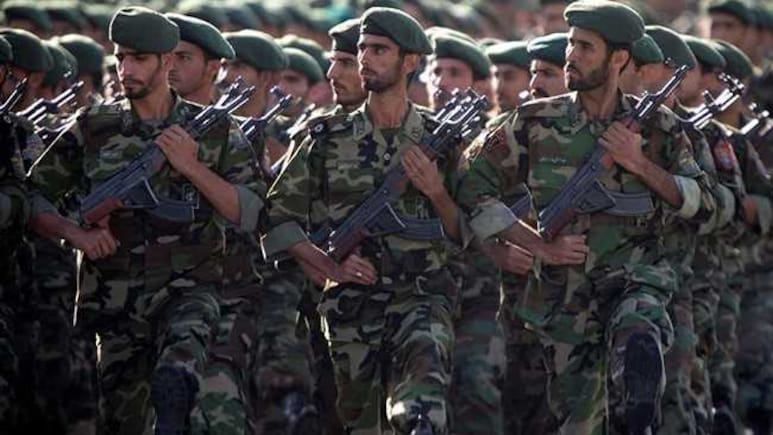
European Union foreign ministers agreed to designate Iran's Islamic Revolutionary Guard Corps (IRGC) as a terrorist organisation, placing the powerful military force in the same category as Islamic State and al Qaeda, in what marks a symbolic shift in Europe's stance toward Iran's leadership, The Times of Israel reported.
Reacting to the decision, EU foreign policy chief Kaja Kallas wrote on X, "Repression cannot go unanswered."
She added, "Any regime that kills thousands of its own people is working toward its own demise."
Israeli Foreign Minister Gideon Sa'ar described the move as "historic," while an Israeli official said the listing would make it easier to prosecute IRGC members, according to The Times of Israel.
The move comes amid heightened scrutiny of the IRGC's role within Iran.
Formed after Iran's 1979 Islamic Revolution to safeguard the Shi'ite clerical system, the IRGC wields significant influence across Iran's economy and armed forces and oversees the country's ballistic missile and nuclear programmes.
Although some EU states had long pushed for the designation, others were cautious, concerned it could disrupt dialogue with Tehran and put European citizens at risk.
Momentum for the decision grew following a violent crackdown on nationwide anti-regime protests earlier this month that reportedly killed thousands, The Times of Israel said.
Against this backdrop, Dutch Foreign Minister David van Weel said on Thursday, "It's important that we send this signal that the bloodshed that we've seen, the bestiality of the violence that's been used against protesters, cannot be tolerated."
France and Italy, previously reluctant, backed the move this week, while Israel welcomed what it called the culmination of years of diplomatic effort.
Highlighting Israel's role in advocating for the designation, Sa'ar wrote on X on Thursday, "For years Israel has worked toward this outcome, and in recent weeks with even greater intensity," calling the IRGC "the number one force behind the spread of terror and the destabilization of the region," and saying the decision would curb such activity in Europe while sending "an important message to the men and women of the Iranian people who are fighting for their freedom."
Iran, however, reacted sharply.
Tehran strongly criticised the EU decision, with Foreign Minister Abbas Araghchi calling it a "major strategic mistake" that would fuel conflict.
"Several countries are presently attempting to avert the eruption of all-out war in our region. Europe is instead busy fanning the flames," he said in a post on X.
"After pursuing 'snapback' at the behest of the US, it is now making another major strategic mistake by designating our National Military as a supposed 'terrorist organization,'" he added, referring to the return of UN sanctions linked to Iran's nuclear programme.
From Israel's perspective, the designation carries concrete legal implications.
Speaking to Israeli reporters after the announcement, an Israeli official said the move would give the EU stronger tools to act against Iran.
The official noted that while the IRGC and its members already face EU sanctions related to human rights abuses, weapons of mass destruction and drones, the new status would simplify legal action by requiring authorities to prove only affiliation with the IRGC rather than involvement in a specific terror plot.
Assets could also be frozen more easily, The Times of Israel reported.
Expanding on operational impacts, the official said, "The linkage between law-enforcement bodies within Europe --sharing information and cooperating through Europol-- will be easier," adding that criminal networks would think twice about assisting the IRGC once they realise European law-enforcement agencies are closely watching.
Diplomatic efforts behind the scenes also played a role.
Germany spearheaded moves within the bloc to persuade countries including Italy, France, Spain and Portugal to support the designation, with other EU members later joining.
"We tailored our messages," the Israeli official said, explaining that outreach focused on issues ranging from terror activity inside Europe to arms transfers to Ukraine, proxy operations and human rights violations.
Even as the EU toughens its stance, officials stressed that diplomatic engagement with Tehran would continue.
Kallas said Europe expects channels with Iran to remain open, while Italy's Foreign Minister Antonio Tajani said the decision "does not mean that we should not continue to engage in dialogue."
Alongside the IRGC listing, the EU also imposed sanctions on 15 individuals and six entities over serious human rights violations in Iran, including senior officials and IRGC commanders.
Additional measures targeted organisations linked to censorship and online disinformation, as well as entities associated with Iran's drone and missile programmes, with the bloc extending restrictions on exports of components used in UAV and missile production, The Times of Israel reported.
(Except for the headline, this story has not been edited by NDTV staff and is published from a syndicated feed.)
Track Latest News Live on NDTV.com and get news updates from India and around the world


