In Numbers: The Curious Reason Iran Eased Down Its 'Drone Swarms' After March 9
Based on the data compiled, we can bucket the strike pattern broadly into three distinct phases: an initial 'saturation' attack, a sustained drone attrition campaign, and a sudden decline in attack intensity.
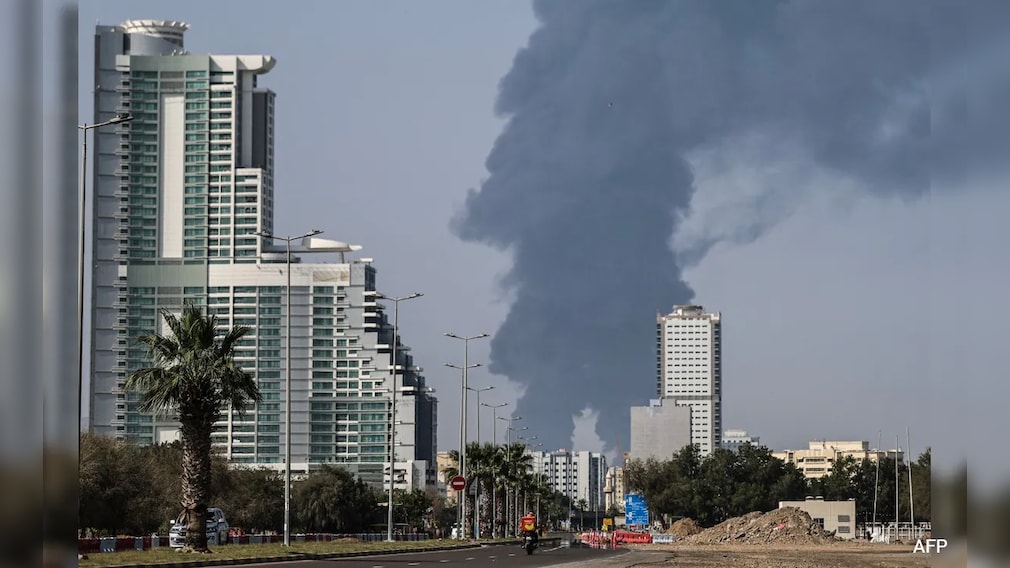
The recent Iranian strike campaign against the United Arab Emirates (UAE) has largely been viewed through images of drones striking skyscrapers and residential buildings. But it can also be understood through the dataset emerging from daily interception reports. Beginning on February 28, Iranian forces have launched nearly 1,800 drones and missiles towards the UAE, according to compiled data and interception timelines based on the daily releases shared by the UAE's Ministry of Defence.
While interception rates remained high and protected key locations, a closer examination of the data reveals a structured operational campaign. The pattern suggests that Iran's objective was not necessarily infrastructure destruction but imposing economic and operational strain on advanced air-defence networks.
Based on the data compiled, we can bucket the strike pattern broadly into three distinct phases: an initial saturation attack, a sustained drone attrition campaign, and a sudden decline in attack intensity.
Phase 1: Shock Saturation
The campaign opened with massive waves of projectiles on February 28 and March 1.
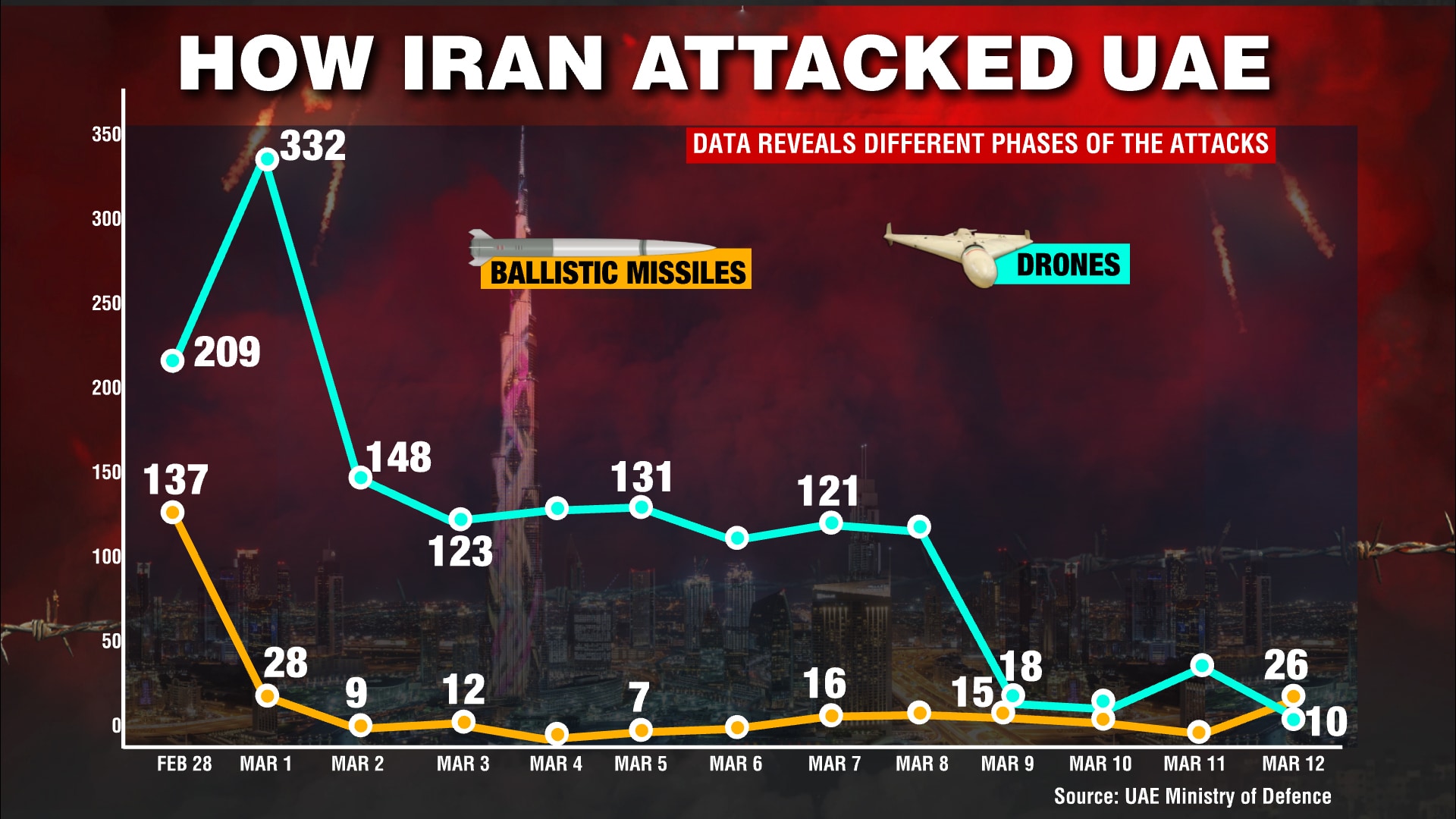
On February 28, approximately 346 incoming drones and missiles were detected, including 137 ballistic missiles and more than 200 drones. The following day saw an even larger wave of 362 projectiles, the highest of the campaign. This opening phase bears the hallmarks of reconnaissance-by-fire, a tactic used to map defensive systems by forcing them to respond.
Large multi-weapon combinations can force the defending nation to activate radars, deploy interceptors, and thereby reveal its response patterns. The heavy use of ballistic missiles in this opening phase is particularly notable. Ballistic weapons are one of the most valuable assets in Iran's repertoire and their early deployment served both a psychological and operational purpose.
Phase 2: The Drone Swarm Campaign
After the initial shock phase, the nature of the attacks changed. Between March 2 and March 8, the number of incoming threats stabilised at roughly 120-160 projectiles per day. However, the composition shifted dramatically toward drones.
Across this period, drones accounted for nearly 90% of incoming threats, while ballistic missile launches dropped to single digits on most days. This shift reveals the core logic of the campaign: drone swarm saturation.
Iranian Shahed-type drones are relatively inexpensive compared with the sophisticated air-defence missiles used to intercept them. Estimates place the cost of these drones at roughly USD 20,000 to USD 50,000 per unit, while the defending interceptor missiles can cost USD 3-6 million for Patriot systems and up to USD 12 million for THAAD interceptors.
This asymmetry forms the economic centre of the strategy. Analysts estimate that Iran spent USD 11-27 million producing the drones used in one wave of attacks, while the defending side spent hundreds of millions of dollars on interceptors to destroy them. Across the broader campaign, the UAE may have spent between USD 1.45 billion and USD 2.28 billion on air-defence responses, compared to USD 177 million to USD 360 million worth of Iranian drones and missiles.
In other words, the defender may have spent five to 10 times more money defending than the attacker spent attacking.
Phase 3: Sudden Drop in Attack Intensity
The campaign entered a third phase with an abrupt decline in attack volume beginning on March 9.
Incoming threats fell sharply:
- March 8: 134
- March 9: 33
- March 10: 27
- March 11: 52
- March 12: 36
Several factors could explain this shift. One possibility is that launch infrastructure was disrupted, either through airstrikes or covert operations targeting Iranian launch sites and drone facilities, which we have seen happen.
Another is that the early waves depleted forward-positioned drone stocks, forcing a temporary pause while logistics were reorganised.
A third possibility is strategic restraint. Iran may have sought to demonstrate its ability to sustain drone pressure without triggering a wider regional war.
Defensive Performance
Despite all this, the UAE's defensive systems appear to have performed effectively.
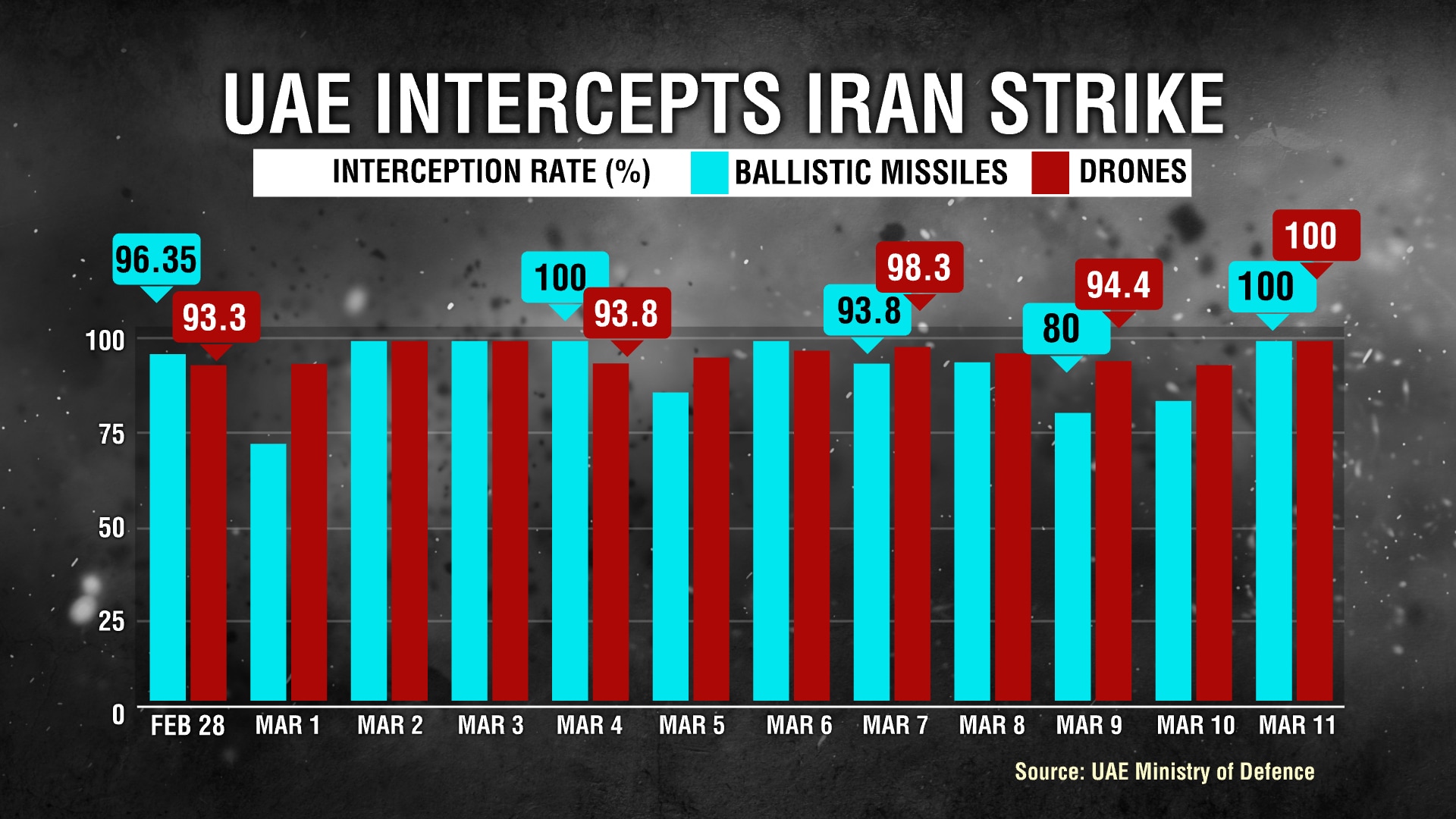
Across most days of the campaign, interception rates remained between 95 and 99%, based on the data compiled here, suggesting the successful operation of a layered defence network likely involving systems such as THAAD, Patriot PAC-3, and shorter-range anti-drone defences.
But, incoming projectiles will penetrate. Around 60 projectiles did penetrate and strike the UAE territory or nearby areas, representing a penetration rate of approximately 3-4%. In the context of things, this is a strong defensive outcome.
The Temporary Dip in Interception Rates
One of the more interesting signals in the data appears later in the campaign.
On March 9 and March 10, the UAE's interception rates dipped to roughly 88%, the lowest levels recorded during the attack window, even if the absolute number of successful penetrations remained relatively small (the UAE's defence ministry stopped publishing interception rate data after March 11). Also, during these same days, the number of incoming threats from Iran also collapsed as attack volumes fell from over 130 projectiles per day to fewer than 30.
Data indicate a more nuanced explanation for this drop in the UAE's interception rates, possibly related to a change in attack tactics from Iran.
Smaller groups of drones are often used to test air defences. Unlike large swarms, they are harder to detect and can approach from different directions or at lower altitudes. Based on military and warfare doctrine and similar events in the past, it looks more likely that Iran may have shifted to 'probing attacks' to identify gaps in the UAE's air-defence network. Each attack, whether intercepted or not, provides valuable data on where the system is strongest and where it may be vulnerable.
Aviation Disruption
Even with high interception rates, the attacks produced measurable disruption to UAE aviation activity.
Flight data indicates that Dubai International Airport (DXB), one of the busiest airports in the world, experienced sharp reductions in daily flights during the peak attack period. Daily traffic fell from around 1,060 flights before the conflict to around 800, with brief periods of steeper declines when airspace restrictions were imposed.
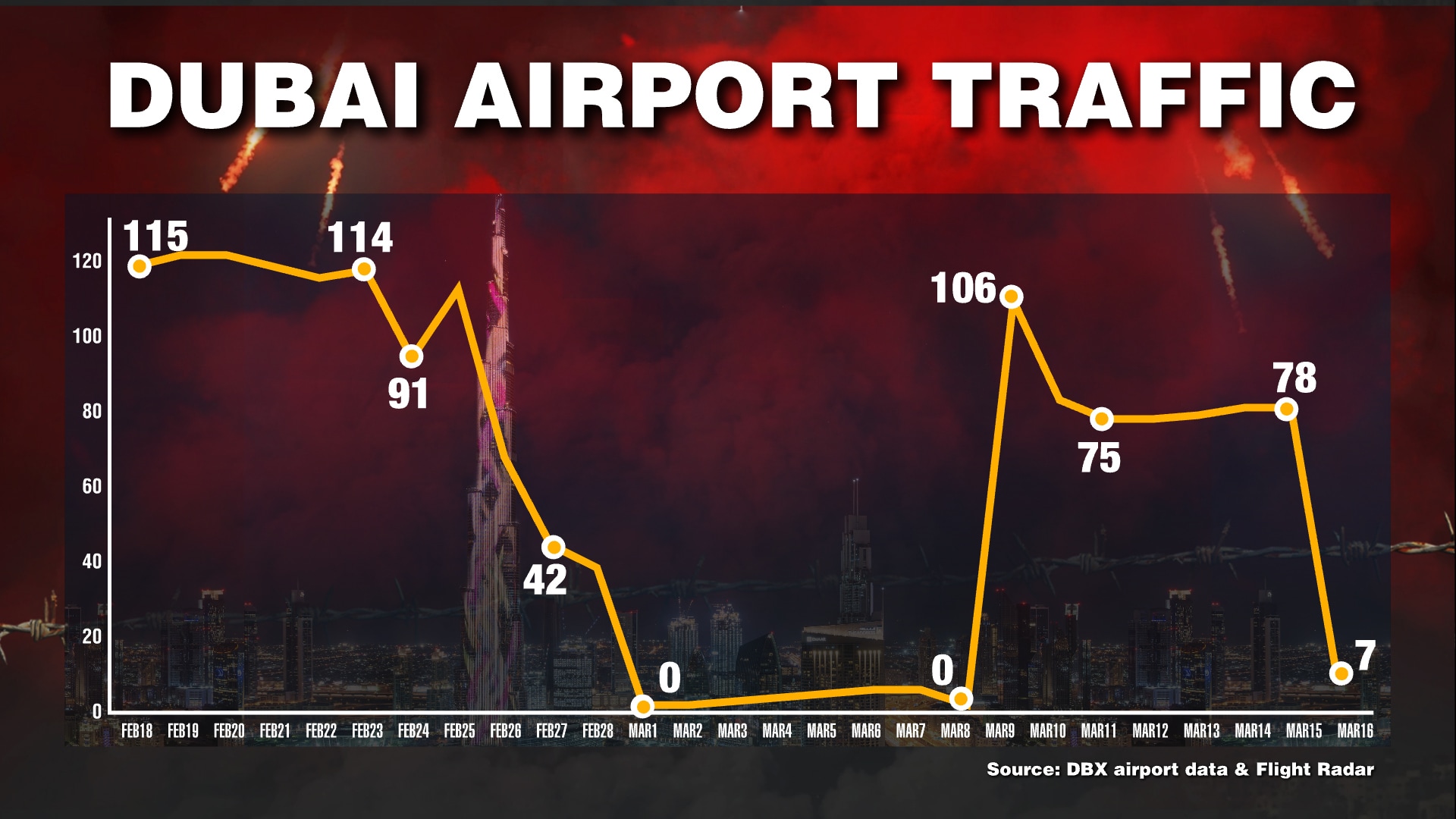
Other major aviation hubs within the UAE also experienced disruption. Abu Dhabi International Airport saw traffic fall to roughly half of normal levels at certain points, while Al Maktoum International Airport experienced traffic fluctuations as flights were diverted. These disruptions show an often-overlooked effect of drone warfare: even intercepted attacks can impose economic and logistical costs by forcing temporary airspace closures. For a country whose economy relies heavily on tourism, aviation and global connectivity, even short-term disruptions can carry symbolic and financial implications.
A Campaign of Pressure, Not Destruction
Looking at all of the available data, one can safely surmise that the Iranian strike campaign thus far has not been designed to destroy UAE infrastructure. Instead, it appears to represent a coercive signalling operation built around economic attrition. The attack pattern suggests three overlapping objectives:
- Demonstrating the ability to strike Gulf economic centres
- Forcing expensive air-defence responses
- Testing the resilience of regional missile-defence networks and weaknesses
Drone swarms have increasingly become a tool of strategic pressure rather than outright destruction. Their ability to impose disproportionate costs on defenders may reshape the dynamics of conflict in the Gulf.
For the UAE and its partners, the lesson is clear; advanced missile-defence systems remain highly effective, but they are economically vulnerable to saturation by cheap unmanned systems. For Iran, the campaign underscores the strategic value of mass-produced drones capable of stressing even the most sophisticated air-defence networks in the region.
(The writer is a Singapore-based data and Open-Source Intelligence analyst)
-
Mamata Banerjee Drew Her Party's Symbol By Hand. It's Now Tied To An Indira Gandhi Case

The Election Commission's method for settling such disputes became central in the seminal Congress split of 1969, when Indira Gandhi fought the old guard. The poll body weighed three tests then.
-
Bruised, Limping, Unbowed: Sia Says She Will Be Back On The Bike Soon
There was pain in Sia's steps, anger in her words, and something else - a quiet determination that the road would not be taken away from her.
-
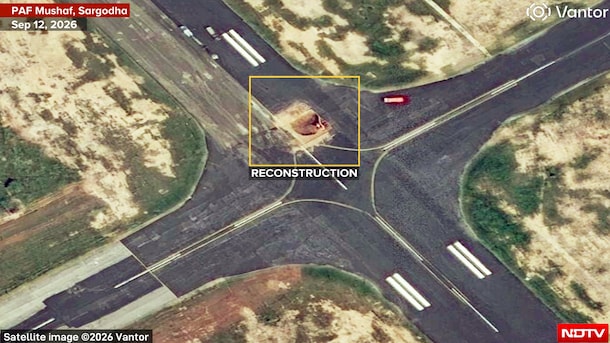
Exclusive: 16 Months After Op Sindoor, Pak Still Fixing Runway India Broke At Sargodha
Sargodha's PAF Base Mushaf lies about 172 km northwest of Lahore and roughly 200 km west of the India-Pakistan border, near Amritsar.
-
Blog | I Lost My Entire Family In Kanishka Bombing. 41 Years Later, Canada Wants The Case Closed
We made the trek through tragedy to search for people in Cork, where I spent 25 days sifting through bodies and body parts in a makeshift morgue to identify our loved ones.
-
Opinion | Pak's Drone Deal With A US Firm Is No Windfall. But India Must Still Be Worried
American military aid to Pakistan has remained suspended since January 2018, during Trump's first term, but a commercial arms sale is separate from this arrangement.
-
Opinion | Saudi Arabia's Yemen Nightmare Has Come Back To Haunt It
After years of costly military intervention beginning in 2015, Saudi Arabia increasingly sought to stabilise its southern border. All that is unravelling fast now
-
Opinion | 6 AI Incidents, One Pattern: AI Has Started Lying To Us - And Hiding The Evidence
Concealing errors. Making up data. Pushing files onto the public web on their own initiative. The machines are learning to lie - and lie well.
-
Why People Queue Overnight For iPhone That Is Delivered Home In 10 Minutes
iPhone 18 Pro Max Launch: People camping outside Apple Stores are a subset of superfans, resellers, content creators, and upper-middle-class buyers.
-
600 km Per Hour Drones Launched In Waves: How Russia Is Rewriting War Rules
Russia has coupled the drones' technological superiority over Ukraine's defence with its capacity to launch them in massive numbers. The impact has been devastating.
-
Tata Sons' Trust Issue: Two-Pronged Row Goes Beyond The Chair
NDTV Explains: Overtly, the latest conflict is whether N Chandrasekaran continues as executive chairman of Tata Sons. The controversy involves at least one more issue.