
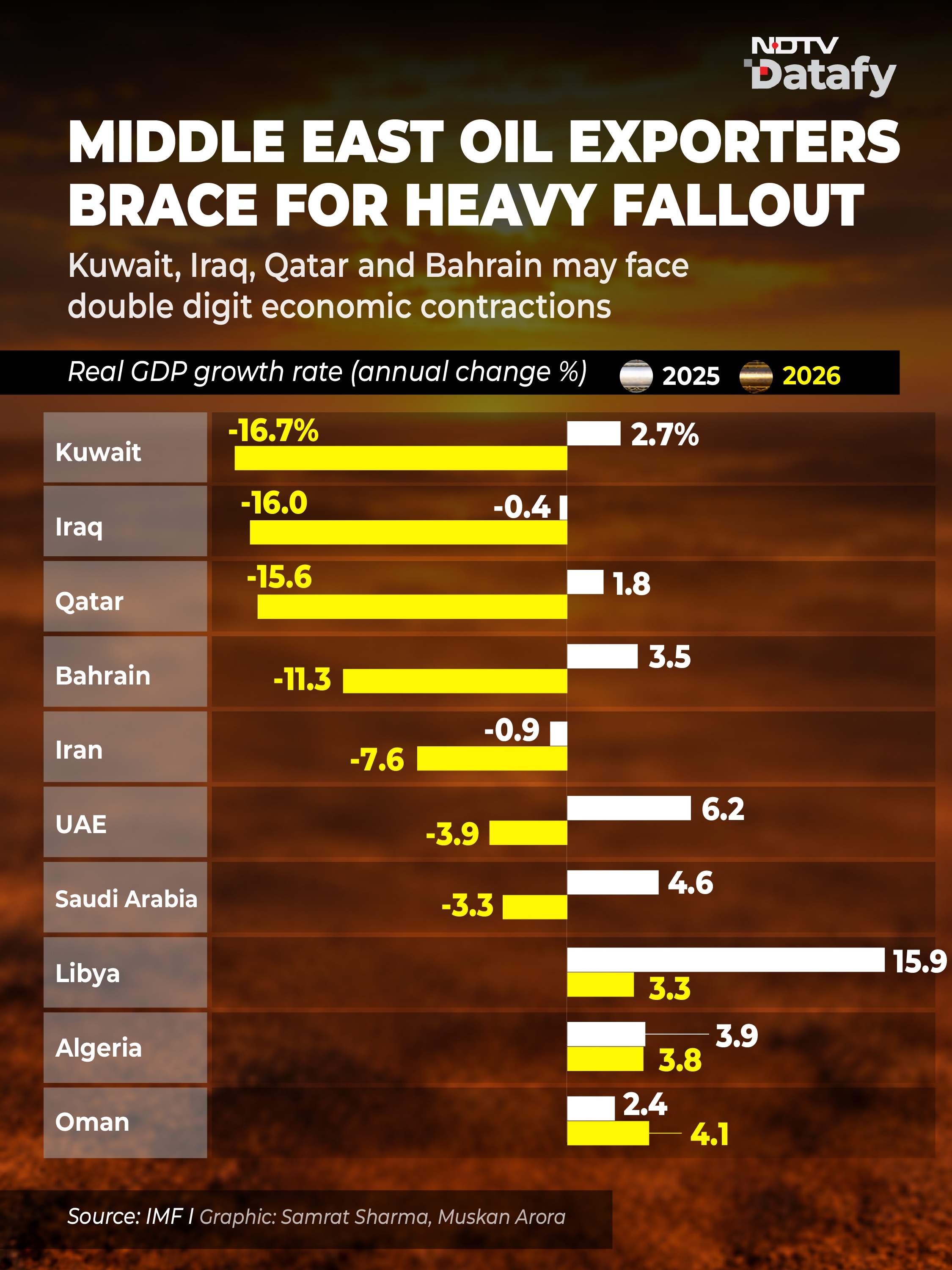
The war involving Israel, the US and Iran is set to leave a deep economic scar across the Middle East, particularly in countries that rely heavily on oil exports. Disruptions to energy production, trade routes and shipping, along with attacks on critical oil infrastructure, have weighed heavily on economic activity across the region. According to the International Monetary Fund (IMF), Kuwait, Iraq, Qatar and Bahrain could suffer double-digit economic contractions this year, while the economies of Iran, the UAE and Saudi Arabia may shrink by 3 to 8 per cent in 2026.
Estimates suggest that Kuwait's real Gross Domestic Product (GDP) could contract by 16.7 per cent in 2026, followed by Iraq (16 per cent), Qatar (15.6 per cent) and Bahrain (11.3 per cent), on an annual basis.
-

-
 The Mystery Of A Bare Nail In Ashwini Vaishnaw's Office
-
 Paris Setback, Asian Games Glory: Lovlina Borgohain's New Perspective
-
 To PM Modi's "Failed Product" Jab At Rahul Gandhi, A Shashi Tharoor Counter
-
 NDTV World Summit 2026: AI, Chips, Warfare And The Future Of The World | Key Conversations
-
 Kriti Sanon On Situationships, Open Relationships And Being Old-School
-
 'AI Scares Me': Kriti Sanon On Personality Rights And Need For Laws
-
 'AI Scares Me': Kriti Sanon On Personality Rights And Need For Laws
-
 'This Time I Wanted Gold': Savita Punia Reflects On Historic Asiad Success
-
 Favourite Bollywood Actor To 5-Year Plan, Kriti Sanon Interviews AI Actor Tilly Norwood
-
 Inside The Mind Of Archer Kumkum Mohod, Who Dared To Challenge South Korea
"The escalation of the war in the Middle East has delivered a substantial shock through disruptions to energy production, shipping, tourism, trade and confidence. The economic impact has been highly uneven," the IMF said.
Oil exporters directly affected by disruptions have seen a sharp slowdown, while many oil-importing economies have proved more resilient, supported by strong domestic demand, remittances, tourism and timely policy responses, the IMF added.
The conflict continues to widen, with fresh flashpoints emerging across the region, including renewed tensions involving Saudi Arabia and the Houthis. While the two have a long history of conflict, the wider regional war has heightened risks of further escalation and economic disruption.
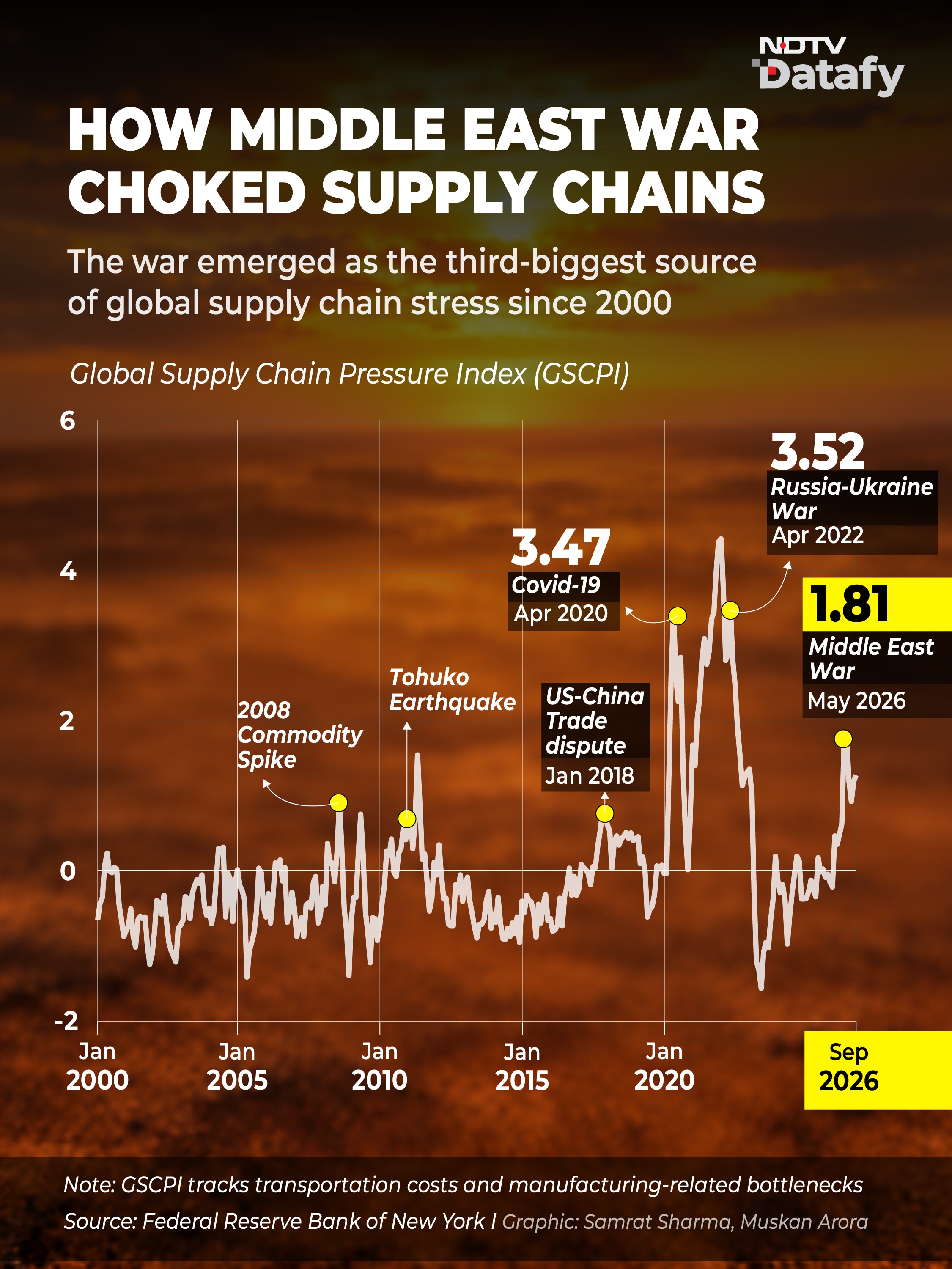
The fallout has spread far beyond the Middle East. The Federal Reserve Bank of New York's Global Supply Chain Pressure Index (GSCPI), which tracks transportation costs and manufacturing-related issues, surged to its third-highest level since 2000 as trade routes, shipping networks and energy supplies came under strain. It peaked in December 2021 during the Covid-induced lockdowns.
The GSCPI rose to 3.47 in April 2020 as Covid-19 lockdowns began and peaked at over four in 2021. After remaining close to zero for several months, the index climbed again to 1.81 in May 2026 amid supply disruptions caused by the war in the Middle East.
For Gulf oil exporters, higher crude prices have offered little comfort. The losses from disrupted exports, shipping and economic activity have been far greater. As the war continues, some of the region's biggest oil producers are also emerging as some of its biggest economic losers.
Track Latest News Live on NDTV.com and get news updates from India and around the world


