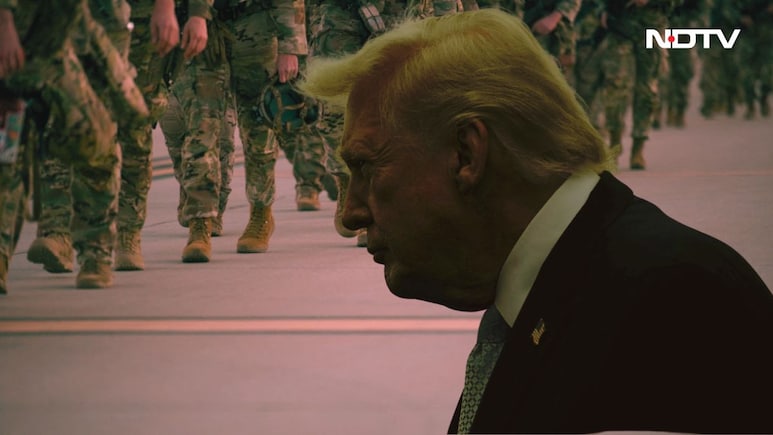
- US President Trump proposes $1.5 trillion defense budget for 2027, a 44% increase from last year
- The request includes $455 billion more than FY 2026, plus a $200 billion emergency fund
- Funds target missile defense, critical minerals, shipbuilding, troop salaries and space weapons
In the largest such request in decades, US President Donald Trump has proposed boosting defense spending to $1.5 trillion in his 2027 budget released Friday. The request comes at a time the Middle East war enters its sixth week, with the proposal laying emphasis on military investments over domestic programs.
Provisions Made For Defence
The sizable increase for the Pentagon as part of Trump's new budget before the Congress would amount to around a 44 per cent increase over what the US spent this fiscal year.
The $1.5 trillion request involves an increase of about $455 billion over fiscal year 2026 and is separate from an emergency request of $200 billion that the Trump administration requested from Congress to support the US-Israel war with Iran, per Al Jazeera. The report adds that the fund will be used to finance Trump's Golden Dome missile defence system, invest in critical minerals, boost US shipbuilding and raise salaries for US troops.
Further, the funds would go towards programs intended to ensure "the United States maintains the world's most powerful and capable military", including expanding the defense manufacturing industrial base and a proposed space-based weapons system to intercept strikes against the United States.
The $1.5 trillion sought for the Pentagon would amount to about 4.5 percent of the nation's gross domestic product, Jessica Riedl, a budget and tax fellow at the Brookings Institution. was quoted as saying by New York Times. That would make it the largest year-over-year increase for defence since the 1950-53 Korean War, inflation adjusted.
Per Department of Defense (DOD) data for financial year 2025-26, a $2.03 trillion outlay was distributed among six sub-components which include defense-wide components, followed by the Navy and Marine Corps. The third in the list is Air Force, followed by Army and then Internal Security Assistance.
How Does Military Spending Of Other Countries Compare?
US military expenditures have surged in recent decades, climbing from about $320 billion in 2000 to $997 billion in 2024, according to the Stockholm International Peace Research Institute.
The US regularly spends more on its military than the total of the next nine countries combined, according to the Peter G Peterson Foundation, an organisation that assesses US fiscal challenges. The US has also historically devoted a larger percentage of its gross domestic product (GDP) to the military than the other top economies in the world.
As of 2024, the World Population Review figures stated that the US had a total military spending of $968 billion, followed by China at $317 billion and Russia at $150 billion. Germany, India and Saudi Arabia followed at $86 billion, $83 billion and $79 billion respectively.
Other Key Takeaways From Proposed Budget
The administration coupled the proposal with a call for $73 billion in cuts spread across many domestic agencies, including the elimination of key federal health, housing and education programs, some of which serve minority groups and the poor. With the nation running nearly $2 trillion annual deficits and the debt swelling past $39 trillion, the federal balance sheets have long been operating in the red. The president's plan would reduce spending on non-defense programs by 10 per cent.
A 13% increase in funding for the Department of Justice to focus on violent criminals and the president's promise to stop what the White House calls migrant crime.
A $10 billion fund within the National Park Service for "construction and beautification" projects in Washington, D.C.
A $481 million increase in funding to enhance aviation safety and support an air traffic controller hiring surge.
More than $15 billion from the Biden-era bipartisan infrastructure law, including funds for renewable energy projects and National Oceanic and Atmospheric Administration grants, cancelled.
A 19% cut in the Department of Agriculture, ending certain university grants, a 13% cut for the Department of Housing and Urban Development, and about a 12% decrease to the Health and Human Services department.
Cut Community Services Block Grants, which funds activities such as financial and job counseling and helping people obtain adequate housing.
The president also seeks to cut $106 million in funding from the Agency for Healthcare Research and Quality.
Track Latest News Live on NDTV.com and get news updates from India and around the world


