How Iran Sucker-Punched Trump Into 'Escalation Trap' 'Hellhole'
Trump is now under pressure, not just from allies but also within; the President's approval rating is the lowest it has ever been with mid-term elections in November.
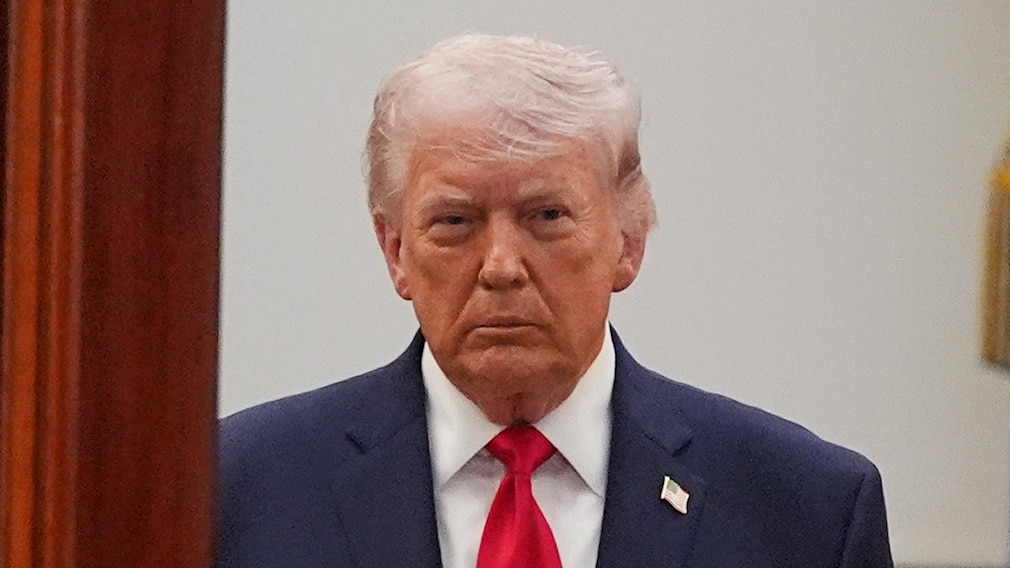
Donald Trump's expletive-laden Truth Social post this week - which referred to the Iranians as "crazy b*****ds" - emphasised the extent to which a sucker-punched United States seems to have lost the initiative in the war on Iran that began Feb 28.
Thirty-eight days ago, Trump promised a swift and decisive win.
But now he seems stuck in a multi-front battlespace with no discernible off ramp, while also struggling to justify a war costing American taxpayers an estimated US$900 million daily and has left the world mired in a long-term energy crisis.
Meanwhile, Iran still has significant ballistic missile capability and a presumed 400-440kg stockpile of enriched uranium.
And a fundamentalist Shiite regime is still firmly in control.
How did this happen?
Because Iran drew the US into an 'escalation trap'.
An 'escalation trap' is when one side reconfigures the battlefield - either by stretching it horizontally or weaponising chokepoints - to make it harder for the other to de-escalate or withdraw from the war without surrendering initiative and political capital, i.e., without looking weak.
In this case, it meant Iran survived decapitation strikes, forced the US into an asymmetric war, and used the Strait of Hormuz to turn a West Asia war into a global economic problem.
Iran's 'escalation trap'
The US thought it won the war on Day 1 after Supreme Leader Ayatollah Ali Khamenei was killed in air strikes on Tehran, and again on Day 18 after Iran's national security chief, Ali Larijani died.
That was when Iran's three-step trap kicked in.
The first - the 'mosaic doctrine' meant the US couldn't break down the Iran regime.
In a 'normal' war, the deaths of Khamenei and Larijani, and other senior figures, like naval chief Alireza Tangsiri, would have created gaping holes in a national command structure.
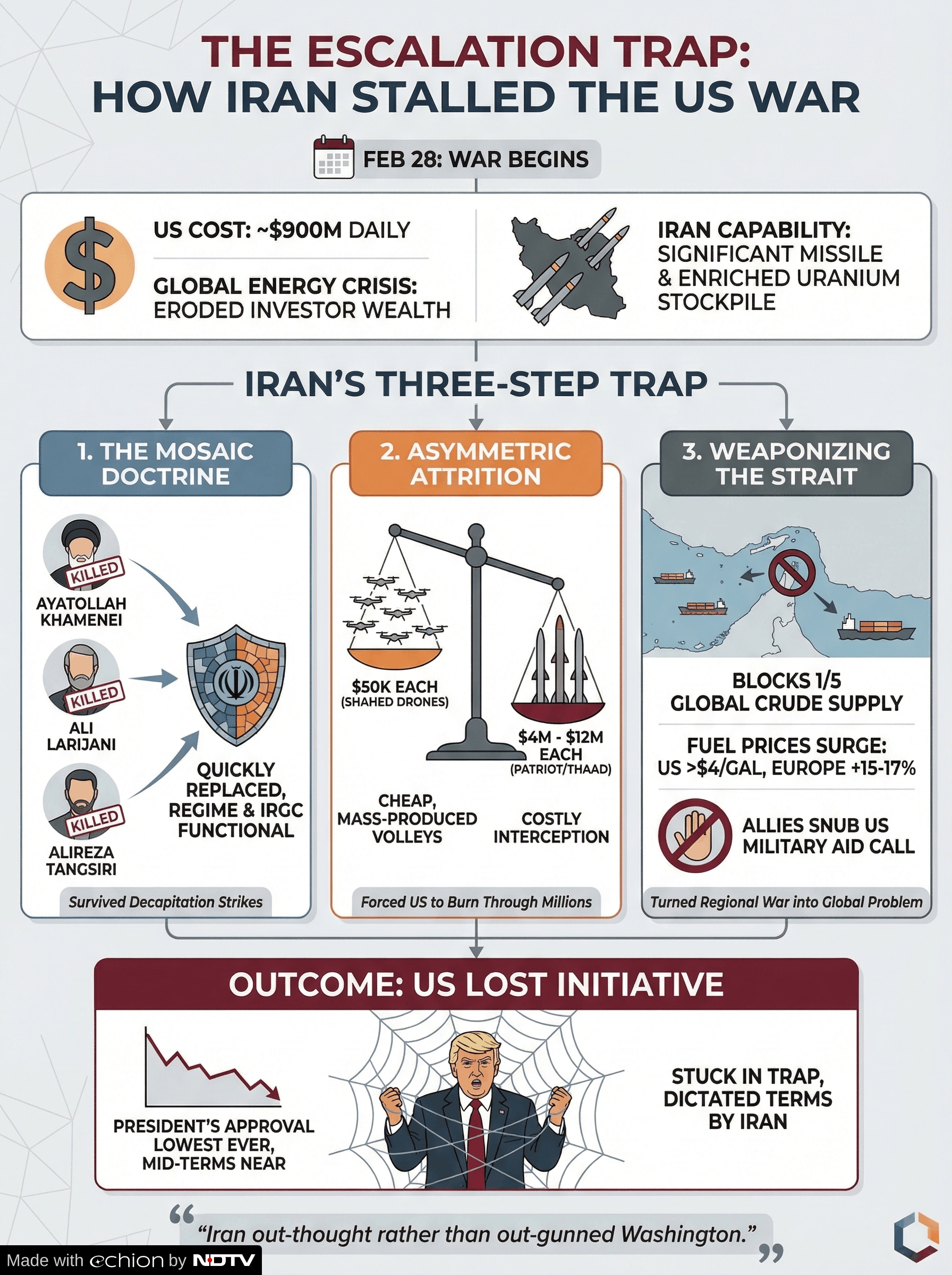
Iran's 'escalation trap' for the US.
But the 'mosaic doctrine' covered those holes, quickly and efficiently. Khamenei was replaced, Larijani was replaced, Tangsiri was replaced, and the regime and IRGC continued to function.
The second - drone-led asymmetric warfare forced the US into a war of attrition.
Iran went into this war with the largest and most diverse arsenal of missiles, including the new hypersonic Fattah series, in West Asia. But Tehran held much of this back in the early days.
Drone Strikes On Middle East Data Centres Signal Pivot In Next-Gen Warfare
Instead, the regime fired volleys of cheap mass-produced Shahed 'kamikaze' drones, targeting US and Israeli military bases, as well as Gulf nations' civilian and energy infrastructure.
This forced the US to burn through millions of dollars in missile interceptors.
With Missiles Carrying 1,000 kg Explosives, A New Tactical Phase For Iran
Iran made interception a costly proposition; conventional military doctrine recommends firing two-three interceptors to block one incoming threat. But a Patriot interceptor costs US$4 million and a THAAD interceptor around US$12 million. A Shahed drone caps out at US$50,000.
The math was never going to be in the US' favour.
Trump's Iran 'Knocked Out' Claim Blown Up By US Intel On Missiles, Drones
And Iran still has 'thousands of drones', sources told CNN last week.
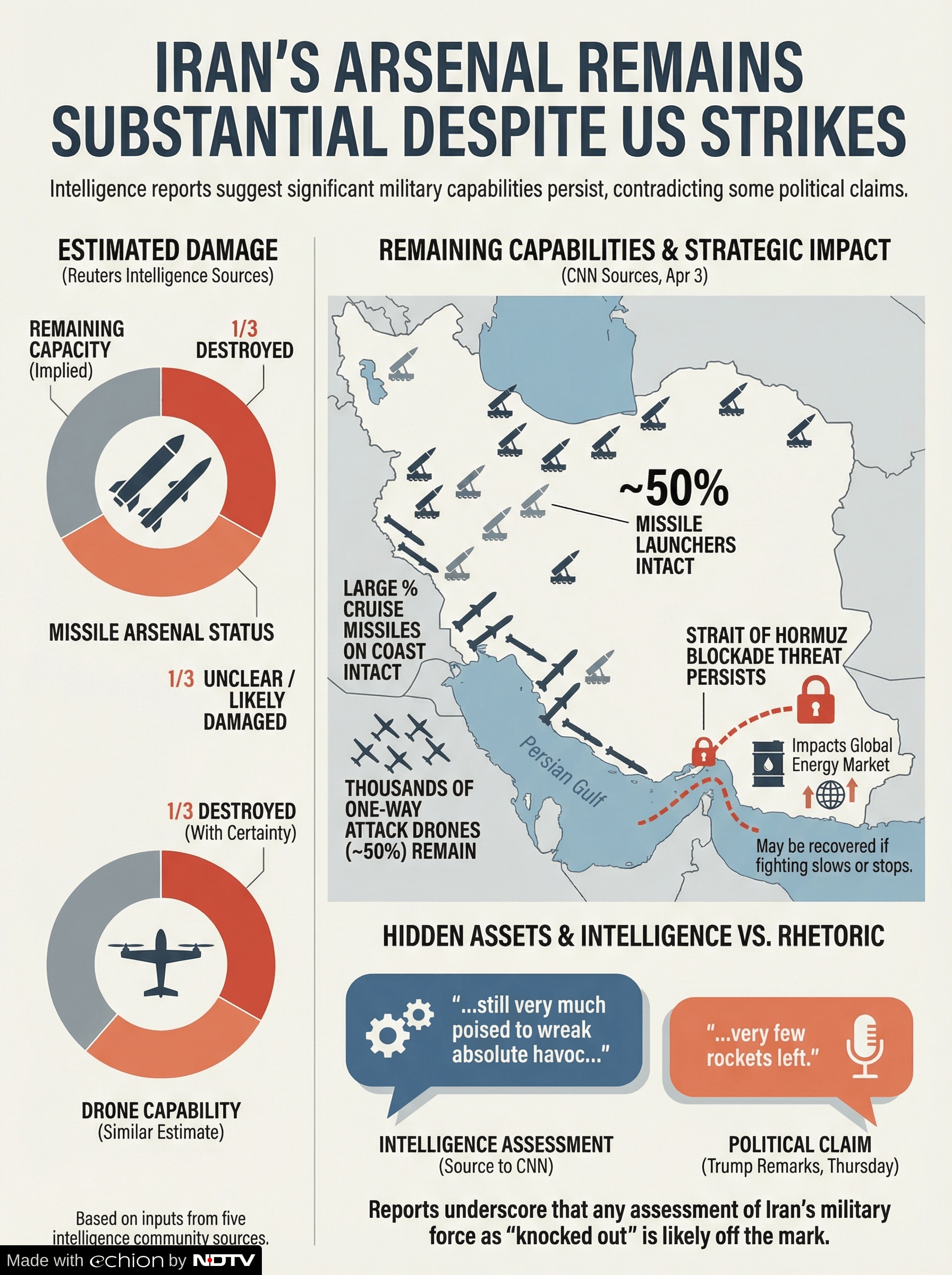
Intel sources on Iran's missile stocks.
The third, and most important, was the Strait of Hormuz.
Targeting the channel was an enormous pressure multiplier.
And this was not symbolic pressure. It was real. The impact is real.
Fuel prices in the US crossed US$4 per gallon, the highest since 2022. Petrol and diesel prices increased by 15-17 per cent in Europe and over 34 per cent in some African and Asian nations.
The Hormuz ships a fifth of the world's seaborne crude oil supply. Stopping traffic through it, or even slowing it, meant global pressure has been ramped up on Trump and the US.
'Five Straits' Trap: How Hormuz Blockade Exposes Global Oil Flow's Flaw
It also turned US allies - Trump's call for military aid to force open the Hormuz was snubbed.
Perhaps most critical was that it forced the US to react rather than set the narrative.
The US President's deadline extensions - his 'open the strait or else...' posts - underlined the truth that he no longer had control over what Iran could or could not do.
Instead, it was Iran dictating terms, as evinced by 'peace' proposals being rejected and Iranian officials, such as parliament speaker Mohd Ghalibaf, making increasingly belligerent remarks.
The enemy promotes its desires as news while threatening our nation at same time. Big Mistake. If they hit one,they'll take several back.
— محمدباقر قالیباف | MB Ghalibaf (@mb_ghalibaf) March 30, 2026
God willing, the people of Iran,under the leadership of the Supreme Leader,will make the enemy regret the aggression and reclaim their rights.
Iran's Hormuz play shifted the dynamic of the war - from missiles and drones to oil and shipping costs, from warfare to economics, and was designed to hold the US accountable to the world.
Stuck in the trap
The more Iran digs in around the Hormuz the harder it will be for Trump and the US to regain control sans a massive military escalation - either a ground invasion, which has its own red flags, or the entry of other nations, such as the Gulf countries, to overwhelm Iranian forces.
Ground War On? US Rushes 57,000 Troops As Iran Crisis Escalates
Iran's leverage in this case does not come from a conventional military point of view.
It knows it does not need to 'defeat the US army'.
It only needs to continue spooking energy markets and the US' allies.
Trump is now under pressure, not just from allies but also within; the President's approval rating is the lowest it has ever been and mid-term elections are only seven months away.
If Iran is now seen as 'winning' this war, it is because Tehran out-thought rather than out-gunned Washington. By using its 'mosaic doctrine', asymmetric warfare models, and the Hormuz, it made the war harder to fight and contain for Donald Trump.
-
3 Minutes, 6 Stanzas, Century-Old Debate: The Many Turns In Vande Mataram's Journey

PM Narendra Modi launched a year-long commemoration of the song's 150th anniversary on November 7, 2025. In December, both Houses held special discussions on it, during which the 1937 Congress decision was scrutinised.
-
Indian Family Wipeout Over iPhone: The Dangerous Lure Of Consumer Tech Debt
Young buyers walk into physical retail stores, hand over basic identity documents and walk out with a consumer electronic device that costs more than their entire family's monthly take-home income
-
China Outspends India In Space, But New Delhi Holds The Trust Card
The US remains the undisputed leader in the global space race. But it's realistic for India to aim for the third place, says Bellatrix Aerospace COO.
-
It's About The Provenance: Head Of Strategy Koreel Lahiri Decodes One Identity Of NDTV
We at NDTV consciously recognise the fact that the same consumer inhabits several screens during the course of a day.
-
Opinion | India's UPI Miracle Has Created A Difficult, Rs 20,000-Crore Question
UPI's whole magic was the Rs 30 payment it charged nothing for. But how long can it stay free?
-
Opinion | Manmohan Singh, Bachchans, And Other Secrets Of 10 Janpath: The Sonia Gandhi Story
She entered politics reluctantly, mastered its power games, chose Prime Ministers, and managed betrayals. Congress's most powerful woman finally tells the world how.
-
Opinion | Why The Congress-Samajwadi 'Merger' Fantasy Could Be Opposition's Biggest Self-Goal
Rahul Gandhi and Akhilesh Yadav do not need to become one another. They need to become better at being themselves, together.
-
Opinion | Mumbai's 'Marathi' Test For Cabbies, And The Art Of Fixing The Wrong Problems
All these years, India's financial capital has worked just fine without a Marathi mandate for its taxiwallahs. Whose problem is the new language rule actually solving now?
-
Opinion | Rs 1.05 Lakh Crore Lost: Inside The Dangerous Rise Of India's Gen Z Stock Traders
Investors under 30 now account for 37.9% of the total investor base in India. But they are also losing money at a much higher rate. Why are they doing it?