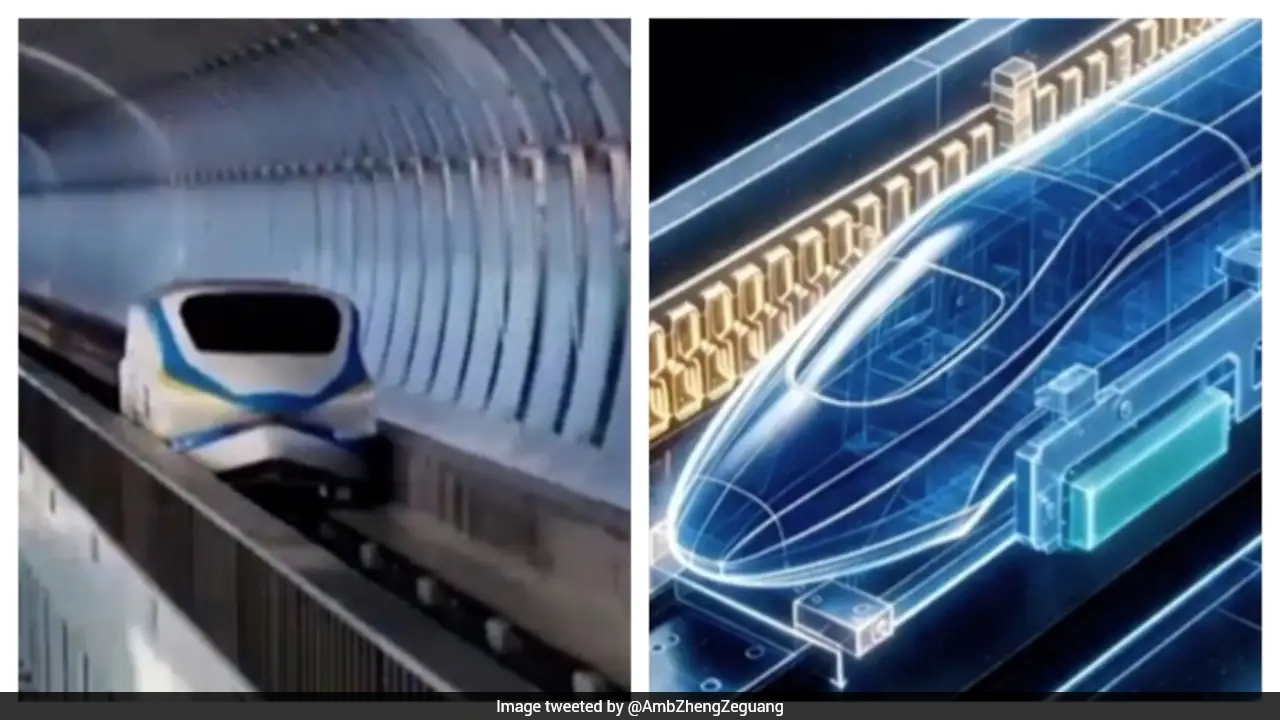
An experimental maglev train in China has broken its own short-distance acceleration record for the third time in six months, reaching 800 kmph from a standstill in just 5.3 seconds. According to a report by the Independent, the 1.1-tonne vehicle completed the test on a 1-km track at the Donghu Laboratory in Hubei province. Unlike regular passenger trains, however, this experimental vehicle is not designed to carry people. Researchers are using it to test technologies that could eventually have applications in rocketry, aerospace and other high-speed systems.
Maglev trains use magnetic forces to raise the vehicle slightly off the track, eliminating much of the friction encountered in conventional rail systems. The coils generate magnetic fields along the track that propel the vehicle forward.
During the latest test, the train reached 800 kmph in just 5.3 seconds before being brought to a controlled stop over roughly 200 metres. The successful braking test was important because travelling at such extreme speeds requires equally advanced systems to slow the vehicle safely.
800 km/h in just 5.3 seconds!
— Chinese Mission to UN (@Chinamission2un) August 11, 2026
China's maglev test train just set another world record - and it did it without wheels.
The frictionless future is moving at full speed. #InnovativeChina pic.twitter.com/HPIhpsRage
The same experimental train first set a record in June 2025, when it reached around 650 kmph in 7 seconds. Researchers later pushed it to about 700 kmph and then 798 kmph, while also cutting the time needed to reach those speeds.
Each test has focused on technologies such as high-power energy delivery, electromagnetic propulsion, high-speed levitation control and emergency braking, according to Chinese state broadcaster CCTV.
The experimental vehicle achieved speeds far exceeding those of today's commercial maglev trains. China's and Japan's maglev services normally operate at speeds of about 320 kmph. China's fastest commercial high-speed trains can reach speeds of about 350 kmph.
Researchers at China's National University of Defence Technology are also working on ultra-high-speed maglev technology. One of their tests reportedly accelerated a vehicle to 697 kmph in just two seconds.
Despite the impressive numbers, these experimental trains are not ready for passenger travel.
Researchers are instead exploring whether the technology could eventually be used for high-speed launch systems, including concepts for rockets and fighter aircraft, CGTN reported. Similar technology is also being developed for trains that could travel through low-pressure or vacuum tubes.
However, there are many challenges to overcome. It would be hard to make long, accurately aligned tracks, to create affordable infrastructure, and to guarantee safety at extreme speeds. Also, passenger transport, braking, stability and emergency systems would have to be subject to stringent safety standards.
Track Latest News Live on NDTV.com and get news updates from India and around the world


