





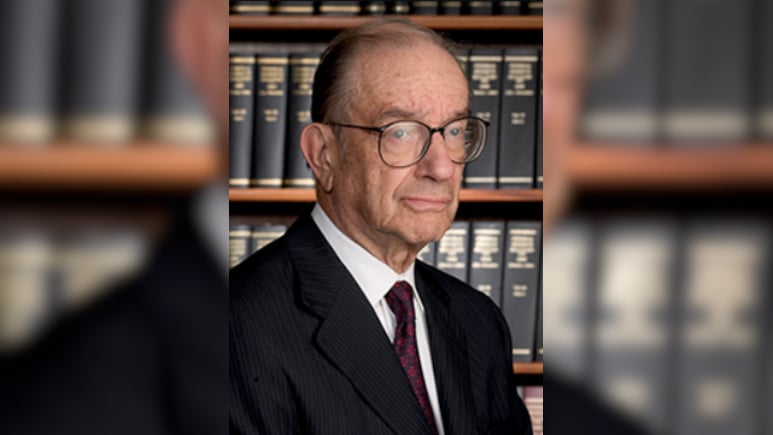
Former Federal Reserve Chair Alan Greenspan has died due to complications from Parkinson's Disease. He was 100.
The New York native served as the Fed Reserve Chair for five consecutive terms from 1987 to 2006. His tenure is the second-longest for the central bank post, just behind William McChesney Martin.
While Greenspan guided the US economy through two recessions, the Asian financial crisis of 1997 and the 2001 terrorist attacks, he was also accused of failing to curb policies that ultimately led to the 2007-2008 financial crisis, NBC reported.
Greenspan was blamed for promoting deregulation of the financial sector, failing to curb trade in securities backed by subprime mortgage loans and missing the housing bubble in the early 2000s.
He did not deny the accusations. In a Congressional hearing in October 2008, the former Fed Reserve Chair said he had “found a flaw” in his model of how the world works, as per Harvard Business Review.
What Alan Greenspan Learnt From The 2008 Financial Crisis
In 2014, he told HBR he was still trying to figure out where he went wrong. He told the outlet, “I've learned more in the last three or four years than the previous ten.”
He also claimed that when people are at the Federal Reserve, they “can't do a lot of research,” and recalled how a group of senior analysts once shot down his idea to do research on constructing a certain statistical procedure.
Greenspan also said that it was hard to burst financial bubbles as doing so could undermine the independence of the central bank.
“Well the question is, do you quash the bubbles? The answer's yes, you can quash them, but not in a democratic society. I mean, I hesitate to think what would have happened if the Federal Reserve had tried to quash the dot-com boom — assuming we knew exactly what it was all about, which we didn't, until later. All hell would have broken loose,” he revealed.
He also stated that no central bank could calibrate monetary policy to withhold a boom and doing so may have made things worse. According to Greenspan, most bubbles “are not toxic.”
He cited the dot-com boom and the 1987 crash as examples, saying that their impact could not be found in the Gross Domestic Product (GDP) figures.
Alan Greenspan On Warren Buffett
The economist talked about how disregarding short-term declines in the market can work out well in the long run, giving the example of Warren Buffett. He said that even if the former CEO of Berkshire Hathaway did nothing else, he never sold his investments.
"The most successful stock market players, the best investors, are those who recognize that the asymmetric bias in fear vs. euphoria is a tradable concept and it can't fail for precisely this reason,” he added.
Greenspan is survived by his wife, Andrea Mitchell.
Track Latest News Live on NDTV.com and get news updates from India and around the world

