Space Telescope Images
- All
- News
- Videos
- Web Stories
-
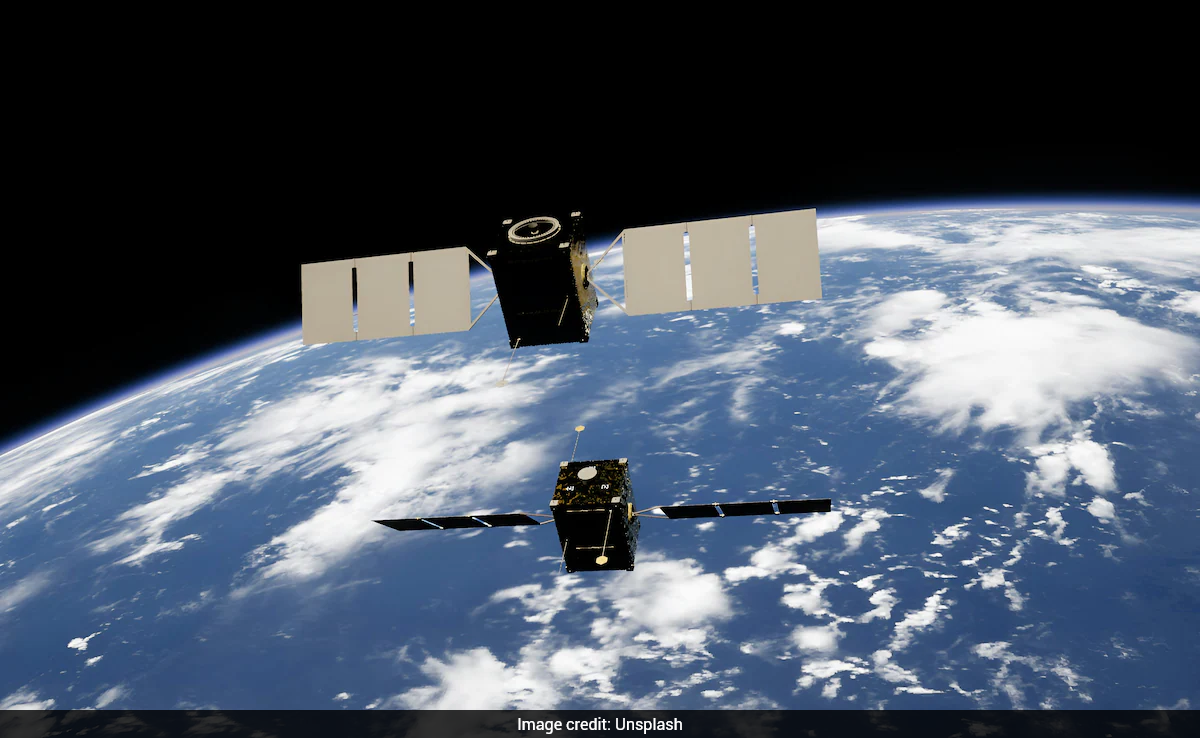
Satellite Constellations Like Elon Musk's Starlink Could Contaminate Space Telescope Images, NASA Warns
- Thursday December 4, 2025
- Science | Edited by Srishti Singh Sisodia
The contaminated images could impact various scientific studies, including asteroid detection and galaxy observations.
-
www.ndtv.com
-
Webb’s Stunning View of Apep Shows a Rare Triple-Star System Wrapped in Spirals
- Sunday November 23, 2025
- Written by Gadgets 360 Staff
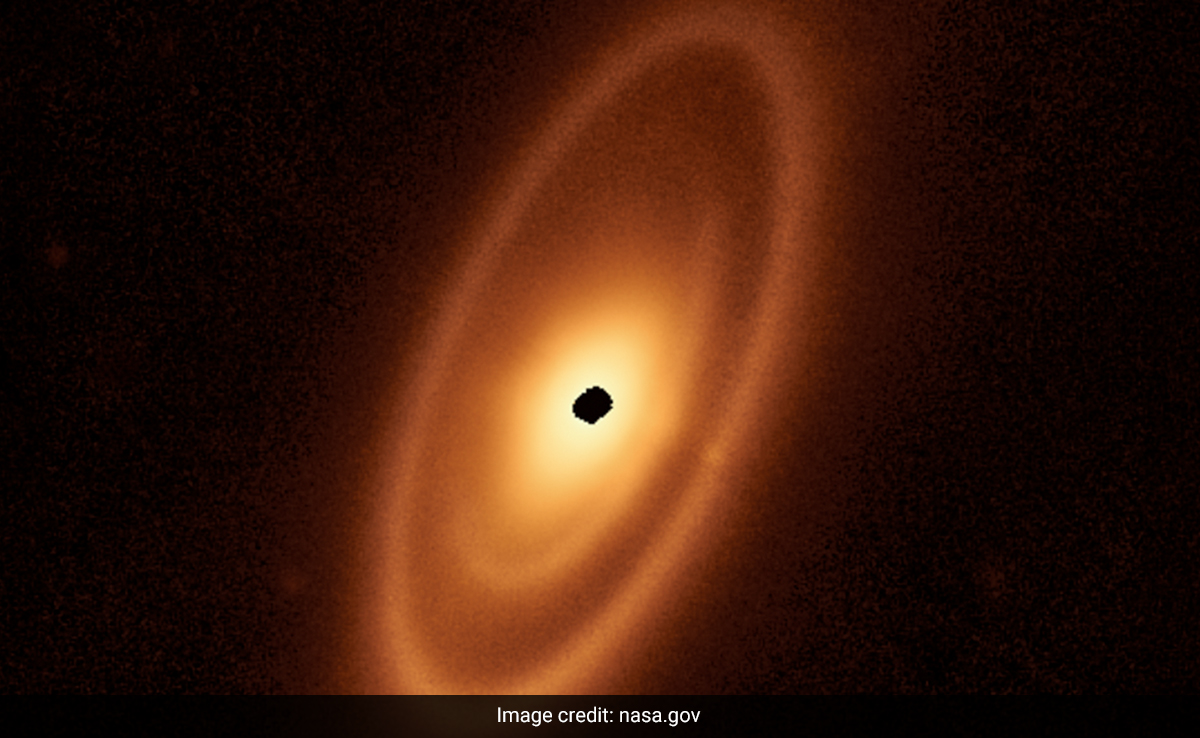
Webb’s mid-infrared images of Apep reveal a rare triple-star system producing vast carbon-rich dust spirals from colliding stellar winds. The two Wolf–Rayet stars and a distant supergiant create layered shells that record centuries of activity and enrich the galaxy with elements vital for future stars and planets.
-
www.gadgets360.com
-
ISRO Captures Rare Close-Up Of Fast-Moving 3I/ATLAS. See Pic
- Thursday November 20, 2025
- Science | Edited by Amit Chaturvedi
As space agencies track the comet's path, 3I/ATLAS is offering astronomers rare clues about what lies beyond our Solar System.
-
www.ndtv.com
-
ESA’s Euclid Telescope Charts Over a Million Galaxies in Landmark First Data
- Wednesday November 19, 2025
- Written by Gadgets 360 Staff
ESA’s Euclid space telescope has captured about 1.2 million galaxies in its first year, providing one of the most detailed wide-field surveys of the universe ever made. Covering distances up to 10 billion light-years, Euclid’s clear, expansive imaging is helping astronomers study galaxy shapes, mergers, dwarf galaxy populations, and the role of...
-
www.gadgets360.com
-
NASA’s JWST Produces First-Ever 3D Map of Distant Planet WASP-18b
- Monday November 3, 2025
- Written by Gadgets 360 Staff
NASA’s James Webb Space Telescope has created the first-ever 3D atmospheric map of an exoplanet, revealing the extreme conditions on WASP-18b, an “ultra-hot Jupiter” located 400 light-years away. Using infrared eclipse mapping, scientists discovered a scorching hotspot over 2,700 °C where water molecules are breaking apart. This groundbreaki...
-
www.gadgets360.com
-
New Images of Interstellar Object 3I/ATLAS Show a Giant Jet Shooting Toward the Sun
- Sunday October 26, 2025
- Written by Gadgets 360 Staff
New telescope images show interstellar comet 3I/ATLAS ejecting a giant jet of gas and dust toward the Sun. Scientists say the phenomenon confirms its natural cometary behaviour, offering clues about how such ancient interstellar visitors react to solar heat.
-
www.gadgets360.com
-
JWST Reveals Stunning New Details About M87’s Supermassive Black Hole Jet
- Saturday October 4, 2025
- Written by Gadgets 360 Staff
Recent images captured by the James Webb Space Telescope (JWST) are the clearest ever pictures of the jet arriving from the massive black hole in the galaxy named Messier 87 (M87). There are clear details in the image shot by the telescope, which show the change of brightness, shape and the jet that is usually in disguise. As per scientists, this d...
-
www.gadgets360.com
-
Rubin Observatory Adopts New AI Algorithm to Enhance Cosmic Imaging
- Tuesday September 30, 2025
- Written by Gadgets 360 Staff
Scientists have developed ImageMM, an algorithm tested on Hawaii’s Subaru Telescope and soon to be used at the Rubin Observatory. The system reduces atmospheric blur, producing sharper images for studying galaxies and dark matter. Researchers believe the technique could make ground-based astronomy nearly as precise as space telescopes
-
www.gadgets360.com
-
James Webb Space Telescope Spots Rare Protostar Blasting Twin Jets Across Milky Way
- Friday September 12, 2025
- Written by Gadgets 360 Staff
NASA’s James Webb Space Telescope has captured a rare protostar about ten times the Sun’s mass blasting twin jets nearly eight light-years long. The beams carve through the glowing Sharpless 2-284 nebula, offering astronomers a vivid glimpse into how massive stars form and shape their galactic environment.
-
www.gadgets360.com
-
NASA's James Webb Space Telescope Captures Lobster Nebula’s Towering Spires and Massive Stars
- Monday September 8, 2025
- Written by Gadgets 360 Staff
NASA’s Webb Telescope imaged the Lobster Nebula (NGC 6357), 5,500 light-years away. Its young star cluster, Pismis 24, contains giant stars carving glowing gas pillars. Pismis 24-1, once thought to be one supermassive star, is a triple system with stars up to 74 times the Sun’s mass.
-
www.gadgets360.com
-
A Planet Is Being Born: Astronomers Capture Rare Cosmic Snapshot
- Saturday August 30, 2025
- Written by Gadgets 360 Staff
Astronomers have captured a groundbreaking sight: WISPIT 2b, a baby gas giant planet forming within a dusty, multi-ring protoplanetary disk around a young Sun-like star 430 light-years away. Infrared images from the Very Large Telescope show the planet carving a dark path in the rings as it feeds on gas and dust. This rare discovery provides the fi...
-
www.gadgets360.com
-
Astronomers Capture Sharpest-Ever Solar Flare Images with NSF’s DKIST Telescope
- Wednesday August 27, 2025
- Written by Gadgets 360 Staff
Astronomers have achieved a major breakthrough by capturing the sharpest images of a solar flare ever recorded, using the National Science Foundation’s Daniel K. Inouye Solar Telescope (DKIST). Observed at the hydrogen-alpha wavelength during the decay of an X1.3-class solar flare, the images unveiled hundreds of ultra-fine coronal loops averagin...
-
www.gadgets360.com
-
Astronomers Detect RBFLOAT, Brightest Fast Radio Burst Ever Observed
- Monday August 25, 2025
- Written by Gadgets 360 Staff
An international team of astronomers has detected RBFLOAT, the brightest fast radio burst (FRB) ever recorded, just 130 million light-years away in Ursa Major. Detected by CHIME in March 2025, the powerful radio flash was traced to galaxy NGC-4141. Follow-up imaging with the James Webb Space Telescope revealed a faint stellar source near the burst,...
-
www.gadgets360.com
-
A New 'Earth' Next Door? Scientists Detect Possible Habitable Planet Around Closest Sun-Like Star
- Friday August 15, 2025
- Science | Edited by Nikhil Pandey
Astronomers using JWST have detected a giant exoplanet in the habitable zone of Alpha Centauri A, our nearest Sun-like star.
-
www.ndtv.com
-
Twisted Jet Confirms Most Extreme Binary Black Hole System in the Universe
- Sunday August 10, 2025
- Written by Gadgets 360 Staff
Astronomers have confirmed that the blazar OJ 287 hosts the most extreme binary black hole system ever found. Using a global radio telescope array, they captured an ultra-sharp image showing a dramatically bent jet—evidence of two supermassive black holes locked in orbit. The system’s 12-year flare cycle and jet twists match predictions of a sm...
-
www.gadgets360.com
-
Satellite Constellations Like Elon Musk's Starlink Could Contaminate Space Telescope Images, NASA Warns
- Thursday December 4, 2025
- Science | Edited by Srishti Singh Sisodia
The contaminated images could impact various scientific studies, including asteroid detection and galaxy observations.
-
www.ndtv.com
-
Webb’s Stunning View of Apep Shows a Rare Triple-Star System Wrapped in Spirals
- Sunday November 23, 2025
- Written by Gadgets 360 Staff
Webb’s mid-infrared images of Apep reveal a rare triple-star system producing vast carbon-rich dust spirals from colliding stellar winds. The two Wolf–Rayet stars and a distant supergiant create layered shells that record centuries of activity and enrich the galaxy with elements vital for future stars and planets.
-
www.gadgets360.com
-
ISRO Captures Rare Close-Up Of Fast-Moving 3I/ATLAS. See Pic
- Thursday November 20, 2025
- Science | Edited by Amit Chaturvedi
As space agencies track the comet's path, 3I/ATLAS is offering astronomers rare clues about what lies beyond our Solar System.
-
www.ndtv.com
-
ESA’s Euclid Telescope Charts Over a Million Galaxies in Landmark First Data
- Wednesday November 19, 2025
- Written by Gadgets 360 Staff
ESA’s Euclid space telescope has captured about 1.2 million galaxies in its first year, providing one of the most detailed wide-field surveys of the universe ever made. Covering distances up to 10 billion light-years, Euclid’s clear, expansive imaging is helping astronomers study galaxy shapes, mergers, dwarf galaxy populations, and the role of...
-
www.gadgets360.com
-
NASA’s JWST Produces First-Ever 3D Map of Distant Planet WASP-18b
- Monday November 3, 2025
- Written by Gadgets 360 Staff
NASA’s James Webb Space Telescope has created the first-ever 3D atmospheric map of an exoplanet, revealing the extreme conditions on WASP-18b, an “ultra-hot Jupiter” located 400 light-years away. Using infrared eclipse mapping, scientists discovered a scorching hotspot over 2,700 °C where water molecules are breaking apart. This groundbreaki...
-
www.gadgets360.com
-
New Images of Interstellar Object 3I/ATLAS Show a Giant Jet Shooting Toward the Sun
- Sunday October 26, 2025
- Written by Gadgets 360 Staff
New telescope images show interstellar comet 3I/ATLAS ejecting a giant jet of gas and dust toward the Sun. Scientists say the phenomenon confirms its natural cometary behaviour, offering clues about how such ancient interstellar visitors react to solar heat.
-
www.gadgets360.com
-
JWST Reveals Stunning New Details About M87’s Supermassive Black Hole Jet
- Saturday October 4, 2025
- Written by Gadgets 360 Staff
Recent images captured by the James Webb Space Telescope (JWST) are the clearest ever pictures of the jet arriving from the massive black hole in the galaxy named Messier 87 (M87). There are clear details in the image shot by the telescope, which show the change of brightness, shape and the jet that is usually in disguise. As per scientists, this d...
-
www.gadgets360.com
-
Rubin Observatory Adopts New AI Algorithm to Enhance Cosmic Imaging
- Tuesday September 30, 2025
- Written by Gadgets 360 Staff
Scientists have developed ImageMM, an algorithm tested on Hawaii’s Subaru Telescope and soon to be used at the Rubin Observatory. The system reduces atmospheric blur, producing sharper images for studying galaxies and dark matter. Researchers believe the technique could make ground-based astronomy nearly as precise as space telescopes
-
www.gadgets360.com
-
James Webb Space Telescope Spots Rare Protostar Blasting Twin Jets Across Milky Way
- Friday September 12, 2025
- Written by Gadgets 360 Staff
NASA’s James Webb Space Telescope has captured a rare protostar about ten times the Sun’s mass blasting twin jets nearly eight light-years long. The beams carve through the glowing Sharpless 2-284 nebula, offering astronomers a vivid glimpse into how massive stars form and shape their galactic environment.
-
www.gadgets360.com
-
NASA's James Webb Space Telescope Captures Lobster Nebula’s Towering Spires and Massive Stars
- Monday September 8, 2025
- Written by Gadgets 360 Staff
NASA’s Webb Telescope imaged the Lobster Nebula (NGC 6357), 5,500 light-years away. Its young star cluster, Pismis 24, contains giant stars carving glowing gas pillars. Pismis 24-1, once thought to be one supermassive star, is a triple system with stars up to 74 times the Sun’s mass.
-
www.gadgets360.com
-
A Planet Is Being Born: Astronomers Capture Rare Cosmic Snapshot
- Saturday August 30, 2025
- Written by Gadgets 360 Staff
Astronomers have captured a groundbreaking sight: WISPIT 2b, a baby gas giant planet forming within a dusty, multi-ring protoplanetary disk around a young Sun-like star 430 light-years away. Infrared images from the Very Large Telescope show the planet carving a dark path in the rings as it feeds on gas and dust. This rare discovery provides the fi...
-
www.gadgets360.com
-
Astronomers Capture Sharpest-Ever Solar Flare Images with NSF’s DKIST Telescope
- Wednesday August 27, 2025
- Written by Gadgets 360 Staff
Astronomers have achieved a major breakthrough by capturing the sharpest images of a solar flare ever recorded, using the National Science Foundation’s Daniel K. Inouye Solar Telescope (DKIST). Observed at the hydrogen-alpha wavelength during the decay of an X1.3-class solar flare, the images unveiled hundreds of ultra-fine coronal loops averagin...
-
www.gadgets360.com
-
Astronomers Detect RBFLOAT, Brightest Fast Radio Burst Ever Observed
- Monday August 25, 2025
- Written by Gadgets 360 Staff
An international team of astronomers has detected RBFLOAT, the brightest fast radio burst (FRB) ever recorded, just 130 million light-years away in Ursa Major. Detected by CHIME in March 2025, the powerful radio flash was traced to galaxy NGC-4141. Follow-up imaging with the James Webb Space Telescope revealed a faint stellar source near the burst,...
-
www.gadgets360.com
-
A New 'Earth' Next Door? Scientists Detect Possible Habitable Planet Around Closest Sun-Like Star
- Friday August 15, 2025
- Science | Edited by Nikhil Pandey
Astronomers using JWST have detected a giant exoplanet in the habitable zone of Alpha Centauri A, our nearest Sun-like star.
-
www.ndtv.com
-
Twisted Jet Confirms Most Extreme Binary Black Hole System in the Universe
- Sunday August 10, 2025
- Written by Gadgets 360 Staff
Astronomers have confirmed that the blazar OJ 287 hosts the most extreme binary black hole system ever found. Using a global radio telescope array, they captured an ultra-sharp image showing a dramatically bent jet—evidence of two supermassive black holes locked in orbit. The system’s 12-year flare cycle and jet twists match predictions of a sm...
-
www.gadgets360.com