





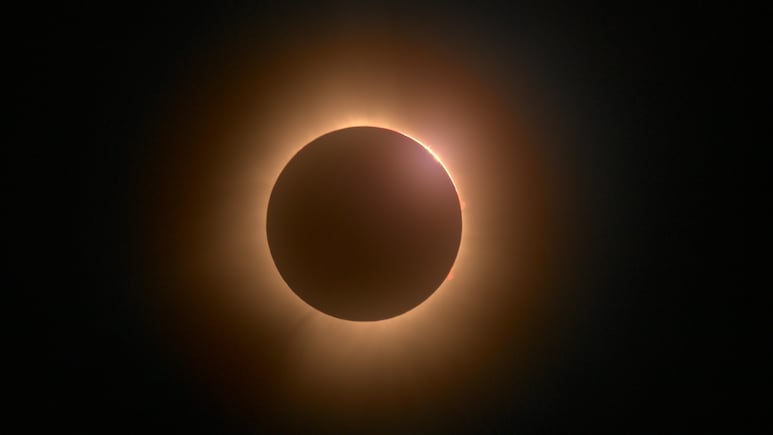
Solar Eclipse on February 17: The first solar eclipse of 2026 is an annular solar eclipse occurring on Tuesday, February 17. Commonly known as a "Ring of Fire," this phenomenon happens when the Moon is too far from Earth to completely cover the Sun, leaving a thin, bright ring visible. According to NASA, this phenomenon happens when the Moon passes between the Sun and Earth, but when it is at or near its farthest point from Earth. Notably, the Moon doesn't cover the Sun entirely and appears smaller because it is farther away from Earth, making the lunar body look like a dark disk on top of a larger, bright disk - creating a ring around the Moon.
Areas just outside the main path will experience a partial eclipse. Experts stress that proper eclipse glasses are essential for safe viewing at all times, including during the annular stage.
Solar Eclipse 2026: Date And Time
- Eclipse Begins: 7:01 UTC (12:31 PM IST)
- Ring of Fire Visible: 11:42 UTC (5:12 PM IST)
- Peak Eclipse: 12:12 UTC (5:42 PM IST)
- Eclipse Ends: 14:27 UTC (7:57 PM IST)
The "ring of fire" will be formed for up to 2 minutes and 20 seconds, Space.com reported, further adding that 96% of the Sun's centre will be eclipsed by the Moon.
Where to Watch the Eclipse
The full "Ring of Fire" effect, where the Moon almost covers the Sun, will be visible mainly along a narrow path in Antarctica. Outside that path, parts of southern South America (such as southern Argentina and Chile) and southern Africa will see a partial solar eclipse.
- Full Annularity (Ring of Fire): Visible almost exclusively over Antarctica.
- Partial Visibility: Nearby regions in the Southern Hemisphere will see a partial eclipse, including:
- Southern Africa: South Africa (Cape Town, Durban), Namibia, Zimbabwe, and Tanzania.
- South America: Southern tips of Argentina and Chile.
- Islands: Mauritius, Reunion, and parts of Madagascar.
Concordia Station in Antarctica is set to be a prime spot for viewing the eclipse. This joint French-Italian research facility, home to 16 scientists, is one of only three permanent bases in Antarctica's interior.
Annular Solar Eclipse: Will It Be Visible From India?
No, this eclipse will not be visible from India. The alignment happens mainly over the Southern Hemisphere, and during the event the Sun will be below the horizon across India, meaning the eclipse cannot be observed from anywhere in the country.
Indian skywatchers and astronomy enthusiasts can still enjoy the event through live streams and broadcasts from international observatories and space agencies covering the eclipse.
The next solar eclipse of 2026 is scheduled to take place on August 12.
Track Latest News Live on NDTV.com and get news updates from India and around the world

