





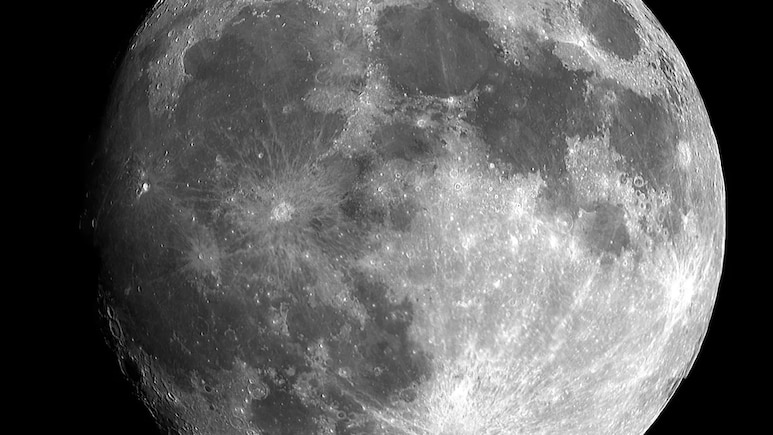
For billions of years, atoms and molecules from Earth's atmosphere have been traveling through space and settling on the moon. New research explains a long-standing lunar mystery first noticed during the Apollo missions. Scientists have found that lunar soil contains surprising amounts of elements such as water, nitrogen, carbon dioxide, helium, and argon. While some of these elements come from the solar wind, particularly nitrogen levels cannot be fully explained by the sun's particles alone.
In 2005, researchers at the University of Tokyo proposed that some elements from Earth's upper atmosphere might have escaped and reached the Moon, accelerated by energetic particles in the solar wind.
However, the Tokyo team believed this was only possible in Earth's early history, when our planet's magnetic field wasn't strong enough to block the escape of atmospheric elements.
A new study from the University of Rochester challenges this notion. The team, led by graduate student Shubhonkar Paramanik and astronomy professor Eric Blackman, used computer simulations to predict how atmospheric particles might reach the Moon. They considered two scenarios- an early Earth with a weak magnetic field and a strong solar wind, and a modern Earth with a strong magnetic field and a weak solar wind.
It turned out that the modern Earth scenario was more effective in transporting particles to the Moon. The simulations showed that Earth's magnetic field didn't block the particles' path but rather provided a path for them. Some magnetic field lines extend to the Moon, allowing particles to travel more easily.
In 2024, scientists at Oxford University studied 3.7 billion-year-old iron-rich rocks in Greenland and found that Earth already had a strong magnetic field at that time. This suggests that Earth's atmosphere has been slowly leaking into space and onto the Moon for billions of years.
Professor Blackman explained that by combining data from lunar soil with computer models, scientists can understand how solar wind interacts with Earth's atmosphere. This can reveal the history of Earth's atmosphere and magnetic field. Moon soil may hold a long-term record of atmospheric changes over billions of years, which will help understand Earth's climate, environment, and the evolution of life.
Paramanik said that this study also helps understand atmospheric loss on other planets, such as Mars, which once had a magnetic field but lost most of its atmosphere over time. The process of atmospheric leakage is helpful in understanding the habitability of planets.
In the solar system, Pluto's thin atmosphere also reaches its large moon, Charon, even though Pluto does not have its own magnetic field. Instead, Charon's gravity pulls particles from Pluto's tenuous atmosphere.
Continuously reaching the Moon from Earth means that the Moon may have a greater supply of useful elements than previously thought. Water and other aerobic elements on the lunar surface could be helpful for future human settlements. These natural deposits could serve as an "initial contribution" for long-term human presence.
The research was published on December 11 in the journal Communications Earth & Environment.
Track Latest News Live on NDTV.com and get news updates from India and around the world

